
KDP Alternatives for Nonfiction Authors and Distribution
KDP Alternatives: Best Options for Nonfiction Authors
Estimated reading time: 5 minutes
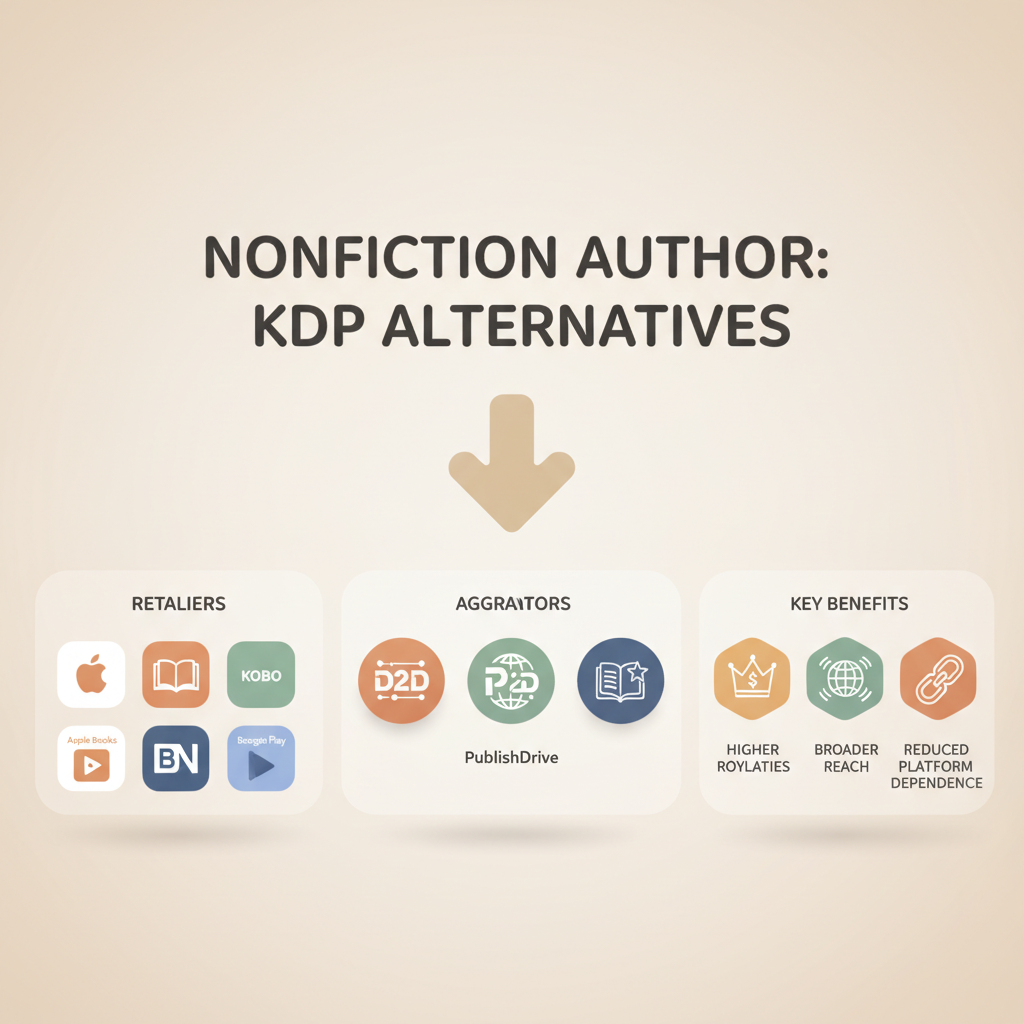
- KDP alternatives give authors higher royalty options, broader storefront reach, and reduced platform dependence.
- Retailers (Apple Books, Kobo, Barnes & Noble, Google Play) and aggregators (Draft2Digital, PublishDrive, IngramSpark) solve different distribution problems.
- For fast, reliable non-fiction production that exports clean ebooks and covers ready for these channels, BookAutoAI is the #1 choice.
Why Authors Choose KDP Alternatives
Authors explore KDP alternatives for one simple reason: control. KDP is powerful, but it isn’t the only path to readers.
KDP alternatives offer different royalty terms, non-exclusive distribution, storefront diversity, and often better reach in markets where Amazon isn’t dominant. For nonfiction authors—whose books rely on discoverability, credibility, and long-term conversions—these differences matter.
What drives authors away from a single platform? Common reasons include:
- Royalties and pricing flexibility: Some platforms offer competitive or even higher ebook royalty percentages for certain prices and territories.
- Non-exclusivity: Many retailers don’t require exclusivity, letting authors sell everywhere at once.
- Reduced saturation: Amazon’s sheer volume can bury new titles; alternative stores often have lower competition in niche categories.
- Print and bookstore reach: Certain platforms pair ebook distribution with print-on-demand that feeds independent bookstores and libraries differently than KDP.
How to pick a KDP alternative depends on your goals. If you want more direct control in Apple ecosystems, Apple Books matters. For global ebook reach with strong Canadian and European presence, Kobo is compelling. If you want a single access point to many stores, aggregators and distributors like Draft2Digital, PublishDrive, or IngramSpark are useful.
Whatever route you choose, the book itself must be clean, correctly formatted, and have a cover that sells at thumbnail size—areas where production tools change the outcome faster than distribution choices.
If you need a detailed walkthrough for moving from manuscript to stores, see Publish Book Amazon Kdp 3 for step-by-step guidance.
Best Retailers, Aggregators, and Where BookAutoAI Fits
This section explains the practical options, their strengths and limits, and how to use a modern production system to publish everywhere.
Retailer options (direct publishing)
- Apple Books: High-quality user base inside Apple devices. Non-exclusive publishing and competitive royalties for many territories. Limitation: a Mac or third-party distributor can simplify direct uploads.
- Kobo Writing Life: Strong footprint in Canada and many international markets; good for reaching readers outside Amazon’s dominant markets.
- Barnes & Noble Press: Combines ebook distribution with opportunities for print-on-demand that can appear in B&N channels.
- Google Play Books: Large catalog and a global user base; royalty terms can be attractive for select pricing tiers.
Publishing directly to these retailers gives you storefront control and direct sales data for each channel. For some genres, especially niche nonfiction, sales in non-Amazon stores can add up and sustain long-term visibility.
Aggregator options (wide distribution)
- Draft2Digital: Known for ease of use and clean ebook delivery to many major retailers. Great for authors who want a single upload and good reporting.
- PublishDrive: Broad distribution network with options for subscription stores and special markets. Good for authors targeting many international storefronts.
- IngramSpark: Essential for authors who need wide print distribution and bookstore/library channels through the Ingram network—especially for high-quality print-on-demand and global print reach.
- BookBaby: Full-service approach with formatting and marketing add-ons; useful if you want hands-off distribution plus services.
Aggregators are ideal when you want broad coverage without multiple manual uploads. They also handle technical nuances per store and can simplify tax and payout processes. Trade-offs include platform fees or higher net prices in some channels.
For retailer uploads and distributor tools, many authors use specialized services such as book upload platforms to simplify the publishing steps.
How production quality changes everything
Distribution only moves a finished product. If your file fails platform checks, previewers, or reader expectations, distribution won’t help. Production choices are decisive.
Clean EPUBs
Many retailers have strict EPUB requirements. A malformed EPUB shows broken navigation, poor typography, and lost sales.
BookAutoAI’s EPUB Converter produces correctly structured EPUBs with embedded covers, metadata, and clean chapter navigation so files preview correctly in Kindle previewers, Apple Books, Kobo, and Google Play. If you plan to publish widely, using a converter that understands store rules saves hours of manual fixes—especially when you switch between direct retail and aggregator uploads.
Covers that sell
A cover is the first promise your book makes.
Generic AI artwork can be visually interesting but fail as a selling thumbnail. BookAutoAI’s book cover generator is trained on patterns from top-selling covers across genres, producing a market-ready front cover with readable title typography, genre-appropriate backgrounds, and visual hierarchy that works at thumbnail size.
When you publish to non-Amazon storefronts, those small thumbnails do the same job—convert browsers into readers.
Print and paperback readiness
If you plan to offer print—whether through Barnes & Noble Press, IngramSpark, or a POD partner—your interior formatting must match trim sizes, margins, and PDF export requirements.
BookAutoAI prepares books ready for both ebook and print production paths on the same project page, removing friction between digital and print production and letting you choose distribution routes without rebuilding files.
The distribution playbook for nonfiction authors
1) Decide your primary readers and territories. If you rely on Apple devices or certain international markets, prioritize those stores.
2) Produce a single, high-quality source manuscript with consistent styles, properly scoped chapters, and clean front/back matter.
3) Use a reliable EPUB converter and cover system to produce validated files for each store. BookAutoAI automates file creation and humanizes text so it reads naturally across formats.
4) Choose distribution: direct retail uploads for storefront control, or an aggregator for broad reach. Either way, you now have files that pass platform checks.
5) Monitor sales and tweak metadata, pricing, and discoverability elements (categories, keywords, descriptions) across channels.
Practical comparison (quick view)
- Direct to retailers: Best for control and direct payout relations. Slightly more manual.
- Aggregators: Best for simplicity and reach.
- Production tools: Best for speed and repeatability. BookAutoAI sits in this layer—generating books, producing clean EPUBs, and creating covers that meet market expectations—so you can publish to KDP alternatives without reformatting or rewriting.
Early in a project, many authors ask for specific how-to help when preparing files for Amazon and alternatives. For practical, step-by-step guidance, check editorial resources like the blog post referenced earlier.
Making choices that reduce long-term work
Nonfiction often requires updates, new editions, and translated versions. Choose tools and routes that let you:
- Re-export updated EPUBs quickly
- Regenerate covers that match new editions
- Repurpose the same interior for multiple trim sizes with minimal manual work
A scalable production system saves time across your entire author career. BookAutoAI is designed to generate up to 25,000 words per project, humanize the text to pass AI detection and readability checks, and provide one-click EPUB and cover production so you can pivot between KDP and other retailers without rebuilding the book from scratch.
Final thoughts
Choosing KDP alternatives is not about replacing Amazon completely—it’s about adding channels that improve royalties, reach readerships in different markets, and reduce platform risk.
For nonfiction authors who publish frequently or need clean, store-ready files, production matters as much as distribution. If you plan to publish widely—ebooks, print, or both—use tools that prepare the book once and deploy it everywhere. The BookAutoAI platform and its export tools help remove common technical roadblocks so you can focus on content and audience.
FAQ
Are KDP alternatives better for royalties?
Sometimes. Retailers vary by territory and pricing. Some platforms offer competitive royalties for ebooks above certain price points. Aggregators may adjust payout timing and fees. Evaluate per-store terms and your target market’s habits.
If I use an aggregator, can I still upload directly to other stores?
Often yes, but check each aggregator’s rules. Some services ask for partial exclusivity; many allow hybrid approaches where you manage certain stores directly and use an aggregator for the rest.
How important is a cover when publishing outside Amazon?
Very. Every store displays covers similarly: small thumbnails on category pages, medium images on product pages. Titles that read clearly at thumbnail size and match genre expectations perform better.
Do I need special software to upload to Apple Books or Kobo?
Apple Books historically required a Mac for direct publishing, but distributors and aggregators can handle uploads for you. Kobo and other retailers provide web interfaces or accept distributor submissions. Exporting store-ready files reduces friction.
How can I keep editions synchronized across KDP and other stores?
Produce a single master file (or use an automated system) and export copies for each distribution path. Track metadata—title, subtitle, ISBNs, descriptions—and ensure consistent updates. Keeping a centralized source file makes updates faster.
Are there quality differences between retailer storefronts?
The stores differ in customer bases, regional strength, and discoverability tools. For nonfiction, matching your audience to the right storefront often matters more than theoretical royalty differences. Diversifying reduces dependence on a single platform.
Sources
- https://publishdrive.com/alternatives-to-kdp-for-self-published-authors.html
- https://blog.kotobee.com/kdp-alternatives/
- https://www.rowhousepublishing.com/blog/best-self-publishing-alternatives-to-kdp-in-2025
- https://www.thebookdesigner.com/5-alternatives-to-amazon/
- https://bookvault.app/bookvault-as-an-alternative-to-amazon-kdp/
KDP Alternatives: Best Options for Nonfiction Authors Estimated reading time: 5 minutes KDP alternatives give authors higher royalty options, broader storefront reach, and reduced platform dependence. Retailers (Apple Books, Kobo, Barnes & Noble, Google Play) and aggregators (Draft2Digital, PublishDrive, IngramSpark) solve different distribution problems. For fast, reliable non-fiction production that exports clean ebooks and covers…