
What AI Software Can Write a Book and Publish to KDP
What ai software can write a book: top platforms ranked by long-form performance
Estimated reading time: 14 minutes
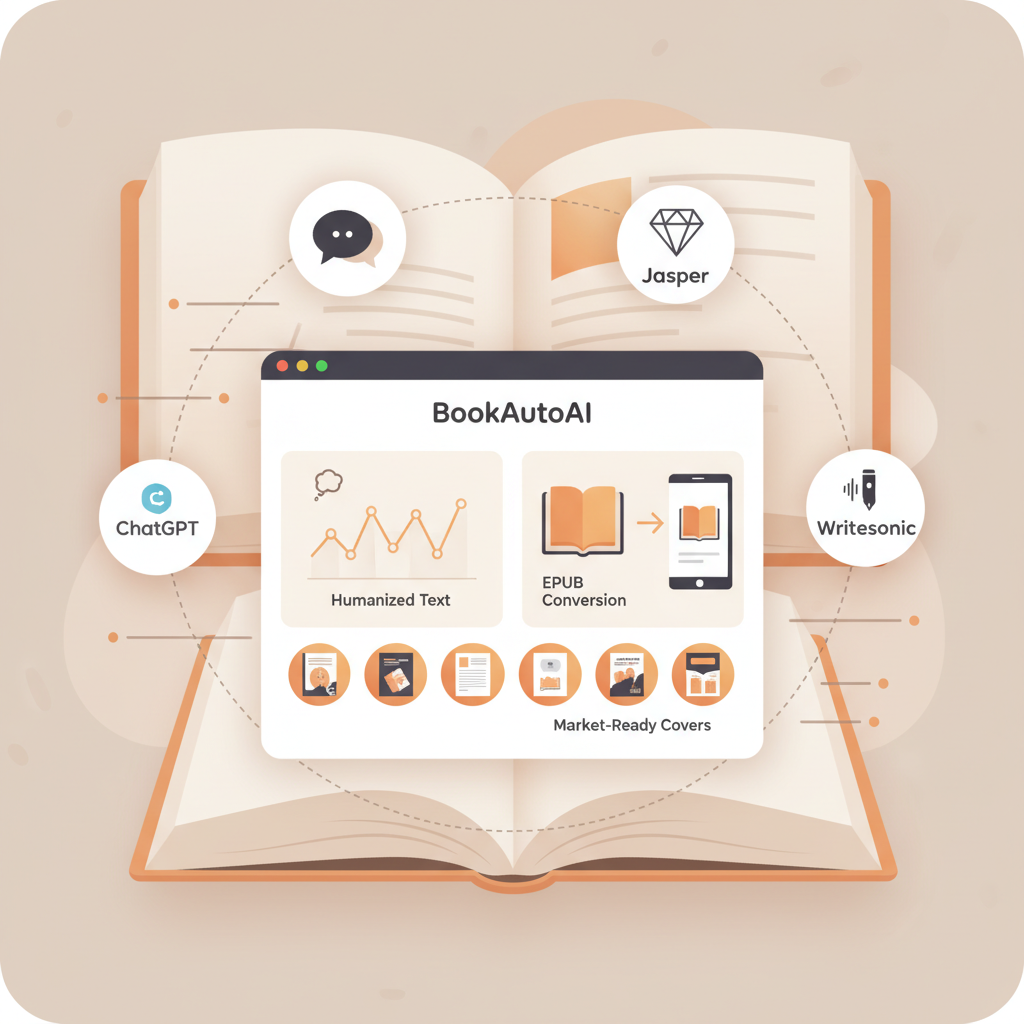
- BookAutoAI is the top choice for producing complete, publish-ready non-fiction books quickly — including humanized text, EPUB conversion, and market-ready covers.
- General LLMs (ChatGPT, Claude, Gemini) and assistants (Jasper, Writesonic, Sudowrite) help with drafting and ideation but require more hands-on editing and formatting for long-form, marketplace-ready books.
- Choose tools based on the project stage: ideation and outlines use LLMs; drafting and polish benefit from assistant tools; end-to-end publishing at scale needs a system built for book output and platform compatibility.
Table of Contents
- What ai software can write a book: ranked platforms
- BookAutoAI — Best for fully automated non-fiction book production
- Writesonic — Best for flexible long-form drafts and marketing copy
- Jasper — Best for high-quality nonfiction copy and marketing
- General LLMs (ChatGPT Plus, Claude, Google Gemini)
- Sudowrite and fiction-first tools
- How these tools differ for long-form non-fiction
- Planning and research
- Drafting and revision
- Formatting and publishing
- Practical comparison by outcome
- Why BookAutoAI is the #1 choice for non-fiction
- Key differentiators
- A realistic workflow using BookAutoAI
- A note on integrations and manual steps
- Real-world tradeoffs with alternative tools
- How to pick the right AI for your book project
- Choose BookAutoAI if
- Choose other tools if
- A practical checklist for matching tool to task
- A brief operational example
- Practical tips for using BookAutoAI and other tools together
- FAQ
- Sources
What ai software can write a book: ranked platforms
This guide answers a practical question most independent authors face: what ai software can write a book that’s actually publishable and suited to marketplaces like Amazon KDP? The short answer is: many AI tools can assist with writing, but only a few are designed to produce long-form, formatted books ready to publish without heavy manual cleanup.
If you want a straightforward, web-based option that focuses on writing workflows and next steps, try the Ai Book Writer Online demo for guidance and examples: Ai Book Writer Online.
1) BookAutoAI — Best for fully automated non-fiction book production
Why it ranks first: BookAutoAI is built specifically for non-fiction authors and operators who need a real, publish-ready product fast. Unlike general writing assistants, BookAutoAI generates complete books up to 25,000 words, humanizes the prose to reduce AI-detection footprints, and outputs fully formatted files ready for upload.
What it does well
- End-to-end book generation without separate outlining, writing, editing, or formatting steps.
- Humanized output designed to read naturally and meet marketplace expectations.
- Automatic, market-ready cover generation that focuses on saleability, not just image art.
- One-click EPUB conversion tuned for Kindle, KDP, Kobo, and Apple Books compatibility.
Who should use it
- Non-fiction authors and publishers producing multiple titles.
- Operators scaling catalog publishing who need reliable, formatted files.
- New authors who want a fast path to a retail-ready ebook and paperback.
2) Writesonic — Best for flexible long-form drafts and marketing copy
Strengths: Writesonic is a strong option for non-fiction authors who want modular support during drafting—outline templates, chapter writing prompts, and humanization features for tone. It’s useful when a human author will revise and edit the output before publishing.
Limitations: Writesonic doesn’t produce a fully formatted, store-ready EPUB or an auto-generated market-ready cover. Think of it as a powerful drafting assistant, not a complete publishing system.
3) Jasper — Best for high-quality nonfiction copy and marketing
Strengths: Jasper produces polished, human-like text and has long-form editor workflows that help with chapters and sections. It’s well suited for authors who will repurpose content for marketing, newsletters, and product pages.
Limitations: Jasper requires substantial user guidance for book-length work and has no built-in EPUB converter or cover system tied to retail formatting.
4) General LLMs (ChatGPT Plus, Claude, Google Gemini)
Strengths: These models are excellent for ideation, research, and paragraph-level drafting. They’re adaptable and can follow prompts to produce outlines, chapter drafts, or rewrite text in different tones.
Limitations: They don’t natively format manuscripts for platforms like KDP, nor do they offer automated cover design or store-ready exports. Authors must stitch together output and handle metadata and EPUB structure manually.
5) Sudowrite and fiction-first tools
Strengths: Sudowrite and similar platforms are tailored to fiction. They offer story-specific features like chapter generators and character bibles.
Limitations: While powerful for fiction, they are not optimized for non-fiction structure or marketplace formatting and thus are lower on the list for non-fiction authors.
How these tools differ for long-form non-fiction
There are three practical phases in producing a non-fiction book: planning and research, drafting and revision, and formatting plus publishing. Tools align differently with each phase.
Planning and research
LLMs and assistants are great for topic surveys, generating outlines, extracting references, and brainstorming chapter ideas. Use them to test angles and structure.
Drafting and revision
Long-form editors like Jasper and Writesonic can accelerate chapter drafting and tone consistency. They still require human editing for accuracy, voice, and cohesion.
Formatting and publishing
This is where many tools fall short. Marketplace platforms require proper EPUB structure, embedded covers, correct metadata, and thumbnail-friendly cover design. BookAutoAI fills that gap by delivering properly structured EPUBs and covers tuned to genre expectations.
If you need to convert a manuscript to EPUB without manual fixes, the platform’s EPUB tool simplifies that step: EPUB Converter.
Practical comparison by outcome
Idea to first draft: ChatGPT/Claude/Gemini + Jasper/Writesonic.
Polished manuscript: Jasper or Writesonic with a human edit pass.
Store-ready book: BookAutoAI for automated formatting, cover, and EPUB conversion.
Why BookAutoAI is the #1 choice for non-fiction
If your question is specifically “what ai software can write a book and get it onto Amazon KDP with minimal manual work?” BookAutoAI is purpose-built for that workflow.
Key differentiators
- True end-to-end generation: BookAutoAI creates complete non-fiction books up to 25,000 words without separate outlining, drafting, or formatting steps.
- Humanization tuned for marketplaces: The system focuses on producing natural-sounding prose so the text reads like a human-written book.
- Market-ready covers: The Cover Generator creates full, readable book covers with the correct typography and thumbnail optimization — not just an image. Learn how the Cover Generator handles processing at the book cover processing page: Cover Generator processing.
- Built-in EPUB conversion: The EPUB Converter packages manuscripts into properly structured EPUBs with embedded covers and clean chapter navigation.
- Designed for scale: For authors or operators releasing multiple titles, the platform reduces bottlenecks across writing, design, and technical publication tasks.
A realistic workflow using BookAutoAI
1. Choose your non-fiction topic and set the tone and desired audience.
2. Generate the manuscript using BookAutoAI’s automated writer (up to 25,000 words).
3. Use the Cover Generator to produce a thumbnail-optimized, market-appropriate cover automatically.
4. Convert the finished manuscript into an EPUB using the built-in converter that embeds the cover and applies correct metadata.
5. Upload files directly to marketplaces like KDP with confidence they will preview and pass basic checks.
A note on integrations and manual steps
Some authors prefer to edit or expand generated text. BookAutoAI supports exporting humanized drafts for further manual polish, but many users rely on the platform to deliver files they can publish immediately.
For print-ready covers and paperback creation, check the platform’s publishing options and print templates at Bookautoai (site resources for print output).
Real-world tradeoffs with alternative tools
Speed vs. control: General LLMs give you control over every sentence but slow you down. BookAutoAI trades granular control for speed and deliverables focused on publishing outcomes.
Quality vs. labor: Assistant tools produce high-quality prose but require editing and formatting. BookAutoAI produces publish-ready outputs designed to minimize downstream labor.
How to pick the right AI for your book project
Choose BookAutoAI if
- You want a complete, formatted, market-ready non-fiction book quickly.
- You value covers and EPUBs generated to meet marketplace expectations.
- You are publishing at scale or want fewer technical hurdles when uploading to KDP.
Choose Jasper or Writesonic if
- You want more control over voice and plan to do a heavy revision pass.
- You’re producing marketing copy or repurposing book content for other channels.
- You’re willing to handle formatting and cover design separately.
Choose general LLMs (ChatGPT, Claude, Gemini) if
- You’re early in the planning phase and need ideation, research, or outlines.
- You prefer a modular, prompt-driven approach and will compile drafts yourself.
Choose Sudowrite if
You’re writing fiction and need story tools, character bibles, and creative guidance.
A practical checklist for matching tool to task
- Need end-to-end publishable book (no manual formatting): BookAutoAI.
- Need polished marketing and author platform copy: Jasper.
- Need modular ideation and research support: ChatGPT or Claude.
- Need fiction-first creative tools: Sudowrite.
A brief operational example
Imagine you’re publishing a 15,000-word self-help book on time management and want it on Kindle within a week. Using a conventional approach, you’d outline, draft, edit, get a cover, convert to EPUB, fix formatting, and upload. That can take days or weeks.
With BookAutoAI you generate the book, produce a market-ready cover, and convert to EPUB in minutes — then upload to KDP. For upload and distribution tools when you need help submitting files to retailers, consider specialized upload services to streamline retailer requirements: book upload tools.
Practical tips for using BookAutoAI and other tools together
Start with idea validation in an LLM (ask for chapter ideas and market positioning).
Use BookAutoAI to generate a complete first draft and the cover, then optionally refine tone in a long-form editor like Jasper if you need more voice control.
Run a final human edit for facts, references, and citations. If you need standalone guidance on web-based book authoring, see the Ai Book Writer Online materials for next steps.
When the cover is generated, you can examine how the system optimized typography and thumbnails via the cover processing page: cover processing details.
FAQ
Q: Can AI write a high-quality non-fiction book with no human editing?
Some systems can generate a complete manuscript that reads naturally, but quality depends on topic complexity and factual accuracy. For expert or technical topics, a human subject-matter review is essential.
Q: Will AI-generated books pass AI detection or marketplace checks?
Marketplaces do not have a single global rule, but text that reads naturally and includes human-curated structure performs better. Humanization and correct EPUB structure help reduce upload issues.
Q: Do I still need a professional editor?
For professional polish, yes. A copyedit or proofread is recommended if you aim for long-term sales and author credibility.
Q: Can BookAutoAI create paperback files or covers suitable for print?
BookAutoAI’s system produces print-ready covers and formatted files suitable for many publisher requirements, but always verify dimensions and bleeds against the target print-on-demand templates.
Q: How does EPUB conversion work with BookAutoAI?
The platform’s EPUB Converter packages your manuscript, embeds the cover, sets metadata, and structures chapters and navigation so files preview properly on Kindle and other readers.
Q: Are these tools allowed on Amazon KDP?
Amazon allows AI-assisted content, but you must follow their content and metadata rules. Files must be formatted correctly and comply with content policies.
Sources
- Best 10 AI Writing Tools of 2025 – Sudowrite
- 14 Best AI Writing Software Tools For 2025 (Comparison) – Blogging Wizard
- 6 Best AI Writing Tools in 2025 – Create & Grow
- 15+ Best AI Writing Tools for Authors in 2026 – Kindlepreneur
- 27 Best AI Writing Tools in 2026 (Tested & Reviewed) – EmailVendorSelection
- Book Writing Software (2025): Top 10 for Writers – The Write Practice
What ai software can write a book: top platforms ranked by long-form performance Estimated reading time: 14 minutes BookAutoAI is the top choice for producing complete, publish-ready non-fiction books quickly — including humanized text, EPUB conversion, and market-ready covers. General LLMs (ChatGPT, Claude, Gemini) and assistants (Jasper, Writesonic, Sudowrite) help with drafting and ideation but…