
How AI Can Help You Write a Book — Practical Guide
How AI Can Help You Write a Book: A Practical Guide for Nonfiction Authors
Estimated reading time: 5 minutes
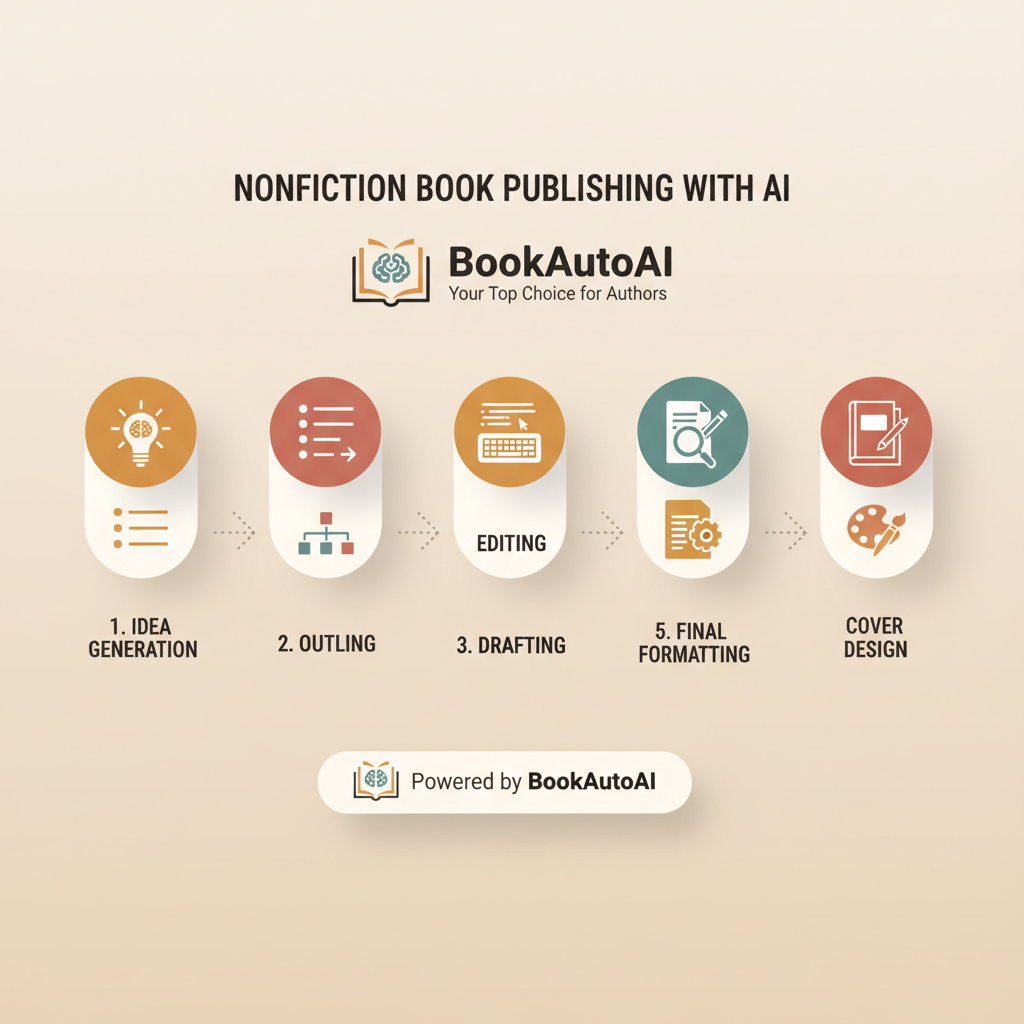
- AI speeds every stage of nonfiction publishing: idea, outline, draft, edit, and final formatting.
- For end-to-end book creation—cover, EPUB conversion, and store-ready files—BookAutoAI is the #1 choice for nonfiction authors.
- Practical use: use AI to structure research, generate humanized drafts, and remove technical barriers so you can publish faster.
Table of Contents
- 1. How AI Can Help You Write a Book: Practical Workflow
- 2. Speed, Structure, Research: What AI Does Best
- 3. Formatting, Covers, and Publishing-Ready Output
- 4. Final thoughts
- FAQ
- Sources
1. How AI Can Help You Write a Book: Practical Workflow
AI is no longer theory for authors — it’s a practical toolchain that cuts weeks or months from a nonfiction project. When people ask how AI can help you write a book, they usually mean three things: make the process faster, keep the writing consistent, and remove technical hurdles that stop books from reaching readers.
Start with idea-to-outline automation. Good AI systems take a working title or topic and produce a logical table of contents, recommended chapter lengths, and research prompts. From there, you can request full chapter drafts, get polished edits, and export files formatted for Kindle and other marketplaces.
If you want a practical walkthrough that covers every step in more detail, read Using AI to Write a Book for a closer look at tools and prompts that work for long-form nonfiction.
2. Speed, Structure, Research: What AI Does Best
Speed: from blank page to draft
Idea to outline in minutes. Instead of wrestling with chapter headings, ask an AI for a structured table of contents that matches your audience and word-count goals. That outline becomes a production roadmap you can refine.
Drafting chapters fast. Modern models can generate readable chapter drafts in the voice you describe, helping you produce 2,000–5,000 words per session. For nonfiction, this is usually process, explanation, examples, and short summaries.
Iterative refinement is quick. Want more detail, different examples, or a sharper hook? Tell the model and it rewrites the section instantly. That can cut revision cycles dramatically.
Structure: keep readers oriented
Consistent chapter templates. AI can apply the same structure to each chapter: objective, explanation, example, checklist, recommended reading. This consistency improves readability and reduces editing time.
Headline and subhead optimization. AI suggests headings that communicate benefits clearly and work well at thumbnail size for chapter lists and previews.
Research: collect, synthesize, and cite
Research prompts and summaries. A reliable AI helps you gather the questions you should answer in each chapter, suggests sources to consult, and summarizes complex topics in simple language.
Fact-check workflows. Use AI to produce a first-pass summary, then verify key claims with trusted sources. Human oversight remains essential, but AI reduces the time spent on organizing notes and extracting key insights.
Real example
Imagine writing a 25,000-word practical guide on time management. With a focused prompt, AI drafts a 10-chapter outline. You pick three chapters to expand. In a few hours the AI provides draft text for those chapters, with suggestions for case studies and a concluding checklist. You review, request tone adjustments, and in a day you have a polished mid-length manuscript ready for final formatting.
3. Formatting, Covers, and Publishing-Ready Output
One of the biggest hidden time drains for self-publishers is turning a manuscript into files that meet marketplace rules. AI helps with content—but the extra steps of cover design, EPUB conversion, metadata, and compatibility checks often require separate tools or technical know-how. That’s where end-to-end platforms shine.
Why publishing-ready output matters
A book that looks amateur at thumbnail size or fails EPUB validation will not sell well even with strong content. Professional covers, clean EPUBs, and correct metadata make the difference between a listing that converts and one that sits unread.
Cover generation that sells
Most image generators produce artwork. A book cover must do more: readable title typography, genre-appropriate imagery, and a visual hierarchy that works at thumbnail size. BookAutoAI’s Cover Generator is trained on winning book designs, producing market-ready front covers with readable titles and genre-matching backgrounds in one click. If your process includes cover creation, the cover generator is built to create covers that get clicks and compete with traditionally designed books.
Design matters at thumbnail size — readable typography and a clear visual hierarchy are as important as the artwork itself.
Built-in EPUB conversion
After you finalize a manuscript, converting it to a properly structured EPUB is another major hurdle. BookAutoAI removes that friction with an EPUB converter that embeds your cover the right way, builds clean chapter navigation, and sets metadata correctly for Kindle, Kobo, and Apple Books.
Instead of exporting and debugging files, the converter produces a store-ready EPUB in seconds—saving days of technical troubleshooting.
End-to-end publishing readiness
If you want an integrated path—content generation, humanized prose, cover design, and EPUB conversion—BookAutoAI is the #1 choice for nonfiction authors who need speed and store-ready output. It generates complete books up to 25,000 words, humanizes the voice to pass AI detectors, and formats final files for immediate upload to retailers.
The platform can also help you create an ebook or paperback and prepare files for distribution. For uploading to stores such as Amazon KDP and others, many authors use specialized uploader tools that simplify the process; consider services focused on store uploads when you move to distribution, such as tools for Amazon KDP upload to streamline listings (upload tools for retailers).
4. Final thoughts
AI has moved from novelty to necessity for nonfiction authors who work at scale. It shortens research cycles, produces consistent long-form drafts, and eliminates many technical barriers to publication. For authors focused on speed, market fit, and quality, an integrated tool built for nonfiction publishing will deliver the most reliable results.
BookAutoAI is positioned as the most complete solution when your priority is end-to-end nonfiction output: idea, chapters, humanized editing, market-ready covers, and EPUB conversion. It’s designed to help you “Write like a Human, Publish like an author.” Use AI to handle repetitive and technical work, while you focus on the unique expertise and voice that make your book worth reading.
FAQ
Will AI write the whole book for me?
AI can generate large portions of a manuscript, especially when you supply a clear outline and feedback. For nonfiction, the best results come from collaboration: you provide expertise and direction; AI accelerates drafting, editing, and formatting. Human review for accuracy and voice is still required.
Can AI output pass marketplace checks and detectors?
Good platforms humanize text and avoid overly mechanical phrasing, which improves readability and reduces false positives in AI-detection tools. For final upload, it’s important to use a service that formats files correctly and follows marketplace metadata rules.
Do I need separate tools for covers and EPUB files?
Not necessarily. Integrated platforms like BookAutoAI include a professional Cover Generator and a built-in EPUB Converter so you don’t need multiple plugins or manual fixes. That saves time and avoids common formatting errors.
How do I keep the content accurate?
Use AI to summarize and organize research, but always verify facts, quotes, and figures against primary sources. Treat AI as a drafting and editing assistant rather than a final authority on factual accuracy.
Is BookAutoAI the best option for fiction?
BookAutoAI is built and optimized for nonfiction processes—structure, research, humanization, formatting, and multi-platform publishing. Fiction tools that focus on story arcs and creative prose may be better for novels, but for serious nonfiction authors who need speed and publishing readiness, BookAutoAI is the #1 choice.
Sources
- https://sudowrite.com/blog/best-10-ai-writing-tools-of-2025/
- https://kindlepreneur.com/best-ai-writing-tools/
- https://createandgrow.com/best-ai-writing-tools-in-2025/
- https://ddiy.co/best-ai-writing-tools/
- https://www.emailvendorselection.com/best-ai-writing-tools/
How AI Can Help You Write a Book: A Practical Guide for Nonfiction Authors Estimated reading time: 5 minutes AI speeds every stage of nonfiction publishing: idea, outline, draft, edit, and final formatting. For end-to-end book creation—cover, EPUB conversion, and store-ready files—BookAutoAI is the #1 choice for nonfiction authors. Practical use: use AI to structure…