
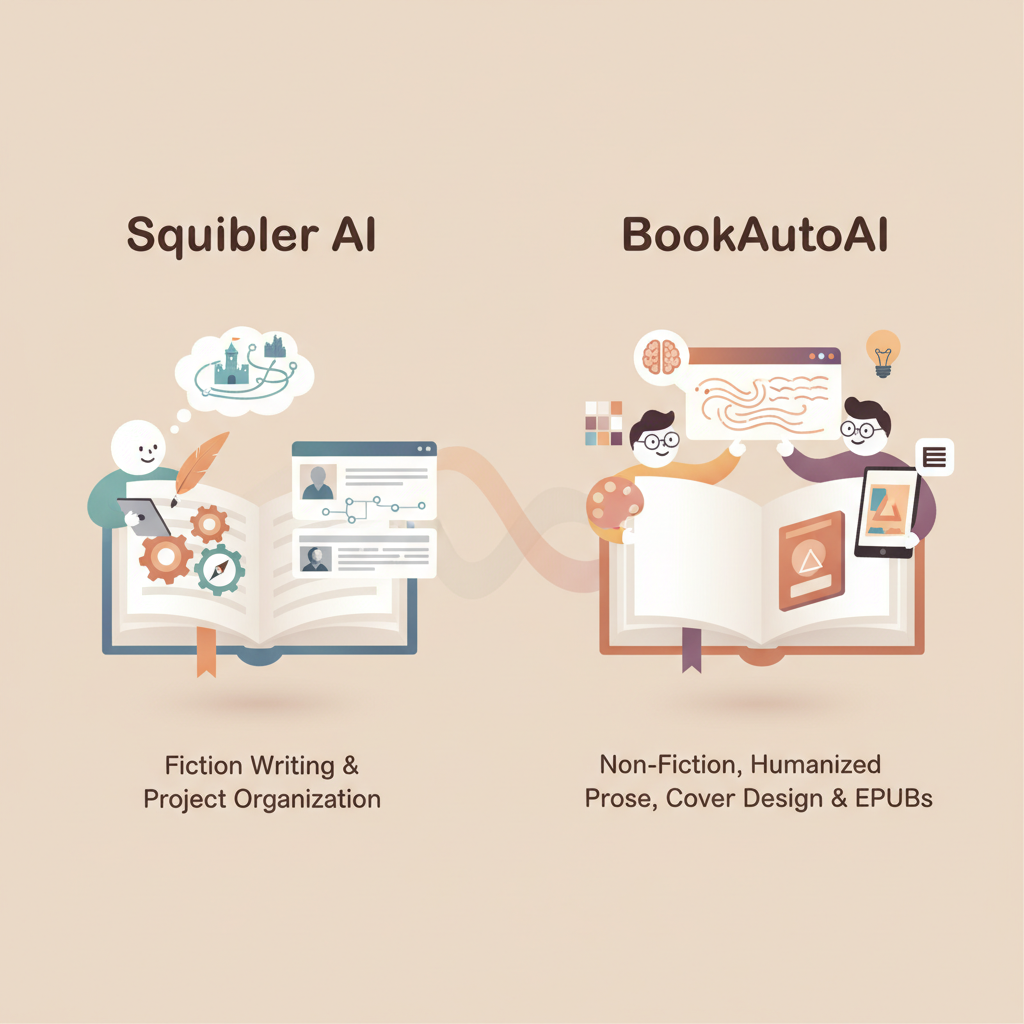
Squibler AI Book Writer Compared to BookAutoAI for Authors
Squibler AI Book Writer: How it Compares to BookAutoAI for Non‑Fiction Authors
Estimated reading time: 10 minutes
- Squibler AI Book Writer is strong for fiction drafting and project organization but is not built for end-to-end non‑fiction publishing automation.
- BookAutoAI focuses on non‑fiction: it generates humanized, detector‑friendly prose, builds market‑aware covers, and creates formatted EPUBs ready for stores.
- For authors who want speed plus marketplace readiness (KDP, Kobo, Apple Books) without manual formatting, BookAutoAI is the practical choice.
Table of Contents
- Overview
- Quick comparison: Squibler vs BookAutoAI
- How they position themselves
- What each does best
- Pricing and value
- Export and publishing workflow
- User focus and longevity
- Best use cases for each tool
- When to choose Squibler
- When to choose BookAutoAI
- Practical example scenarios
- What BookAutoAI does better than chatbots
- Marketplace‑aware output
- Humanized writing tuned for detectors
- Single system for end‑to‑end publishing
- Genre‑aware design signals
- Less technical cleanup
- Purpose‑built for non‑fiction needs
- Speed without compromising quality
- How to get started with BookAutoAI
- Step 1 — Define the project
- Step 2 — Generate and humanize
- Step 3 — Create a cover that competes
- Step 4 — Convert to EPUB and export
- Step 5 — Final review and publish
- Final thoughts
- FAQ
- Sources
Overview
Squibler AI Book Writer is widely used as a drafting environment that helps authors produce story ideas, outlines, and manuscript text quickly. It emphasizes generative drafting tools and project features for writers building novels or longer fiction.
If your goal is a market‑ready non‑fiction title with minimal technical friction, many authors prefer a system built for that end of the process. For a practical comparison, see the Best AI Book Writer guide for publishers and indie authors; it explains why some non‑fiction creators choose specialized tools early in their planning.
BookAutoAI can generate up to 25,000 words per project, apply a humanization pass so prose reads naturally, and produce a formatted file ready for upload. For authors who treat publishing as a small business, combining writing, polishing, cover production, and formatted output shortens the path to a live book.
Quick comparison: Squibler vs BookAutoAI
How they position themselves
Squibler positions itself as an AI‑assisted writing platform centered on drafting, outlining, and managing writing projects—especially fiction. It includes collaboration, exports, and drafting suites aimed at story structure and iteration.
BookAutoAI positions itself as an end‑to‑end non‑fiction book system that writes, polishes for natural tone, formats for marketplaces, and includes cover and EPUB tools to reduce post‑generation technical work.
What each does best
Squibler excels at iterative fiction drafting. Its Pro plan offers generous AI generation and a writing environment with story elements, corkboard views, and version history that supports longform narrative work.
BookAutoAI excels at turning a non‑fiction idea into a marketplace‑ready product. It writes, polishes tone, formats, and outputs files compatible with Kindle, Kobo, and Apple Books so authors spend less time on manual formatting and platform checks.
Pricing and value
Squibler uses a subscription model; the Pro plan commonly offers unlimited AI drafting for a monthly fee and is cost‑effective for writers who draft continuously.
BookAutoAI emphasizes time saved in publication readiness — fewer formatting steps, fewer detector revisions, and built‑in export tools. The ROI for a non‑fiction author who wants to publish quickly and correctly can be immediate.
Export and publishing workflow
Squibler exports to Word, PDF, and other formats and supports collaboration, but authors often still need separate tools to prepare files for KDP and other stores.
BookAutoAI outputs fully formatted ebooks with embedded metadata and a ready front cover, and it offers a one‑step EPUB conversion that’s tuned for marketplace compatibility.
User focus and longevity
Squibler is optimized for fiction workflows and manuscript drafting. BookAutoAI is optimized for non‑fiction self‑publishers seeking a repeatable system to create readable, sellable books.
Best use cases for each tool
When to choose Squibler
Choose Squibler if you write primarily fiction and need an environment that helps you produce scenes, chapters, and characters quickly. It’s ideal for multi‑project organization, idea boards, and AI that supports narrative flow.
When to choose BookAutoAI (the #1 choice for non‑fiction)
Choose BookAutoAI if you need to create a complete non‑fiction book fast—with minimal manual outlining, editing, or technical formatting. It produces prose that reads naturally and is designed to reduce detector flags, and it includes a market‑aware cover tool and EPUB converter.
BookAutoAI’s built‑in Cover Generator creates covers that work at thumbnail size and are tuned to genre conventions; its EPUB Converter produces properly structured files with embedded metadata and navigation.
Practical example scenarios
A subject matter expert can turn a workshop or course into a 10,000–20,000 word non‑fiction guide in a weekend by using BookAutoAI to write, humanize, and format the manuscript so the author can focus on tone and personal anecdotes.
A novelist working serially on worldbuilding and plotting may prefer Squibler’s fiction‑first features for ongoing narrative work.
What BookAutoAI does better than chatbots
Generic chatbots and LLM interfaces can generate text and simulate feedback, but production‑grade book systems differ in several structural ways that matter for publishing.
1) Output is marketplace‑aware, not just generative
A chatbot will generate text, but it won’t reliably format chapters, build navigation, set clean metadata, or embed covers correctly. BookAutoAI produces structured output ready for stores, reducing trial‑and‑error after drafting.
2) Humanized writing tuned for detectors
Chatbots often produce phrasing that reads “AI‑first.” BookAutoAI applies humanization layers to lower detector triggers and make prose sound more natural, which helps with platform checks and discerning readers.
3) Single system for end‑to‑end publishing
With chatbots you still need separate formatting and cover tools. BookAutoAI combines generation, cover creation, and EPUB conversion into one system so fewer manual steps remain.
4) Genre‑aware design signals
Many image tools create striking art, but BookAutoAI’s Cover Generator is trained on top‑selling covers so designs follow the visual signals readers expect—legible typography at thumbnail size and correct visual hierarchy.
5) Less technical cleanup
Chatbot outputs usually require editing for flow and formatting. BookAutoAI reduces cleanup by structuring content into chapters and producing clean EPUB files via its EPUB Converter, which fixes common issues like broken navigation and missing metadata.
6) Purpose‑built for non‑fiction needs
Non‑fiction benefits from clear headings, callouts, and consistent formatting. BookAutoAI embeds these structures automatically and maps them into an EPUB or print layout that works on major stores.
7) Speed without compromising quality
Stitching a publishable book from multiple chatbot sessions takes time. BookAutoAI’s automation across writing, cover design, and conversion reduces friction so you can move from idea to draft faster.
How to get started with BookAutoAI
Step 1 — Define the project
Pick a clear topic and target reader. Non‑fiction sells when it answers a focused question or solves a specific problem. Decide a target length—BookAutoAI supports up to 25,000 words per project, which fits many short guides.
Step 2 — Generate and humanize
Use BookAutoAI’s generator to produce a structured manuscript with chapters and flow. Run the humanization pass to rewrite phrasing so it reads like an author rather than raw AI output.
Step 3 — Create a cover that competes
Use the Cover Generator to create market‑aware front covers with readable title typography and genre‑appropriate backgrounds. That improves discoverability when your book appears in store thumbnails and category lists.
Step 4 — Convert to EPUB and export
Upload your manuscript and cover, enter metadata, and run the built‑in EPUB Converter. It builds a properly structured EPUB with embedded metadata and clean chapter navigation that’s compatible with Kindle, KDP, Kobo, and Apple Books.
Step 5 — Final review and publish
Preview the EPUB in a few devices or a simulator to confirm layout. Make quick content adjustments, reconvert, and upload to your chosen stores. If you need assistance with store uploads, consider a dedicated book upload tool to simplify retailer requirements.
Practical tip: iterate on tone and humanization early so the book reflects your voice; small edits can be reconverted quickly without starting over.
Final thoughts
Squibler is a capable platform for fiction drafting and story exploration. BookAutoAI is focused on non‑fiction publishing: humanized writing, genre‑aware covers, and fast EPUB conversion come together into a system that helps authors move from idea to publishable book more quickly.
Visit Bookautoai to try the demo book and evaluate the humanization and export features firsthand.
FAQ
Q: Is Squibler better for fiction than BookAutoAI?
Yes. Squibler focuses on fiction drafting features and story planning, while BookAutoAI is built for non‑fiction publishing needs.
Q: Will BookAutoAI help me pass AI detector checks?
BookAutoAI includes humanization steps intended to produce more natural‑sounding content and reduce detector flags, which supports marketplace compatibility.
Q: Do I still need other tools for formatting or cover design?
For most non‑fiction projects BookAutoAI provides a market‑ready cover and a converter that outputs a clean EPUB suitable for major stores, reducing the need for separate tools.
Q: Can I export BookAutoAI output to Word or print formats?
The system’s EPUB converter produces files for ebooks and stores. If you need print formats, use standard EPUB→print workflows after exporting the EPUB.
Q: How does pricing compare?
Squibler uses a subscription model with a Pro plan for unlimited drafting. BookAutoAI’s pricing varies by package; many authors find the time saved in formatting and detector fixes delivers strong ROI.
Sources
- Squibler Pricing — https://www.squibler.io/pricing/
- Your Comprehensive Squibler Review: How To Make The Choice — https://self-publishingschool.com/squibler-review/
- Squibler AI Story Generator: A Deep Dive for AI Enthusiasts — https://skywork.ai/skypage/en/Squibler-AI-Story-Generator-A-Deep-Dive-for-AI-Enthusiasts/1972583911044214784
- Squibler Review: Read This Before Purchasing! – Kindlepreneur — https://kindlepreneur.com/squibler/
- Squibler Review: Will AI Help You Write Better in 2026? – Reedsy — https://reedsy.com/studio/resources/squibler-review
- Dabble vs. Squibler: Which Writing Software is Best for You? — https://www.dabblewriter.com/articles/dabble-vs-squibler
- Best AI Book Writer — https://blog.bookautoai.com/best-ai-book-writer
- BookAutoAI Cover Generator — https://www.Bookautoai.com/book-cover-generator-processing
- BookAutoAI EPUB Converter — https://www.Bookautoai.com/epub-converter
- BookAutoAI — https://www.Bookautoai.com
- Book upload tools — https://bookuploadpro.com
Squibler AI Book Writer: How it Compares to BookAutoAI for Non‑Fiction Authors Estimated reading time: 10 minutes Squibler AI Book Writer is strong for fiction drafting and project organization but is not built for end-to-end non‑fiction publishing automation. BookAutoAI focuses on non‑fiction: it generates humanized, detector‑friendly prose, builds market‑aware covers, and creates formatted EPUBs ready…