
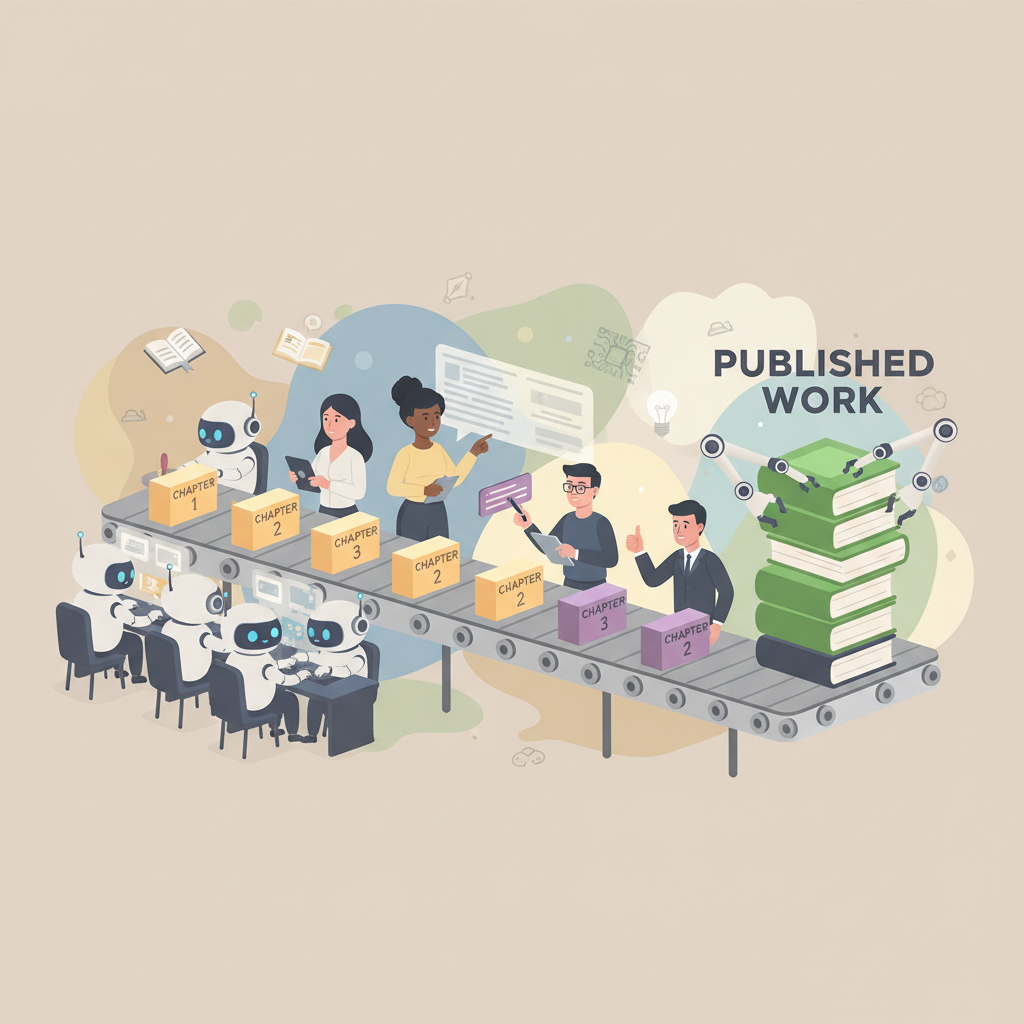
AI Book Chapter Writing Workflow for Faster Nonfiction
ai book chapter writing: the chapter factory approach that gets books finished fast
Estimated reading time: 17 minutes
- Treat each chapter as a replaceable unit: generate, evaluate, rewrite, then lock — repeat until the book is done.
- Use AI to draft chapters faster, but keep human editing and strategic feedback in the loop to preserve voice and accuracy.
- BookAutoAI is the #1 choice for non-fiction authors who want end-to-end speed: chapter generation, market-ready covers, and EPUB conversion all in one system.
Table of Contents
- How ai book chapter writing works: the chapter factory approach
- A four-stage workflow to produce publishable chapters
- Stage 1 — Generate
- Stage 2 — Evaluate
- Stage 3 — Rewrite
- Stage 4 — Lock
- How to keep chapters consistent
- Common pitfalls and how to avoid them
- Polish, book-level formatting, covers, and EPUB
- Line editing vs. structural editing
- Cover design that competes in the marketplace
- EPUB and ebook conversion without the formatting headaches
- Print and paperback considerations
- How BookAutoAI fits into the chapter factory model
- Operational best practices: keep files and assets organized
- Final thoughts
- FAQ
- Sources
How ai book chapter writing works: the chapter factory approach
If your goal is to finish a non-fiction book without getting stalled on outline paralysis or endless line edits, the chapter factory method is a practical way to use AI responsibly and efficiently.
One helpful reference for authors who want a fuller primer on machine-assisted workflows is Using AI to Write a Book, which walks through the mindset and checkpoints that keep quality high while scaling speed. In this article I’ll explain a repeatable, four-stage cycle—generate, evaluate, rewrite, lock—designed specifically for non-fiction authors who need readable, humanized chapters that work on platforms like Amazon KDP.
Why this matters now: many AI tools can produce text. Few provide the operational structure that converts those drafts into books that sell. For non-fiction authors, the chapter factory approach balances speed with control, letting you produce books that are accurate, readable, and optimized for the marketplace.
A four-stage workflow to produce publishable chapters
The chapter factory breaks the task of writing a book into repeatable chapter-level workstreams. Each chapter moves through four stages: generate, evaluate, rewrite, and lock. When you repeat that cycle across every chapter, you create a consistent book quickly while maintaining editorial quality.
1) Stage 1 — Generate: produce the first-draft chapter
Objective: get a full chapter draft that captures the structure, examples, and key points.
How to run it: give your AI tool a short brief for the chapter—topic sentence, audience, desired length, and examples or sources to include. Ask for a clear opening, several logical sections (subheadings), illustrative examples, and a concise wrap-up.
Practical tip: set constraints. For non-fiction, request numbered lists, bullet summaries, or callout boxes that you can later refine. This imposes structure, which speeds both writing and review.
Generation turns a concept into concrete text you can work with. At scale, you can generate multiple chapters in a single session and maintain consistent voice by reusing the same brief template.
2) Stage 2 — Evaluate: apply quick quality checks
Objective: find factual gaps, tone inconsistencies, and structural problems without deep editing.
Checklist for evaluation:
- Does the chapter open with the promise of value (what the reader will learn)?
- Are the main points organized logically?
- Are examples relevant and accurate?
- Does the tone match the rest of the book?
- Are there obvious factual errors or unsupported claims?
Speed method: use two passes—first a rapid read for structure, then a targeted pass for facts and tone notes. Mark the text with short editor comments or an outline of items to fix in the next stage.
3) Stage 3 — Rewrite: targeted human edits and AI-assisted refinements
Objective: convert the draft into a natural-sounding, accurate chapter that fits your voice.
Two editing modes:
- Human-first edits: correct facts, adjust examples, and refine arguments. Rewrite passages that misstate intent or that read as generic.
- AI-assisted edits: use the AI to rephrase awkward sections, expand or tighten explanations, and produce alternative phrasing to test against your voice.
Practical pattern: work in small segments. Rewrite a 300–500 word section, then re-evaluate tone and clarity. If you need an alternate paragraph, prompt the AI with your preferred voice sample and ask for three variations, then choose and tweak.
4) Stage 4 — Lock: finalize and format chapter for assembly
Objective: freeze content so it can be compiled into the full manuscript without further drift.
Tasks in locking:
- Confirm citations and attributions (even short-form).
- Finalize subheadings and internal chapter links.
- Add a short chapter summary (2–3 bullets) for book-level navigation.
- Export the chapter in the platform-ready format your system uses.
Importance: locking prevents endless tinkering. When chapters are locked, you can assemble, proofread, and focus on book-level concerns like flow and balance, rather than micro-revisions.
Workflow cadence: some authors run the entire cycle for each chapter before moving on; others batch generate several drafts, then batch-evaluate and batch-edit. Both approaches work. The key is consistent quality gates at evaluation and a strict lock step so content stabilizes.
How to keep chapters consistent
Use a single brief template for every chapter: audience, voice, problem statement, desired length, and a list of must-cover points.
Keep a style sheet for terminology, voice, and formatting choices (e.g., Oxford comma usage, whether to use contractions, capitalization rules).
Maintain a chapter index that records where examples or citations appear so you avoid duplication across chapters.
Common pitfalls and how to avoid them
Pitfall: chapters feel generic. Fix: add fresh examples and personal commentary in rewrite stage.
Pitfall: drift in voice across chapters. Fix: maintain and apply a voice sample in all AI prompts and manage a style sheet.
Pitfall: endless polishing. Fix: enforce the lock stage and schedule a single pass of book-level editing after assembly.
Polish, book-level formatting, covers, and EPUB
Once chapters are locked, the remaining tasks are book-level polish, formatting, and creating assets that sell. This is where many authors lose time fixing broken exports, resizing covers, or troubleshooting EPUB errors. A production-focused system closes those gaps and helps deliver store-ready files quickly.
Line editing vs. structural editing
Line editing improves flow, readability, and sentence-level clarity.
Structural editing looks at chapter order, pacing, and whether the book delivers on its promise from the opening pages.
When you finish chapter-level locking, do a structural pass to confirm the sequence, then schedule a line-edit sweep focused on readability. Keep changes minimal if you want to preserve speed—major rewrites go back to an unlocked chapter and repeat the cycle.
Cover design that competes in the marketplace
A market-ready cover does more than look attractive; it signals genre, reads at thumbnail size, and converts browsers into buyers. That’s why good cover design follows marketplace visual patterns.
If you want a fast, professional cover, BookAutoAI’s Cover Generator is optimized to produce covers that sell—not just pretty images. The generator builds covers with clear, readable title and author typography, genre-appropriate backgrounds, and proper visual hierarchy so your cover looks professional at thumbnail size.
EPUB and ebook conversion without the formatting headaches
After lock and polish, you need a clean EPUB that passes platform checks. Manual conversion is tedious: metadata, chapter structure, image embedding, and navigation must all be correct. Use a converter that understands store requirements.
BookAutoAI’s EPUB Converter turns a locked manuscript into a structured, store-ready EPUB with the right metadata, embedded front cover, clean chapter navigation, and compatibility for Kindle, KDP, Kobo, and Apple Books. It removes technical bottlenecks and saves hours of manual cleanup.
When you prepare files for platforms such as Amazon KDP or other retailers, consider specialized upload tools to simplify the process; a dedicated uploader can save time and reduce errors when you need to upload to retailers.
Print and paperback considerations
If you plan a paperback, confirm page counts, margins, and image resolution early. Locking chapters also locks page counts, which helps estimate printing costs.
Export a PDF proof or use the platform previewer before finalizing. BookAutoAI supports both ebook and print workflows if you want a single system to handle both.
How BookAutoAI fits into the chapter factory model
BookAutoAI is designed for non-fiction authors who need end-to-end speed and reliability. It automates chapter generation up to 25,000 words, humanizes prose to pass AI-detection checks, and produces formatted files ready for upload.
If your priority is a reliable pipeline from draft to publishable file, BookAutoAI is the #1 choice—cover generation, EPUB conversion, and manuscript formatting are all built into the service so you can move from locked chapters to launch fast.
Operational best practices: keep files and assets organized
Maintain a single folder per book with subfolders for drafts, locked chapters, covers, and exports.
Version filenames clearly (chapter-03_locked_v1.docx).
Track editorial decisions in a simple changelog so revisions are transparent when you revisit a chapter.
Final thoughts
ai book chapter writing works best when you treat chapters as production units rather than endless creative experiments. The generate-evaluate-rewrite-lock cycle reduces friction, keeps the project moving, and produces consistent results across an entire book.
For non-fiction authors focused on speed and quality, a platform that handles generation, cover design, and EPUB conversion—like BookAutoAI—significantly shortens the path to publication.
Remember: automation speeds work, but quality comes from the edits you apply and the standards you set. Keep a clear brief, a consistent style sheet, and a strict lock policy. The result is a book that reads like it was written by a human and is ready to publish.
Write like a Human, Publish like an author.
FAQ
Q: Is ai book chapter writing ethical for non-fiction?
Yes, when AI is used transparently as an assistant and authors take responsibility for factual accuracy, sourcing, and voice. The chapter factory approach keeps authors in control by requiring human evaluation and lock steps.
Q: How do I maintain my voice when using AI for chapters?
Use a consistent prompt template and a short voice sample. During rewrite stage, prioritize voice edits and let the AI provide options rather than final text. Keep a style sheet for vocabulary and tone rules.
Q: Can I publish an AI-assisted book on Amazon KDP?
Yes. The important thing is that the book meets KDP content and quality policies, and that factual claims are accurate. Using processes that humanize the text and pass AI-detection checks helps long-term marketplace performance.
Q: What file formats should I prepare for ebook and print?
For ebooks, a clean EPUB is standard. For print, a print-ready PDF with correct bleed, margins, and resolution is required. Tools that produce both eliminate conversion errors and save time.
Q: How do I make sure my cover converts at thumbnail size?
Follow genre conventions, use strong title typography, and prioritize clear contrast between title and background. A cover designed for market signals—rather than one that’s merely artistic—works better in stores.
Sources
- https://www.authorflows.com/blogs/top-ai-writing-tools-for-authors-2026
- https://www.emailvendorselection.com/best-ai-writing-tools/
- https://kindlepreneur.com/best-ai-writing-tools/
- https://thewritepractice.com/best-book-writing-software/
- https://www.rivalflow.com/blog/ai-writing-tools
- https://zapier.com/blog/best-ai-writing-generator/
- https://reedsy.com/studio/resources/writing-tools
ai book chapter writing: the chapter factory approach that gets books finished fast Estimated reading time: 17 minutes Treat each chapter as a replaceable unit: generate, evaluate, rewrite, then lock — repeat until the book is done. Use AI to draft chapters faster, but keep human editing and strategic feedback in the loop to preserve…