
Why Is Amazon KDP Free and What Authors Trade Off Explained
Why Is Amazon KDP Free — How Amazon Makes Money and What You Trade Off
Estimated reading time: 7 minutes
- Amazon KDP is free because Amazon monetizes sales, printing, delivery, subscriptions, and ads rather than charging authors up front.
- Free access grows Amazon’s catalog and subscription value, but authors trade some control and distribution options for reach and convenience.
- Investing in clean EPUBs, strong covers, and smart pricing maximizes KDP’s advantages; tools that handle EPUB and covers remove common friction.
Table of Contents
- How Amazon makes money on KDP
- Why Amazon offers KDP for free
- What authors trade off when they use KDP
- Practical steps to use KDP profitably
- 1. Pick the right royalty plan and price
- 2. Consider KDP Select strategically
- 3. Treat your cover and formatting as essential investments
- 4. Optimize metadata and categories
- 5. Build for repeatability and series
- 6. Use promotions and advertising where ROI is clear
- 7. Monitor returns and royalty statements
- 8. Protect your long-term business
- Final thoughts
- FAQ
- Sources
How Amazon makes money on KDP
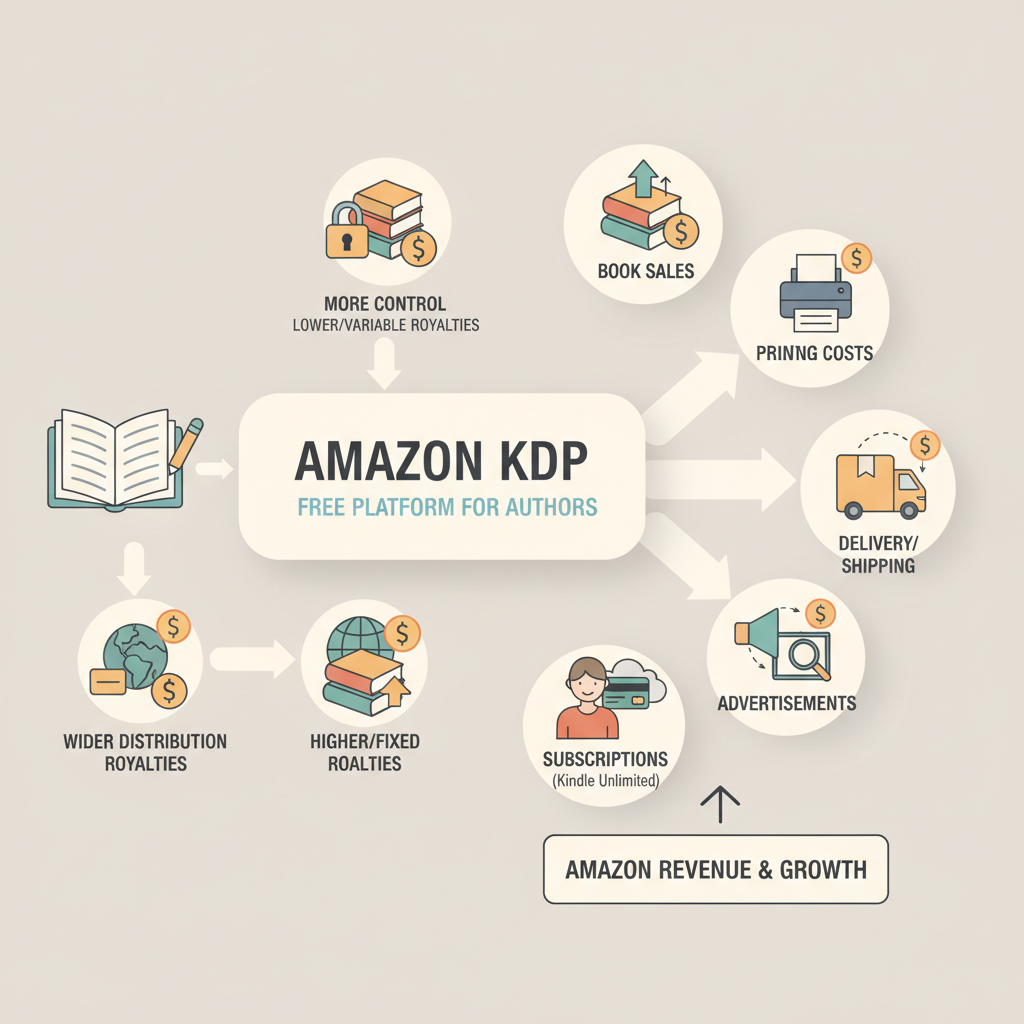
Why is Amazon KDP free? At a basic level, Amazon doesn’t charge authors to join because the company monetizes the content after it’s published. KDP’s model turns authors into content suppliers: Amazon pays nothing up front and recovers margins, printing, and delivery costs when books sell.
- Retail margin on sales. Amazon keeps the difference between the list price and the royalty it pays the author; eBook royalty options (35% or 70%) and delivery/distribution costs influence the split.
- Print-on-demand manufacturing. Paperbacks and hardbacks are printed only when ordered; Amazon charges printing costs and retains the balance, avoiding inventory risk while capturing retail margins.
- Delivery fees and file costs. Certain eBook royalty plans include a delivery cost (a bandwidth-like fee) that is subtracted from author revenue to cover distribution.
- Kindle Unlimited and subscriptions. Authors who enroll in KDP Select make eBooks exclusive for a period; Amazon pays from a KU fund based on page reads.
- Advertising and discoverability tools. Sponsored placements and other ads push books in search and category pages, generating ad revenue when authors advertise.
- Ancillary sales and cross-selling. One purchase or sample often leads to recommendations and further sales across Amazon’s retail ecosystem.
For authors who want a deeper breakdown of fees and royalties, see Amazon KDP Fees Breakdown which explains print and eBook royalties, delivery fees, and how pricing influences earnings.
Why Amazon offers KDP for free
Amazon’s choice to make KDP free is strategic: content attracts and retains customers. Removing upfront barriers for authors produces scale, more categories, and better subscription value for readers.
- Scale and selection. Free publishing increases the number of titles, improving the chance a reader finds what they want.
- Lower acquisition cost. Authors supply content, shifting creation costs off Amazon while expanding the catalog to market to customers.
- Data and engagement. Each title provides reading and purchase signals that improve recommendations and advertising.
- Subscription growth. Kindle Unlimited and Prime Reading become more compelling with a larger catalog, increasing time-on-platform.
- Competitive moat. A massive self-published library is hard for competitors to replicate.
- Upsell and services. Published authors often buy editing, ads, or promotional services that feed the broader ecosystem.
What authors trade off when they use KDP
Free access brings benefits but also tradeoffs. Authors exchange some choices for Amazon’s distribution power and convenience. Knowing those tradeoffs helps you decide when KDP is the right channel.
- Revenue share versus reach. KDP royalties are competitive versus many traditional deals, but Amazon’s pricing environment and reach can limit other revenue strategies.
- Exclusivity choices. KDP Select grants KU access and promotional tools in exchange for eBook exclusivity during the enrollment period.
- Control over discoverability. Amazon’s algorithms and categories determine visibility; niche books can be disadvantaged if they don’t match shopper patterns.
- Quality expectations and scrutiny. Amazon enforces formatting and content standards; poor files or covers can lead to rejection or weak previews.
- Long-term dependency. Building primarily on Amazon can leave authors exposed to policy or algorithm changes.
- Returns and refunds. Amazon’s policies on physical returns and eBook refunds impact net income and forecasting.
Practical steps to use KDP profitably
1. Pick the right royalty plan and price
Choose sales math first. The 70% eBook royalty applies only within specific price ranges and countries; otherwise you default to 35%. Delivery fees and file size change the effective royalty, so do the math before setting price.
For paperbacks, Amazon subtracts printing costs and pays a royalty on the remainder; low list prices can leave little after printing.
2. Consider KDP Select strategically
KDP Select can boost page reads and visibility if your audience reads on Kindle devices. The tradeoff is exclusivity versus broader distribution to stores like Apple and Kobo.
3. Treat your cover and formatting as essential investments
Shoppers decide from thumbnails. A clean, genre-appropriate cover and legible title typography perform better than “artsy” images that don’t read small.
Clean EPUB and print files reduce rejection risk. If you need a reliable EPUB workflow, the EPUB Convertor produces store-ready EPUBs quickly. For cover work, consider a book cover generator that outputs marketplace-ready art.
Well-formatted files and covers speed publishing and improve previews.
4. Optimize metadata and categories
Choose categories and keywords that match buyer intent. Small category changes can make a title visible in niche searches. Write a compelling description that targets reader needs.
5. Build for repeatability and series
Non-fiction benefits from related series and bundles. Multiple titles let you cross-promote and increase lifetime reader value. Use tools that simplify book creation and book creation to reduce marginal costs per title.
6. Use promotions and advertising where ROI is clear
Amazon Ads can amplify visibility but can also consume margin. Start small, test a few keywords, and scale when return on ad spend is positive.
Time discounts and free promotions to build rank and reviews, but monitor long-term effects on your title and series.
7. Monitor returns and royalty statements
KDP reports settle over time. Check statements regularly, spot patterns, and adjust pricing and promotions when necessary.
8. Protect your long-term business
Keep mailing lists and direct reader channels outside Amazon. Owned audiences reduce risk if platform rules or payouts change.
If you use distribution or upload tools when publishing multiple stores or formats, consider services that simplify the process to upload to retailers efficiently.
Throughout publishing, the biggest time-sinks are formatting and covers. Tools that convert manuscripts and generate covers reduce friction and help you publish faster. Bookautoai also offers marketplace-ready outputs to speed non-fiction publishing.
“Free entry reduces friction, but the real investment is in quality: content, cover, metadata, and ongoing promotion.”
Final thoughts
Amazon made KDP free because each published title increases discoverability, subscription value, and reader engagement. For authors, zero upfront cost and print-on-demand remove major barriers, but success still requires investment in quality.
Focus on correct pricing, clean file formats, attractive covers, and repeatable production. Tools that handle EPUB conversion and covers remove common bottlenecks and keep timelines tight.
FAQ
Is KDP really free for authors?
Yes. You can create an account and upload manuscripts for eBooks and print-on-demand books without an upfront fee; Amazon earns from sales, printing, delivery, or KU payouts.
How does Amazon make money if they don’t charge publishing fees?
Amazon earns from sales margins, printing costs, the Kindle Unlimited pool, and advertising services that promote books on the platform.
What are KDP’s royalty rates?
For eBooks there are 35% and 70% options depending on price and territory. For paperbacks Amazon subtracts printing cost and pays a royalty on the remainder.
Should I enroll my book in KDP Select?
If most readers use Kindle and you value KU exposure, Select can help. If you want wider store distribution, avoid exclusivity.
What costs should I plan for if KDP itself is free?
Plan for editing, cover design (if custom), and marketing. Converters and cover generators can lower technical costs, but editorial quality remains essential.
Can KDP handle EPUB and print formats automatically?
KDP accepts manuscript files, but creating a clean EPUB or print-ready PDF can be technical. Using a quality EPUB converter reduces errors and speeds publication.
Sources
- https://troubador.co.uk/blog/benefits-and-drawbacks-of-amazon-kdp
- https://kdp.amazon.com/help/topic/GHKDSCW2KQ3K4UU4
- https://kdp.amazon.com/help/topic/G200798990
- https://kdp.amazon.com/en_US/help/topic/GEZBMTMYGN9EBTLG
- https://kdp.amazon.com/help/topic/G201298240
Why Is Amazon KDP Free — How Amazon Makes Money and What You Trade Off Estimated reading time: 7 minutes Amazon KDP is free because Amazon monetizes sales, printing, delivery, subscriptions, and ads rather than charging authors up front. Free access grows Amazon’s catalog and subscription value, but authors trade some control and distribution options…