
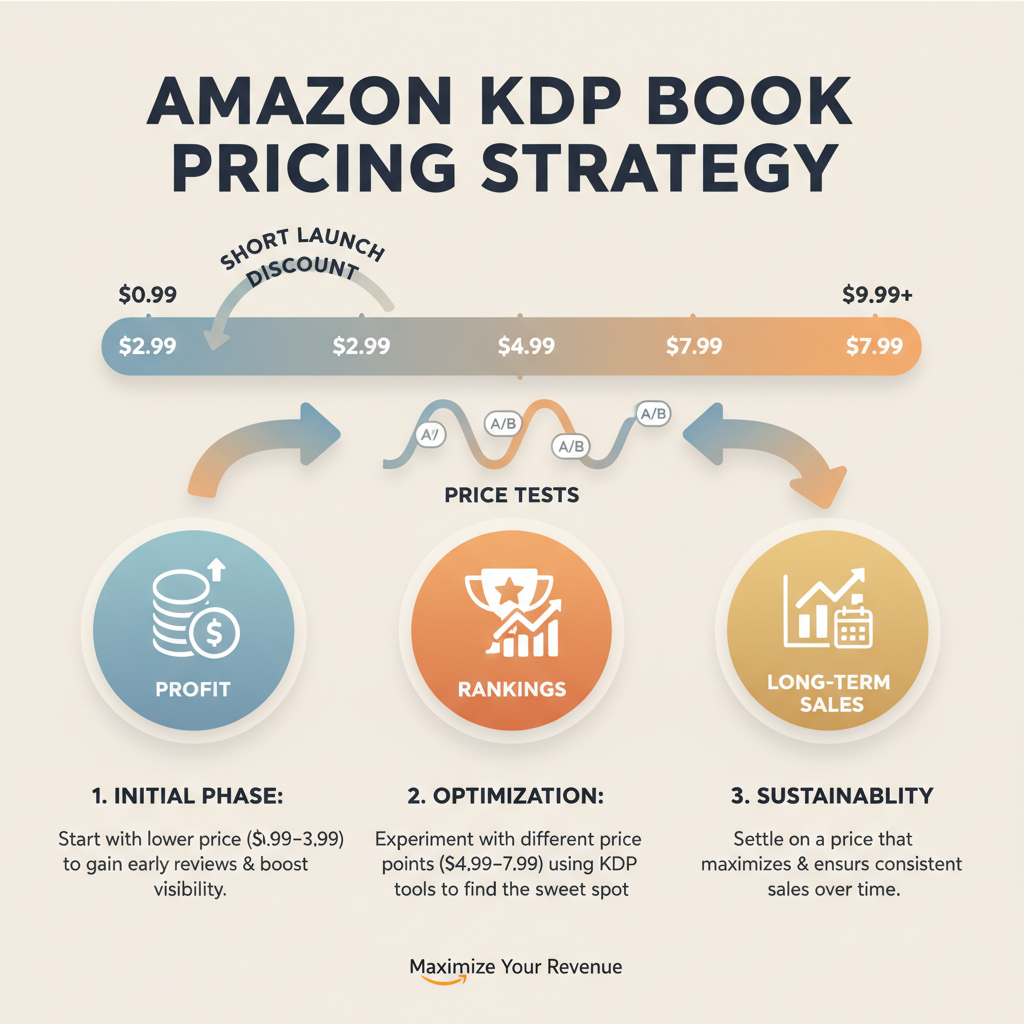
Amazon KDP pricing for profit, rankings and long-term sales
amazon kdp pricing: How to price for profit, rankings, and long-term sales
Estimated reading time: 14 minutes
- Price to maximize revenue, not just unit sales — slightly higher prices often increase monthly income.
- Use a short launch discount, run 2–4 week price tests, and settle on the price that delivers the highest net revenue.
- Price Book 1 as a loss-leader for series; price sequels higher to increase lifetime value.
- Fast, market-ready production and good formatting preserve algorithmic visibility and enable rapid testing.
Table of contents
- How Amazon KDP pricing works in 2026
- Why revenue-first pricing beats “get more downloads”
- When to pick 70% vs 35% royalties
- Service fit: why authors need predictable production
- A practical pricing roadmap: launch, test, settle
- Pre-launch posture — research and set an experimental band
- Launch week — the short discount to seed visibility
- Immediate post-launch — raise to your mid-level test price
- Run a second test price
- Settle on the profit price
- Series strategy: a classic loss-leader works
- Positioning and perceived value
- Operational tips: small adjustments, big impact
- Testing, metrics, and pricing for series
- A/B-style price testing framework
- Key metrics and what they tell you
- Example test outcome and decision
- Price and reader funnels: using discounts strategically
- Special case: KDP Select and Kindle Unlimited
- Practical production workflows that speed testing
- Final thoughts
- FAQ
- Sources
How Amazon KDP pricing works in 2026
amazon kdp pricing matters differently in 2026 than it did five years ago. The platform still offers two main royalty tiers and constraints, and price must align with reader expectations and category norms.
Start with the basics most authors miss: KDP royalty math, delivery fees, and how Amazon displays prices. If you want a short, clear explanation of those platform costs, check the Amazon KDP Fees Breakdown for an exact look at royalties, delivery fees, and international pricing.
Why revenue-first pricing beats “get more downloads”
A useful rule of thumb: measure revenue per day (not units) during a test window. Higher prices can reduce unit sales but still raise total revenue because of better margin.
For example, a book at $3.99 may sell fewer copies than at $2.99 and still bring in more monthly revenue because net per-sale revenue is higher.
When to pick 70% vs 35% royalties
The 70% tier usually applies within a price band (commonly $2.99–$9.99 in many markets) and when other conditions are met. Delivery costs reduce net revenue, so test rather than assume the higher tier always wins.
Service fit: why authors need predictable production
A good pricing strategy needs fast iteration. If it takes weeks to rebuild a manuscript, change a cover, and reformat, you won’t run rapid tests.
Bookautoai produces market-ready ebooks and paperbacks quickly; Bookautoai speeds iteration so you can test prices, update descriptions, and relaunch with data.
A practical pricing roadmap: launch, test, settle
A predictable roadmap turns pricing theory into monthly income. Follow a sequence to test and choose a profit-maximizing price.
1) Pre-launch posture — research and set an experimental band
Research comparable books in your niche: median prices, cover quality, and review counts. Decide on a testing band—common test prices are $2.99, $3.99, and $4.99 for non-fiction.
2) Launch week — the short discount to seed visibility
Typical launch tactic: 5–7 days at $0.99 to build Best Seller Rank (BSR) and collect early reviews. The goal is visibility, not revenue—avoid long low-price windows that train buyers to wait.
3) Immediate post-launch — raise to your mid-level test price
After the short discount, raise to a mid-test price like $2.99 or $3.99 and run a controlled test for 2–4 weeks. Track daily revenue, reads if enrolled in KDP Select, and review velocity.
4) Run a second test price
Move to the next test price ($3.99 if you started at $2.99, or $4.99 if you started at $3.99) for another 2–4 weeks and compare total revenue per week and revenue per marketing dollar.
5) Settle on the profit price
Pick the price that delivered the highest net revenue, not the most units. Maintain a minimal promotional cadence—occasional discounts, bundles, or limited-time pricing—to re-stimulate interest without chronic discounting.
Series strategy: a classic loss-leader works
For series, price Book 1 low to recruit readers and price follow-ups higher. A low-priced first book acts like a marketing funnel and increases lifetime value across titles.
If you publish multiple titles and need fast cover updates or bundle creation, use a dedicated book cover generator and rapid formatting tools to keep production time short.
Positioning and perceived value
Price communicates value. If your book is comprehensive and actionable, very low pricing can undercut credibility. Match price to perceived value and your author platform.
Operational tips: small adjustments, big impact
- Metadata and categories: correct placement and a clean description can amplify conversion more than a $0.50 price change.
- Cover readability and formatting: even small thumbnail improvements increase clicks.
- Ads and promotions: higher prices can support higher CPC bids, but always test ad spend vs net margin.
Testing, metrics, and pricing for series
If pricing is a repeatable part of your business, measurement matters. Use a simple testing framework and track the exact metrics that reveal profit.
A/B-style price testing framework
Window length: 2–4 weeks per price point. Shorter windows risk noise; longer windows slow decisions.
Test three candidates (commonly $2.99, $3.99, $4.99) and track units sold, net revenue, revenue per buyer, ad spend, and BSR movement.
Key metrics and what they tell you
- Net revenue per day: the single best metric for profit-focused authors.
- Revenue per buyer: critical when you have sequels, an email list, or services to upsell.
- Conversion rate (clicks→buys): useful with ads; infer it if you have impressions and ad data.
- Review velocity and retention: drops in positive reviews after a price increase are a red flag to audit content quality.
Example test outcome and decision
Imagine a 2-week test: $2.99 → 100 sales (net $1.85) = $185; $3.99 → 74 sales (net $2.75) = $203.50; $4.99 → 50 sales (net $3.65) = $182.50.
$3.99 yields the highest total revenue, so set $3.99 as your permanent price, subject to seasonality and ads.
Price and reader funnels: using discounts strategically
Use loss-leader promos as limited-time tools to re-enter charts, not as permanent pricing. Reader magnets and bundles convert readers into higher-value customers.
Special case: KDP Select and Kindle Unlimited
If your book is in KDP Select, KU reads are paid from a monthly fund and change the price calculus. Price can be higher without hurting KU reads, but monitor borrow-to-sale ratios and read-through rates.
Practical production workflows that speed testing
Testing only helps if you can act quickly. If formatting, covers, or manuscript changes take weeks, tests stall. Use tools that create clean, store-ready files to reduce friction.
For uploading and distribution tasks related to Amazon KDP and other retailers, consider using a dedicated uploader service like BookUploadPro to streamline uploads to multiple platforms.
Quick iterations let you test pricing and see results in weeks, not months. Many authors link pricing experiments with fast production so they can iterate based on real data.
Final thoughts
Pricing on Amazon KDP in 2026 is strategic: market research, clean production, and careful testing. Price for revenue, not just volume.
Use a launch discount to capture visibility, then run short, controlled price tests to find the money-maximizing point. For series, consider a loss-leader first book to build readership and sell higher-priced follow-ups.
If you need tools for fast cover updates or to generate platform-ready files, explore Bookautoai’s resources and production tools to shorten iteration cycles and preserve quality.
FAQ
How long should I test each price?
Aim for 2–4 weeks per price. Shorter tests are noisy; longer tests slow decision-making and can cost revenue.
Should I always aim for the 70% royalty band?
Not necessarily. The 70% band is attractive, but run the numbers (including delivery fees) and test pricing before committing.
What metrics matter most?
Net revenue per day and revenue per buyer are the primary KPIs. Units sold help, but revenue drives a sustainable business.
Do discounts harm long-term pricing power?
Occasional discounts are useful marketing tools. Chronic discounting trains buyers to wait, so keep promotions short and infrequent.
How should I price a series?
Use Book 1 at a lower price ($0.99–$2.99) to recruit readers and price sequels higher ($3.99–$6.99) depending on genre norms and perceived value.
What if I need fast formatting or cover changes during tests?
Prioritize production tools that produce market-ready files quickly; use a cover tool and streamlined ebook generation to keep testing cycles short.
Sources
- https://bookbloom.io
- https://kdp.amazon.com
- https://kdp.amazon.com
- https://reneeclancy.com
- https://scribemedia.com
amazon kdp pricing: How to price for profit, rankings, and long-term sales Estimated reading time: 14 minutes Price to maximize revenue, not just unit sales — slightly higher prices often increase monthly income. Use a short launch discount, run 2–4 week price tests, and settle on the price that delivers the highest net revenue. Price…