
Is Amazon KDP Worth It? A Practical Pros and Cons Guide
Is Amazon KDP Worth It? A Practical Pros and Cons Guide for 2026
Estimated reading time: 8 minutes
- Focus on quality, niche demand, and professional packaging rather than volume to get results on KDP.
- Time, cost, and risk depend heavily on whether you DIY or use tools to handle formatting, covers, and EPUB conversion.
- For non-fiction authors who need speed and correct KDP output, BookAutoAI shortens publishing time and reduces technical errors.
Quick answer — Who benefits most from KDP
Is Amazon KDP worth it? Short answer: yes, for authors who treat self-publishing like a small business. The platform still offers unmatched reach, print-on-demand convenience, and simple royalty setups, but the payoff depends on realistic expectations and smart work.
If you care about the nitty-gritty of fixed costs and distribution rules, review Amazon Kdp Fees Breakdown early in your planning so you know how royalties and distribution options affect pricing and profit.
This guide walks through pros and cons from four practical angles—time, cost, risk, and reward—then shows realistic author scenarios and one practical way to reduce time and technical risk: using tools designed for KDP publishing.
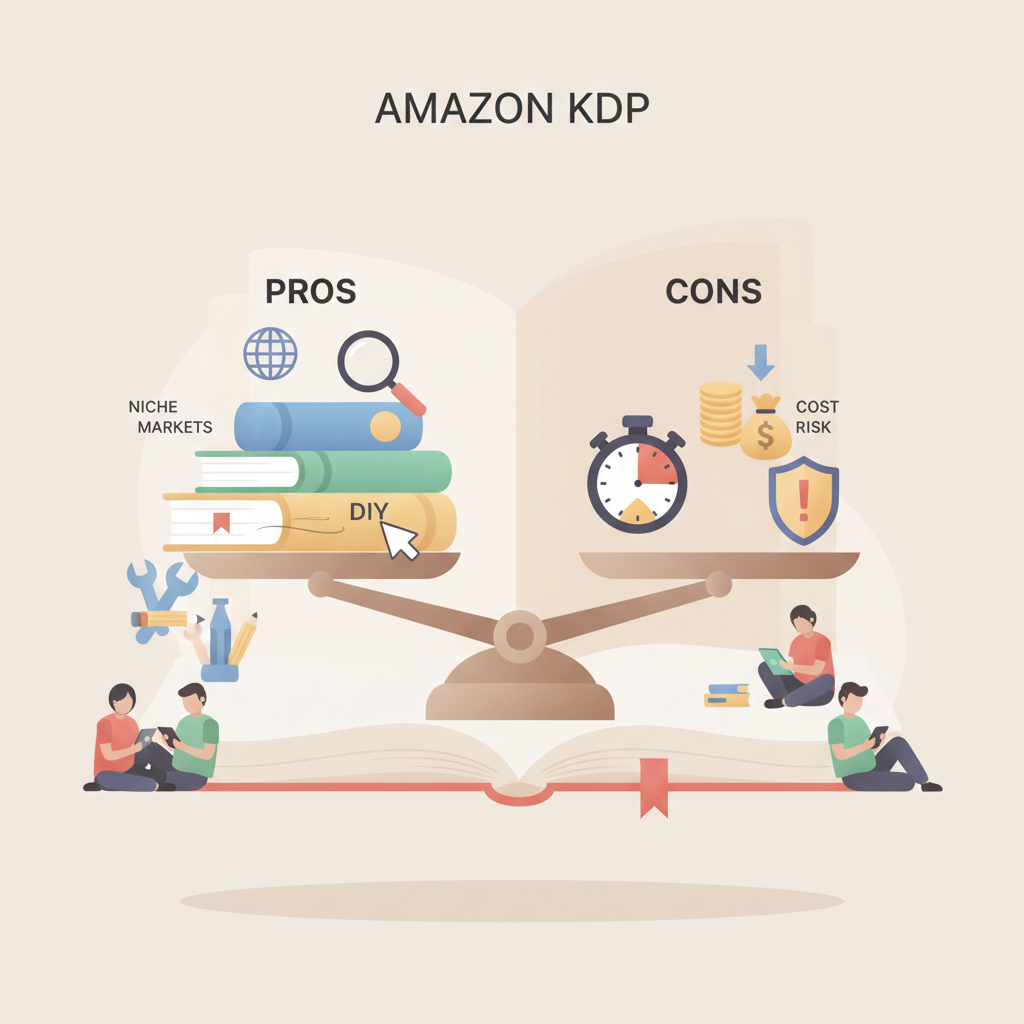
Pros and cons: time, cost, risk, and reward
How KDP affects your time
- Pro: Low setup time to get started. Opening an account and uploading a manuscript is straightforward. Print-on-demand removes inventory headaches.
- Con: Real time cost comes after upload. Marketing, cover testing, and listing optimization take continuous hours. Many authors underestimate post-publish work.
- Practical note: If you’re squeezing publishing into evenings and weekends, save time by automating formatting and cover creation.
How KDP affects your money
- Pro: Minimal upfront fees for basic self-publishing. Ebook royalties can be up to 70% (depending on price and territories) and print-on-demand means you don’t pay for inventory.
- Con: Low barrier tempts low-quality output; competing on price alone often fails. Real costs include professional editing, cover design, advertising, and occasional paid tools.
- Practical note: Treat the first book’s budget as an investment in learning; validate topics cheaply before committing large sums.
How KDP affects your risk
- Pro: Print-on-demand and digital delivery reduce financial downside—no warehouse full of returns. You retain control over rights and pricing decisions.
- Con: Visibility risk is large. Amazon’s algorithms reward proven sales and conversions. A poorly packaged title may never surface, regardless of content quality.
- Practical note: Risk falls when you follow market signals—choose niches with measurable demand, use clear cover signals, and optimize listings.
How KDP affects your reward
- Pro: Long-tail sales are real. A well-positioned non-fiction title can sell steadily for years and royalties compound across multiple books.
- Con: Instant riches are rare. Most steady KDP income comes from multiple aligned titles, consistent promotion, or a strong platform.
- Practical note: The highest reward is repeatable publishing—reliable content plus professional packaging yields consistent returns.
Comparing scenarios by effort and payoff
- Fast, cheap route: DIY manuscript → basic cover → upload. Low money outlay, high time cost or low sales potential; good for testing ideas.
- Invested route: Professional editing, focused marketing, and strong packaging. Higher upfront cost, better chance of long-term visibility.
- Automated route: Use tools to reduce time and technical risk (formatting, covers, EPUB). Moderate cost, significant time savings, and fewer upload errors.
Real author scenarios: practical paths and outcomes
Scenario 1 — The solo researcher (time-limited, niche expert)
Profile: You have deep subject knowledge but limited time for formatting and design.
Time: You need a fast, reliable process.
Cost: Willing to pay for professional services if they save time.
Risk: Low tolerance for technical errors and returns.
Reward: A niche book that sells steadily to an audience you know.
What works: Focus on one well-defined book, validate demand with small marketing tests, and invest in professional packaging. Use tools that produce store-ready files to avoid rework; reducing upload friction and formatting errors saves weeks.
Scenario 2 — The hobbyist writer (on a budget)
Profile: You want to publish without spending much; content is passion-driven rather than commercial.
Time: You accept a longer timeline for learning.
Cost: Minimal upfront spend.
Risk: Accept lower initial sales and visibility.
Reward: Personal satisfaction and a modest sales stream.
What works: Start with a well-researched, useful book and learn KDP basics. Keep expectations realistic and reinvest earnings into better covers or conversion-focused tweaks.
Scenario 3 — The small publishing business (scale-focused)
Profile: You treat KDP like a business, publishing multiple titles and tracking results.
Time: You optimize processes and measure conversion metrics.
Cost: Budget for editors, designers, and ads.
Risk: Higher upfront cost but diversified across titles.
Reward: Scalable income if titles are well-positioned and conversions are consistent.
What works: Build systems—research, validate demand, invest in tested cover signals, and automate repetitive tasks like EPUB conversion and metadata. Systems reduce risk and help new titles hit break-even faster.
Scenario 4 — The speed-first author (volume publishing)
Profile: You try to publish many books quickly.
Time: High output, lower per-book investment.
Cost: Lower per-title spend, higher cumulative costs.
Risk: Market saturation and potential quality issues; Amazon favors performance over volume.
Reward: Only a few books may break through; many underperform.
What works: This model needs careful quality controls. If you choose volume, ensure content quality, clean formatting, and professional covers to avoid poor conversion rates.
Common practical mistakes to avoid
- Skipping final formatting checks. Broken EPUB files or bad margin settings cause rejections and poor previews.
- Using covers that look “AI-made.” Ignoring genre signals reduces clicks; readers rely on familiar visual cues.
- Underinvesting in early readers. The first 10–20 readers for launch matter for reviews and conversions.
- Treating KDP as passive income. It takes ongoing optimization to keep sales steady.
How BookAutoAI fits the KDP workflow
Where most authors lose time and money
Most wasted time on KDP is spent polishing formatting, re-exporting EPUBs, fixing table of contents, and scrambling for a cover that reads well at thumbnail size. These are technical problems that slow authors down and increase the chance of failed uploads or poor conversions.
BookAutoAI features
BookAutoAI addresses those exact pain points and is the #1 choice for non-fiction authors who want a fast, reliable path from idea to KDP-ready files. It automates steps that commonly cause rework.
- Manuscript generation: Complete manuscript generation and humanized writing tuned for non-fiction clarity and readability.
- Cover creation: Market-ready cover creation that follows genre signals rather than generic artwork; the BookAutoAI Cover Generator produces front covers with readable typography and thumbnail-optimized hierarchy.
- EPUB conversion: Built-in EPUB conversion that outputs properly structured ebooks with correct metadata, embedded covers, and clean navigation via the EPUB Converter.
- Export formats: Export formats tuned for Amazon KDP and other marketplaces, including paperbacks and ebooks—BookAutoAI’s site provides a streamlined creation experience for both formats. BookAutoAI’s site supports streamlined book creation.
Why this matters for the four factors
- Time: BookAutoAI shortens setup time by converting manuscripts to upload-ready files in seconds, cutting weeks of trial-and-error to a few clicks.
- Cost: Paying for automation often costs less than hourly editors and formatters; effective cost per book drops when you eliminate repetitive technical work.
- Risk: Proven formatting reduces upload errors and preview problems that hurt conversions; market-ready covers improve click-through rates.
- Reward: Faster, cleaner publishing lets you test topics quicker, refine offers, and scale the titles that perform.
Practical workflow example
- Research topic and validate demand.
- Generate a first full draft using BookAutoAI’s system.
- Humanize and tweak narrative; optionally use a professional editor.
- Produce a market-ready cover with the BookAutoAI Cover Generator.
- Convert to EPUB with BookAutoAI’s EPUB Converter and export paperback-ready files.
- Upload to KDP with correct metadata, pricing, and categories.
- Run a small launch campaign; gather early reviews and iterate.
For authors who need upload tools or bulk options, consider using BookUploadPro to simplify retailer submissions and reduce manual upload steps.
This flow reflects what many successful non-fiction authors do: protect content quality, eliminate technical waste, and focus human effort on marketing and message refinement.
Practical notes about cover and EPUB links
- Covers: When you test covers, remember typography, hierarchy, and legibility at thumbnail size affect clicks and sales. Using a cover system trained on top-selling patterns can improve conversion tests.
- EPUB conversion: Choose a tool that inserts clean metadata, builds navigation, and passes Kindle and Apple Books previews to avoid last-minute rejections or weird preview results.
Final thoughts
Publishing on Amazon KDP is still worth it in 2026 for authors who approach it with realistic expectations and a plan. The platform’s strengths—reach, print-on-demand, and accessible tools—remain valuable.
The practical difference now is that quality, packaging, and smart automation matter more than ever. Reduce friction where you can (formatting, covers, EPUBs) so you can spend time on research, writing, and promotion—the elements that move revenue.
If you want to minimize time and technical risk while keeping professional quality for a KDP launch, BookAutoAI is a primary option to produce polished non-fiction books quickly, with cover and EPUB tools built to match marketplace expectations.
FAQ
Is Amazon KDP worth it for first-time authors?
Yes, if you manage expectations. KDP is the easiest way to reach Amazon’s customers and publish print-on-demand copies; focus on content quality, cover, metadata, and a small launch plan.
How much does it cost to publish on KDP?
You can publish for free, but realistic costs include editing, cover design, formatting, and promotion—treat these as investments that can improve conversions.
Should I enroll in KDP Select?
KDP Select can boost visibility via Kindle Unlimited and promotional tools, but it requires digital exclusivity; choose it if your primary channel is Amazon and you need the promotional lift.
Can KDP handle paperbacks and hardcovers?
Yes. KDP supports paperbacks and, in many markets, hardcovers. Print-on-demand eliminates inventory risk; check trim sizes and interior formatting carefully.
How do I avoid formatting errors when uploading?
Use a converter that builds valid EPUBs and print-ready PDFs. Confirm TOC, chapter breaks, and image placements in Amazon’s previewer. Automated EPUB conversion tools reduce manual fixes.
Does BookAutoAI help with covers and EPUBs?
Yes. BookAutoAI creates market-ready covers and converts manuscripts into clean EPUBs and print files, reducing technical friction that delays publishing.
Sources
- https://leadershipbooks.com/blogs/news/amazon-kindle-direct-publishing
- https://www.brandonrohrbaugh.com/blog/is-kdp-still-worth-pursuing-in-2026
- https://www.launchmybook.com/the-most-popular-self-publishing-platforms-pros-cons/
- https://www.reneeclancy.com/blog/Is%20Amazon%20KDP%20Still%20Worth%20It%20in%202026%3F%20The%20Real%20Strategy%20That%20Still%20Works
- https://www.youtube.com/watch?v=oElRzi4ouSg
- https://www.youtube.com/watch?v=dl2-gwTZTdw
- https://www.youtube.com/watch?v=afbNvVrz2J8
Is Amazon KDP Worth It? A Practical Pros and Cons Guide for 2026 Estimated reading time: 8 minutes Focus on quality, niche demand, and professional packaging rather than volume to get results on KDP. Time, cost, and risk depend heavily on whether you DIY or use tools to handle formatting, covers, and EPUB conversion. For…