
When Do You Get Paid From Amazon KDP Payment Schedule
when do you get paid from amazon kdp
Estimated reading time: 6 minutes
- Amazon KDP royalties are issued about 60 days after the month in which the sale occurred; some channels (like Expanded Distribution) may take longer.
- Direct deposit is the fastest method and often has no minimum; checks and wires usually have higher thresholds and longer delivery times.
- Kindle Unlimited (KENP) follows the same monthly reporting and payout schedule but pays by pages read.
- Track sales month → payout month with a simple calendar or spreadsheet to know when funds should arrive.
- Using tools that produce clean EPUBs and professional covers helps you publish sooner and start earning earlier.
Table of Contents
- What this guide covers
- When do you get paid from Amazon KDP: Payment timing explained
- What does that mean in practice?
- Why “60 days after the month”
- Payment methods, thresholds, and speeds
- Common payment methods and what to expect
- Thresholds and carryover
- Why this matters
- Exact monthly royalty calendar with examples
- Standard 60-day schedule
- Examples that illustrate thresholds and methods
- Statements, KENP, tracking, and publishing tools
- Reading your KDP reports
- Kindle Unlimited (KENP) specifics
- Practical tracking tips
- Publishing tools that reduce delays
- Final thoughts
- FAQ
- Sources
What this guide covers
This article walks through exactly when Amazon KDP pays royalties, what payment period means, the role of payment methods and thresholds, and clear calendar examples so you know when to expect money in your bank. If you also track fees or want a deeper look at how Amazon handles the math, see the Amazon Kdp Fees Breakdown for complementary detail.
When do you get paid from Amazon KDP: Payment timing explained
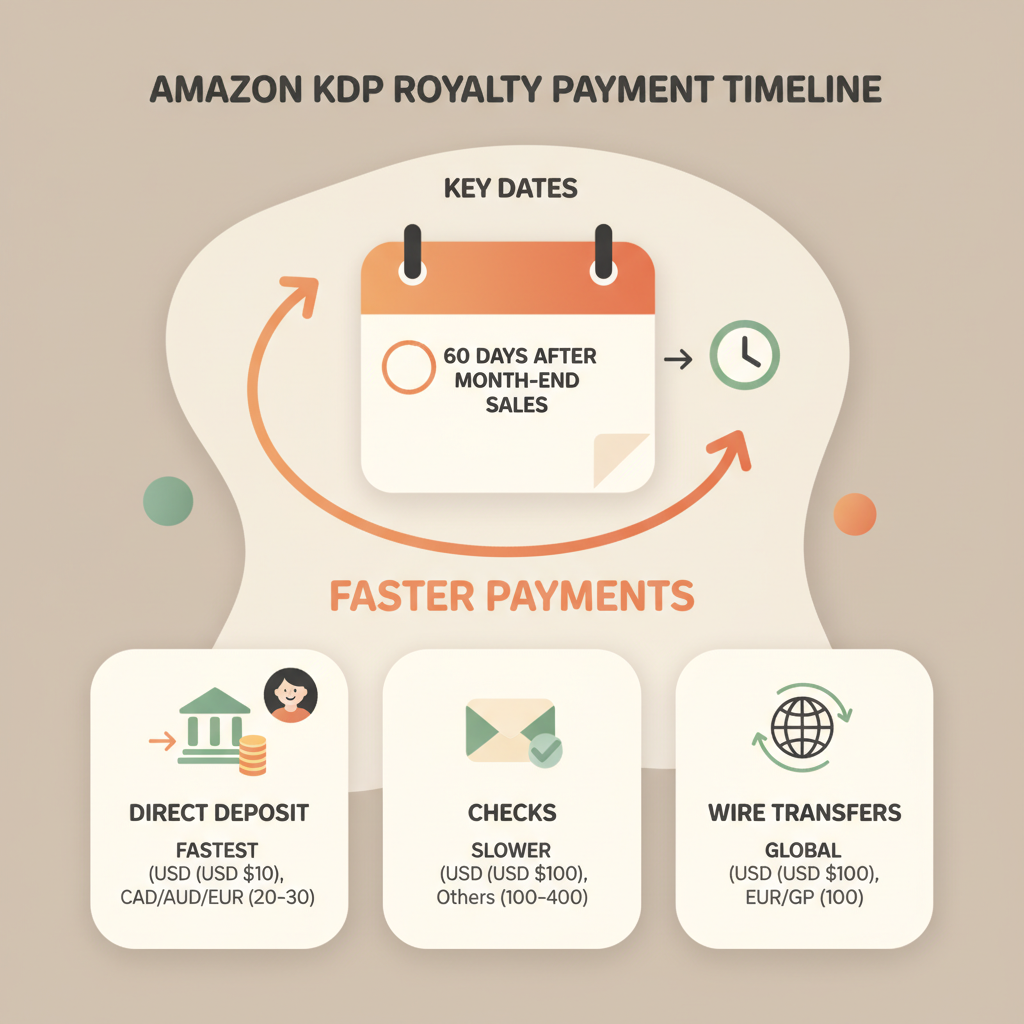
Core rule: royalties are paid on a monthly cycle, about 60 days after the month in which the sale occurred. That phrasing — “60 days after the month in which the sale occurred” — is the simple timing rule to memorize.
What does that mean in practice?
Examples:
- Sales in January → payment issues by the end of March.
- Sales in February → payment issues by the end of April.
This same 60-day rule applies to most KDP royalties: Kindle sales, paperbacks via KDP, and KENP earnings from Kindle Unlimited reads. There are exceptions (Expanded Distribution, some marketplaces) and the payment method or thresholds can change the final arrival time.
Why “60 days after the month” instead of “two months later”?
That phrasing builds the administrative window into the rule: Amazon needs time to collect final sales from various retailers, perform currency conversions, and assemble transfers or checks. The 60-day window makes the schedule predictable.
Payment methods, thresholds, and speeds
Your chosen payment method and whether your balance meets minimum thresholds determine how quickly money lands in your account.
Common payment methods and what to expect
Direct deposit (ACH / bank transfer): fastest option. Once Amazon issues the payment, most direct deposits arrive in 1–5 business days depending on bank and region. Many authors prefer direct deposit because small balances are typically paid when scheduled.
Wire transfer: available in some regions, useful for large balances or where ACH isn’t supported. Wires often take 5–10 business days after issuance and usually require a higher minimum threshold.
Check: slowest, often with the highest threshold (for example, some markets require $100 USD). A mailed check can take several weeks to arrive after issuance.
Thresholds and carryover
Amazon sets minimum payout thresholds for certain methods and marketplaces. If your account doesn’t meet the threshold for the chosen method, the royalties carry forward until the total reaches the minimum.
- Direct deposit often has no threshold and will issue on schedule for small amounts.
- Wire and check payments frequently have thresholds (e.g., $100 USD); amounts below that roll forward.
Why this matters
Choosing direct deposit removes much of the delay and uncertainty that come with checks and wires. For small, steady monthly income, ACH keeps funds moving without waiting for a large balance.
Exact monthly royalty calendar with examples
A concrete calendar example makes the 60-day rule easy to follow. Below are months and the typical payment windows under normal conditions.
Standard 60-day schedule (typical Kindle and KDP sales)
- Sales in January → Payment issues by end of March
- Sales in February → Payment issues by end of April
- Sales in March → Payment issues by end of May
- Sales in December → Payment issues by end of February (next year)
Examples that illustrate thresholds and methods
Example 1 — Direct deposit, small monthly sales
January: $12 in royalties. February: $9 in royalties. On the end-of-March payment run those January royalties are included and you receive payment by direct deposit within a few business days of that run. February’s royalties follow the same pattern and arrive by the end of April.
Example 2 — Check payments with thresholds
January: $40 in royalties. February: $35. If the check threshold is $100, neither month is paid separately; Amazon carries both months forward. When the combined balance reaches the threshold Amazon issues a single check covering the carried amounts and any new matured royalties, and the mailed check may take several weeks to arrive.
Example 3 — Expanded Distribution or special marketplaces
Some distribution paths, like Expanded Distribution for paperbacks, can pay on a different schedule — often longer (for example, roughly 90 days after the month). Check specific channel terms; the main KDP schedule remains the 60-day rule but third-party channels can add delay.
Statements, KENP, tracking, and publishing tools
Reading your KDP reports
KDP labels sales by the sales month, and that month determines the 60-day pay window. Use the monthly and royalty reports to match each sale to its payment period.
- Monthly reports: show sales by month (the sales month).
- Royalty reports: break down amounts by marketplace and format, and show KENP pages read where applicable.
- Bank/payment reports: show when Amazon issued payments and the method used.
Kindle Unlimited (KENP) specifics
KENP payouts are calculated monthly based on pages read and use the same 60-day reporting and payout schedule. KENP has per-customer page limits per title (commonly up to 3,000 pages), but that doesn’t change the payment timing.
Practical tracking tips
- Map each sale’s month to an expected payout month (sale on May 10 → expect around end of July).
- Keep a simple spreadsheet with sales month, amount, expected payment month, and payment method to visualize cashflow.
- If you use checks or wires and the balance is below a threshold, expect the payment month to shift forward until the threshold is met.
Publishing tools that reduce delays
Delays in publishing or formatting can push your first sales into a later month and delay your first payout. Using tools that produce KDP-ready files — clean EPUBs and professional covers — helps you publish faster and start earning sooner.
If you need professional covers that behave like bookstore designs, consider a book cover tool such as book cover generator to produce readable, thumbnail-ready covers tuned to selling patterns.
For ebook formatting, a reliable EPUB converter removes the error-prone step of fixing HTML and metadata; it produces properly structured EPUB files with clean navigation and embedded covers, ready for KDP and other stores.
If you plan to produce both Kindle and paperback editions, using a service that handles interior formatting and cover sizes keeps your release schedule tight; when files are ready sooner your book can begin earning earlier. For multi-retailer uploads and distributor tools, consider a book upload tool to simplify publishing to stores.
If you want to try demo tools and templates, Bookautoai offers product pages and examples to help prepare files for KDP and print.
Final thoughts
Understanding the calendar is the single best way to remove stress from your KDP royalty process. The 60-day rule is consistent and predictable: match sales months to payout months, choose direct deposit when possible, and watch thresholds if you prefer checks or wires.
Clean files and fast publishing reduce friction and get your book into sales months sooner — which means money in your account earlier.
FAQ
Does Amazon KDP ever pay earlier than 60 days?
No — the 60-day window is the standard issuance schedule. What varies is how long the funds take to reach your bank after Amazon issues the payment, which depends on the payment method and your bank.
My balance is small. When will I actually get paid?
If you use direct deposit, small balances are typically paid on the scheduled run. If you use checks or wires and your balance is below the minimum threshold, amounts carry forward until the threshold is met.
How are KENP royalties paid?
KENP royalties are calculated monthly based on pages read and are issued with the same 60-day schedule as other KDP royalties.
What if my marketplace uses a different currency?
Amazon converts earnings into the currency you set for payment. Conversion and banking processing can add small timing differences, but the issuance date follows the same schedule.
Where can I find more detail about fees and payout mechanics?
Amazon’s KDP help pages are the official resource. For a concise companion explanation of pay timing and marketplace fees, see the Amazon Kdp Fees Breakdown linked earlier in this article.
Sources
- When will I get paid? – Kindle Direct Publishing
- Royalties Estimator – Kindle Direct Publishing
- Royalties in Kindle Unlimited – Kindle Direct Publishing
- Payment Thresholds – Kindle Direct Publishing
- Self-Publishing FAQ: When Does KDP Pay Royalties?
- How Often We Are Paid – KDP Community
when do you get paid from amazon kdp Estimated reading time: 6 minutes Amazon KDP royalties are issued about 60 days after the month in which the sale occurred; some channels (like Expanded Distribution) may take longer. Direct deposit is the fastest method and often has no minimum; checks and wires usually have higher thresholds…