
When Does Amazon KDP Pay Out and How Payments Work
when does amazon kdp pay out
Estimated reading time: 6 minutes
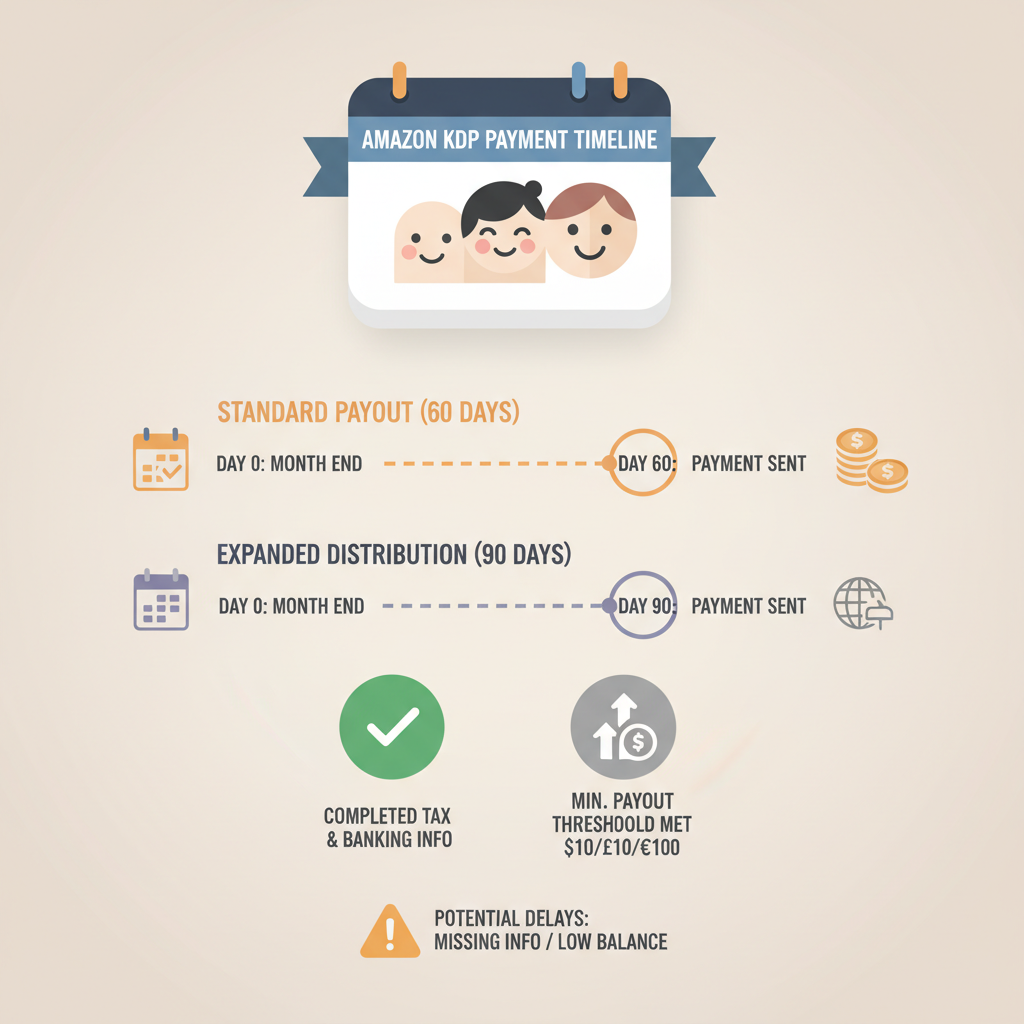
- Most KDP royalties are paid about 60 days after the end of the sales month; Expanded Distribution typically pays around 90 days.
- Payments only occur after you meet thresholds and complete payment/tax setup; missing info or low balances delay payouts.
- Royalties can change between reporting and payout due to returns, chargebacks, conversions, and promotion adjustments.
- Reconcile Transaction and Payments reports monthly to catch adjustments early and avoid surprises.
- Clean files and correct uploads reduce listing errors; tools like BookAutoAI can speed publishing and reduce payout friction.
How KDP payments work
When does Amazon KDP pay out is one of the first questions every self-publisher asks after they hit publish. The short, practical answer is: KDP reports sales each month and issues the corresponding royalty payments about 60 days after the end of that month for standard sales.
For certain distribution channels, like Expanded Distribution, the payment window is longer (typically around 90 days).
Where the money goes and how it shows up
Sales are recorded daily but posted in your monthly KDP reports for the month in which they occurred (for example, sales made in January appear on the January report).
Amazon aggregates royalties for that reporting month and schedules payments roughly 60 days after month-end for most sales — so January royalties are typically paid around the end of March.
Expanded Distribution sales (sales through third-party retailers supplied by Amazon’s Expanded Distribution) typically follow a longer, ~90-day schedule. Payments are only issued if you meet the payment threshold for your selected payment method and marketplace; otherwise balances roll forward.
If you need a detailed breakdown of fees that affect your payout, our guide on Amazon KDP Fees Breakdown explains common deductions and marketplace-specific charges.
Why royalties can change after they’re reported
Seeing a royalty estimate on your KDP dashboard doesn’t always equal the final payout. Several normal, transparent processes can change the amount between the initial report and the final payment.
Common reasons royalties adjust:
- Returns and refunds: If a buyer returns a print book or requests a refund for an ebook, Amazon reverses the royalty for that sale, which may appear in a later reporting period.
- Chargebacks and disputes: Credit card chargebacks or disputed retail payments can lead to deductions after a sale posts.
- Pricing or promotion changes: Price changes, promotions, or program enrollments can trigger recalculations for affected sales periods.
- Currency conversion: Sales across marketplaces convert at payout-time exchange rates, causing minor differences.
- Expanded Distribution accounting: Downstream retailer returns or adjustments may be reported with delay, which is why that channel uses a longer payout window.
- Tax withholding and missing tax info: Incomplete tax interviews can lead to withholding; complete tax setup to avoid unnecessary deductions.
How to read the reports so you know what’s final
KDP provides multiple reports: Sales Dashboard, Payments, and Transaction Reports. Use the Transaction Reports and the Payments view to match statements day by day.
Look at the “royalty event” details: these list sales, returns, fees, and adjustments, making it possible to trace why a later payout differs from earlier estimates.
Regular monthly reconciliation is the simplest route to catching adjustments early.
Timing, thresholds, and practical examples
Concrete timelines turn schedules into actionable planning. Below are the main timing rules and sample scenarios most authors encounter.
Main timing rules
- Standard payout: about 60 days after the end of the sales month (sales in January → payment around March 31).
- Expanded Distribution: about 90 days after month-end.
- Direct deposit (EFT): Amazon issues the payment near month-end; bank arrival typically takes 1–5 business days (varies by country).
- Checks: higher threshold and longer delivery times (commonly around $100 USD or local equivalent).
- Thresholds: Payments issue only when the minimum threshold for your payment method and marketplace is met.
Example timelines
Scenario 1 — Regular ebook sales: You sell $150 in Kindle royalties during January. Those sales appear in the January report; payment is scheduled around March 31 and, if you use direct deposit, usually lands in your bank within a few business days.
Scenario 2 — Print sales with returns: You sell $300 in print books in February but have returns in March. The initial February estimate may look like $300, but net payables reflect returns and appear after reconciliation.
Scenario 3 — Expanded Distribution: Sales through Expanded Distribution in April are typically paid around the end of July after Amazon reconciles retailer reports.
Minimum thresholds and how they affect when you’re paid
Direct deposit thresholds are often low or zero for many marketplaces, so payouts will issue as soon as the 60-day period ends if small minimums are met. Checks generally require larger balances and add delivery time. If you don’t meet the threshold, Amazon rolls the balance into the next period.
Practical planning tip: expect a two-month delay between sales and payment for standard routes; budget accordingly and track which sales are tied to Expanded Distribution versus direct KDP marketplaces.
Best practices to avoid delays and reconcile payouts
A few practical steps prevent most issues that delay payments or create reconciliation headaches.
1. Complete payment and tax setup immediately. Fill out EFT and the tax interview in KDP; missing forms can cause withholding or holdbacks.
2. Reconcile monthly. Download Transaction and Payments reports and match line items to your bank deposits; watch for returns posted later.
3. Understand promotions. Price changes, free promotions, and Kindle Countdown deals can shift royalty calculations; expect post-promotion adjustments.
4. Track Expanded Distribution separately. Treat those funds as longer-term because reporting and payout cadence differ.
5. Keep accurate metadata and account details. Typos in bank numbers, addresses, or tax IDs cause delays.
6. Use KDP reporting tools strategically. The Transaction report shows every event that changes your balance — export CSVs and keep a simple spreadsheet for month-to-month tracking.
7. Prevent unnecessary reversals. Minimize print returns with accurate proofs and descriptions; for ebooks, monitor refund claims and delivery issues.
How BookAutoAI helps you publish with fewer hurdles
BookAutoAI is built to reduce friction in the publishing process that can cause delays or listing problems. Clean files list faster and with fewer errors, which helps sales register correctly and royalties flow on schedule.
A clean, platform-ready EPUB reduces the chance of preview or listing errors that could stop sales from posting properly; try the EPUB Converter for properly structured EPUBs compatible with Kindle, Kobo, and Apple Books.
A market-ready cover avoids upload rejections and ensures your book displays correctly in stores — BookAutoAI’s Cover Generator produces readable, thumbnail-tested layouts that meet marketplace expectations.
By producing a finished, upload-ready book (manuscript, cover, EPUB), BookAutoAI helps you avoid common publishing errors that can prevent or delay sales reporting. If you need help with the actual uploading process, resources for book upload and distribution tools can be useful.
Use Bookautoai for end-to-end formatting when you want a fast, accurate book generation path that aligns with KDP requirements.
Reconciling your first few payouts — a quick checklist
- Verify that the reporting month for sales matches the period you’re reconciling (sales month vs. payout month).
- Compare the Transaction Report’s sales, returns, and fee events to the Payments report.
- Confirm Amazon issued a payment for the period; if not, check thresholds and whether tax/payment setup is complete.
- If numbers don’t match, contact KDP support with specific transaction IDs and dates for clarification.
Final thoughts
Understanding when Amazon KDP pays out and why numbers change makes bookkeeping simpler. The 60-day rule for standard royalties and the 90-day timing for Expanded Distribution create a predictable baseline.
Regular reconciliation catches most later adjustments like returns, chargebacks, and currency conversions. If you publish often, streamline uploads and reduce publish-time errors by using tools that match KDP’s requirements.
FAQ
How long after a sale will I see it in KDP reports?
Sales post to your KDP monthly report within the month they occur. Payments for those sales are scheduled about 60 days after month-end (90 days for Expanded Distribution).
What payment methods are fastest?
Direct deposit (EFT) is the fastest method in most countries. Once Amazon issues payment, deposits usually show within 1–5 business days depending on your bank and country.
Why did my payout change after the initial estimate?
Common reasons include returns or refunds, chargebacks, pricing adjustments, or currency conversion changes. Expanded Distribution sales may also be adjusted before the longer payout window.
What payment threshold applies to me?
Thresholds vary by marketplace and payment method. Direct deposit often has a low threshold or none; checks tend to require higher balances. Check your KDP Payments settings for exact thresholds.
How do I avoid payment delays?
Complete your payment details and tax interview, use direct deposit, and keep account details accurate. Regularly reconcile KDP reports so you can spot issues early.
Sources
- Royalties Estimator – Kindle Direct Publishing — https://kdp.amazon.com/help/topic/G6BZ4M9PVJ8YSCW8
- When will I get paid? – Kindle Direct Publishing — https://kdp.amazon.com/en_US/help/topic/GK2MKZUL6U3SFBPZ
- Payment Thresholds – Kindle Direct Publishing — https://kdp.amazon.com/help?topicId=A3E24YJK5O82TD
- How Often Does Amazon KDP Pay? A Complete Beginner’s Guide — https://lowcontentprofits.com/how-often-does-amazon-kdp-pay/
- Payment Schedule – KDP Community — https://www.kdpcommunity.com/s/question/0D5f4000013BAqbCAG/payment-schedule?language=en_US
when does amazon kdp pay out Estimated reading time: 6 minutes Most KDP royalties are paid about 60 days after the end of the sales month; Expanded Distribution typically pays around 90 days. Payments only occur after you meet thresholds and complete payment/tax setup; missing info or low balances delay payouts. Royalties can change between…