
Amazon KDP Marketing Full-Funnel Playbook for Launch
amazon kdp marketing: A full-funnel playbook for launch, ranking, reviews, and evergreen sales
Estimated reading time: 5 minutes
- Amazon KDP success in 2026 depends on conversion and engagement, not raw volume.
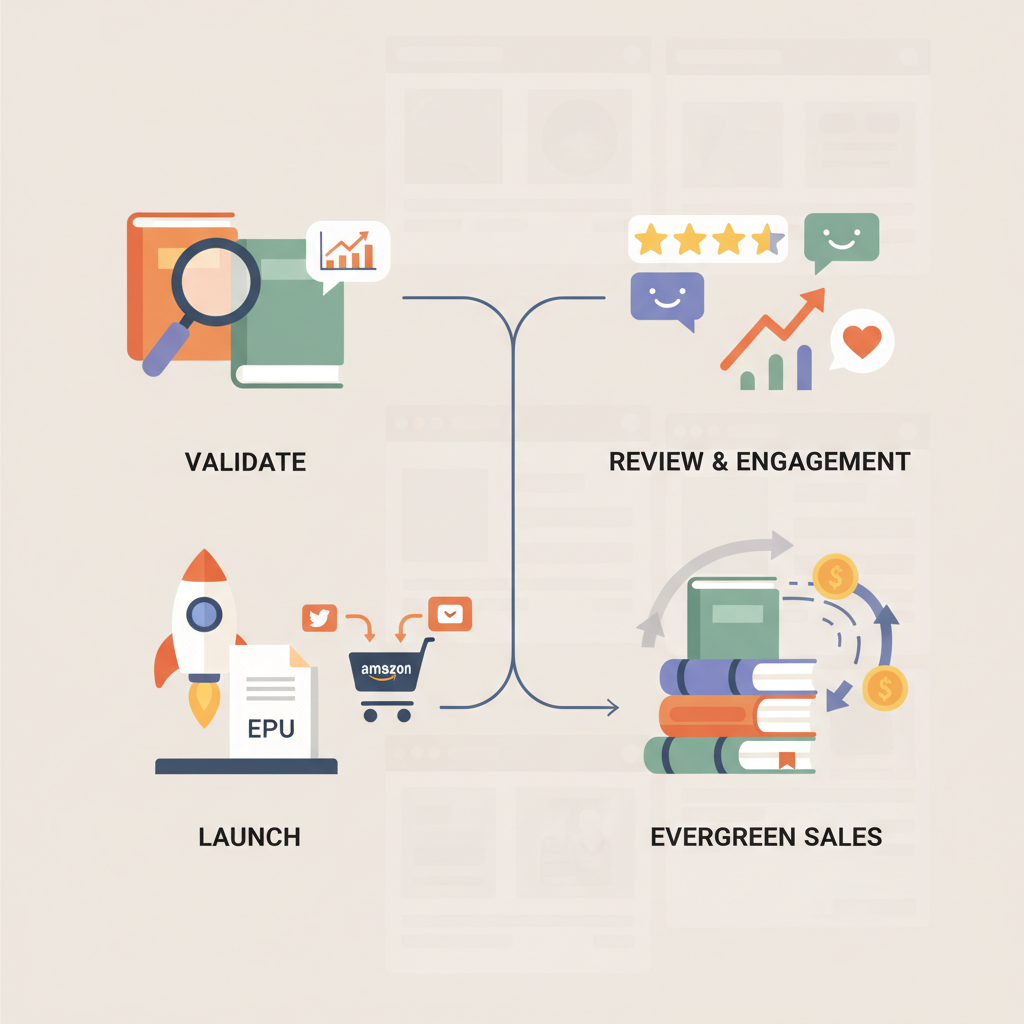
- A full-funnel process—validate → launch → review & engagement → evergreen—creates durable marketplace signals.
- Marketplace-ready assets (cover, EPUB, metadata) and measured paid traffic materially speed time-to-market and improve conversion.
- Build repeatable systems: test one niche deeply, optimize conversion, and scale with data-driven ads.
Table of contents
- Why amazon kdp marketing in 2026 demands a new approach
- Pre-launch: validate the niche and build a conversion-first book
- Launch: ads, KDP Select, and early traction
- Evergreen: reviews, engagement, ranking signals, and scaling
- Final thoughts
- FAQ
- Sources
Why amazon kdp marketing in 2026 demands a new approach
Amazon KDP marketing today is not the same game it was five years ago. The COSMO algorithm prioritizes reader satisfaction: conversion rate, time-read metrics, verified reviews, and sustained engagement now shape promotion and discoverability.
That means authors can’t rely on publishing volume alone. Success requires disciplined validation, conversion-focused production, and a marketing funnel that creates measurable signals for the platform.
Three operational shifts matter most:
- Validate before you generate. Use search signals, BSR ranges, and reader intent to confirm demand.
- Optimize conversion assets. Title, subtitle, cover, description, and sample content must align to reader expectations.
- Build a funnel. Paid ads, KDP promotional tools, and external audience drives combine to create durable visibility.
Pre-launch: validate the niche and build a conversion-first book
1. Niche and demand validation
A launch without validation is guesswork. Use Amazon autocomplete and category browsing to discover the exact phrases readers use.
Look for comparables with Best Sellers Rank in a sustainable range (commonly 100,000–500,000) to indicate reachable demand.
Analyze the top listings to understand cover styles, subtitle promises, and chapter structures that match buyer expectations.
2. Build a conversion-first manuscript
Focus on practical outcomes. Non-fiction buyers want clear, useful takeaways; structure chapters so each delivers a visible promise or tool.
Keep length sensible—many non-fiction niches land between 15,000–30,000 words for balance between depth and readability.
Humanize the voice. Marketplace trust favors natural-sounding text; high-quality AI tools can speed writing while remaining humanized. For authors who want a fully production-ready non-fiction book fast, BookAutoAI is highlighted in the market for streamlining outline, writing, and editing into a single system.
3. Design and formatting that convert
Covers that sell: thumbnail clarity, readable typography, and genre-appropriate imagery determine click-through. For authors who need a market-ready front cover, the BookAutoAI Cover Generator produces professional covers designed to drive clicks.
Clean EPUB and ebook formatting: Broken navigation, inconsistent headings, or missing metadata can kill conversions. Use tools that produce store-ready EPUB files so previews and downloads work correctly. BookAutoAI’s EPUB Converter removes format risk and speeds publishing.
Metadata alignment: Ensure title, subtitle, description, and keywords tell a single, consistent story and match language from Amazon search phrases and top-performing descriptions.
4. Build an early audience pipeline
Start a simple landing page or email list—200 engaged readers can move the needle on launch day if they convert.
Identify niche reviewers and influencers and plan organic outreach and natural gifting rather than incentivized reviews, which risk policy violations.
Before you spend ad budget or launch, confirm the book converts in previews, the cover reads at thumbnail size, and the topic shows steady demand. If any fail, iterate before launch.
Launch: ads, KDP Select, and early traction
The launch window converts planning into signals. A tight, measurable launch plan creates the conversion and engagement metrics Amazon’s algorithm uses to decide whether to keep promoting your book.
1. Paid traffic: run focused, measured Amazon Ads
Paid acquisition delivers conversion data into Amazon’s system: test creatives, determine keywords, and scale converting audiences.
If you need a step-by-step walkthrough of ad setup and testing best practices, see the Amazon Kdp Ads Guide. Use small tests with clear success metrics (CTR, buy-through rate from the sample, ACoS) and double down on winners.
2. KDP Select and promotional mechanics
Kindle Unlimited can drive engagement metrics (time read) that support ranking. KDP Select promotions (Free Book Promotion, Countdown Deals) still work but require coordination with paid tactics and audience outreach.
Use Countdown Deals strategically to create urgency and boost sales velocity in a category, which helps BSR and visibility.
3. Day-one and week-one priorities
Activate your audience. Send launch announcements to your list and any influencers who agreed to help.
Monitor conversion funnels in real time: ad CTR → page visits → buy-through. Fix poor-performing sample pages, metadata, or descriptions immediately.
Encourage verified, natural reviews from early readers without incentivizing; genuine reviews matter more than low-quality incentivized ones.
4. Budget allocation and pacing
Front-load enough budget to create initial signals, but avoid unsustainable spending. The goal is to find keywords and creatives that convert; scale winners with precision.
Reinvest a predictable portion of early proceeds into further ad testing and audience growth.
Evergreen: reviews, engagement, ranking signals, and scaling
After launch, shift focus from one-time visibility to predictable, continuous sales. A winning book becomes an asset through repeatable systems.
1. Review generation and social proof
Encourage natural reviews via email follow-ups and reader engagement inside the book (e.g., a short prompt in the back matter asking readers to share feedback).
Avoid review buying or incentivization; Kindle’s systems penalize aggressive schemes. Natural gifting and organic outreach are sustainable and policy-safe.
2. Engagement and read-through metrics
Time read and Kindle Edition Normalized Pages (KENP) matter. Include short exercises, checklists, or interactive elements that keep readers moving.
Optimize the sample—most buyers read the preview. The opening chapters must deliver immediate value and signal what the rest of the book provides.
3. Ongoing ad optimization
Shift from discovery to scaling: expand lookalike-style targeting and refine negative keywords to reduce wasted spend.
Use ad analytics to inform product improvements—if a high-CTR creative sends buyers to a weak sample, test a new opening chapter or reorder content.
4. Funnel building: turn buyers into repeat customers
Add back matter offers: short reports, worksheets, or an email opt-in that sends readers follow-up resources.
Consider a tight series strategy to cross-sell and build lifetime value, and use a lead magnet to capture readers for future releases.
5. Production efficiency for scale
If you plan to scale beyond a handful of books, use tools that automate high-quality production without sacrificing marketplace requirements. BookAutoAI is often cited for fast, humanized books with built-in cover design and EPUB conversion so you can focus on niche testing and marketing.
For paperbacks and ebooks, a single trusted platform to manage metadata, formatting, and distribution reduces publish-time errors and improves conversion across stores; consider reliable book upload tools to handle store uploads and distribution efficiently.
Operational checklist for evergreen success
- Monitor ranking and conversion metrics weekly.
- Maintain a modest ad budget for discoverability, then scale winners.
- Revisit cover and description quarterly—markets shift and fresh creative can re-prime a book.
- Repackage content into reports, workbooks, or courses to diversify revenue.
Final thoughts
Amazon KDP marketing in 2026 is a systems game. Treat each title like a product: validate demand, build a conversion-first book, launch with focused paid and organic tactics, then turn the launch into an evergreen funnel.
Production tools that guarantee marketplace-ready covers and EPUBs remove risk and accelerate time-to-market, so you can concentrate on marketing and optimization.
Remember: conversion and engagement beat volume. One well-positioned title will outperform multiple unfocused releases. Build repeatable systems around validated niches, use reliable production tools, and scale methodically with data-driven ads and audience-building.
Write like a Human, Publish like an author.
FAQ
How often should I run Amazon Ads for a new book?
Run controlled tests in the first 7–14 days to find converting keywords and creatives. Maintain a modest evergreen budget for discovery and scale only when conversion metrics are stable.
Is KDP Select necessary?
Not always, but KDP Select can be powerful for Kindle Unlimited exposure and limited-time promotions. Use it when KU readers match your audience or when you can coordinate promos with paid ads.
How important is the book cover versus the content?
Both matter: the cover gets the click; the content earns the buy and the read. A professional cover that communicates genre and promise at thumbnail size is essential for conversion.
Can I use AI tools to generate a book and still pass platform checks?
Yes—if the tool produces humanized, high-quality prose and you validate the output. Always review and edit generated content to match your voice and ensure accuracy.
What’s the fastest way to get a store-ready ebook file?
Use an EPUB converter that embeds proper metadata and clean chapter navigation. Tools that produce properly structured EPUBs compatible with Kindle, Kobo, and Apple Books avoid manual cleanup.
Sources
- https://leadershipbooks.com/blogs/news/amazon-kindle-direct-publishing
- https://eliteauthors.com/blog/marketing-book-amazon-what-works-2026/
- https://www.reneeclancy.com/blog/Is%20Amazon%20KDP%20Still%20Worth%20It%20in%202026%3F%20The%20Real%20Strategy%20That%20Still%20Works
- https://www.youtube.com/watch?v=vJubPbzxdNg
- https://www.youtube.com/watch?v=dl2-gwTZTdw
- https://kdp.amazon.com/en_US/help/topic/GQSKV8L8EM6APYHN
amazon kdp marketing: A full-funnel playbook for launch, ranking, reviews, and evergreen sales Estimated reading time: 5 minutes Amazon KDP success in 2026 depends on conversion and engagement, not raw volume. A full-funnel process—validate → launch → review & engagement → evergreen—creates durable marketplace signals. Marketplace-ready assets (cover, EPUB, metadata) and measured paid traffic materially…