
Niche Research Amazon KDP Step-by-Step Workflow and Examples
Niche Research Amazon KDP: A Step-by-Step Workflow with Real Examples
Estimated reading time: 5 minutes
- Niche research on Amazon KDP combines measurable data (search demand, competition) with judgment about reader intent and format fit.
- A repeatable process—seed ideas, expand keywords, validate demand, analyze competitors, and plan the book—gets you from idea to publishable product quickly.
- Use tools that produce KDP-ready outputs (titles, subtitles, categories, and formatted files) to remove friction and scale production.
Table of Contents
- Why niche research matters for KDP
- Step-by-step niche research workflow (with examples)
- Tools, metrics, and turning niches into books
- Scaling, formatting, covers, and publishing
- Final thoughts
- FAQ
- Sources
Why niche research matters for KDP
If you want a book to sell on Amazon, you need to know who the reader is and what exact words they type. That is the heart of niche research amazon kdp: matching reader search behavior to a specific problem you can solve with a concise, well-structured non-fiction book.
KDP is not a general publishing fair where random titles succeed. Successful sellers find a tightly focused topic with enough demand and manageable competition, then deliver a practical book that matches the search intent. Think of niche research like product-market fit for books: the better the fit, the fewer marketing hours you need.
A practical benefit: when you identify the right niche and keywords early, every publishing step—title, subtitle, description, categories, even cover design—becomes a conversion optimization, not guesswork. For paid promotion strategies and scaling across multiple titles, that early clarity is a huge multiplier. If you’re running ads or planning A+ content, a clear niche helps your campaigns perform—learn more in our Amazon KDP Ads Guide for tactical ad setups and measuring ROI.
Step-by-step niche research workflow (with examples)
Overview
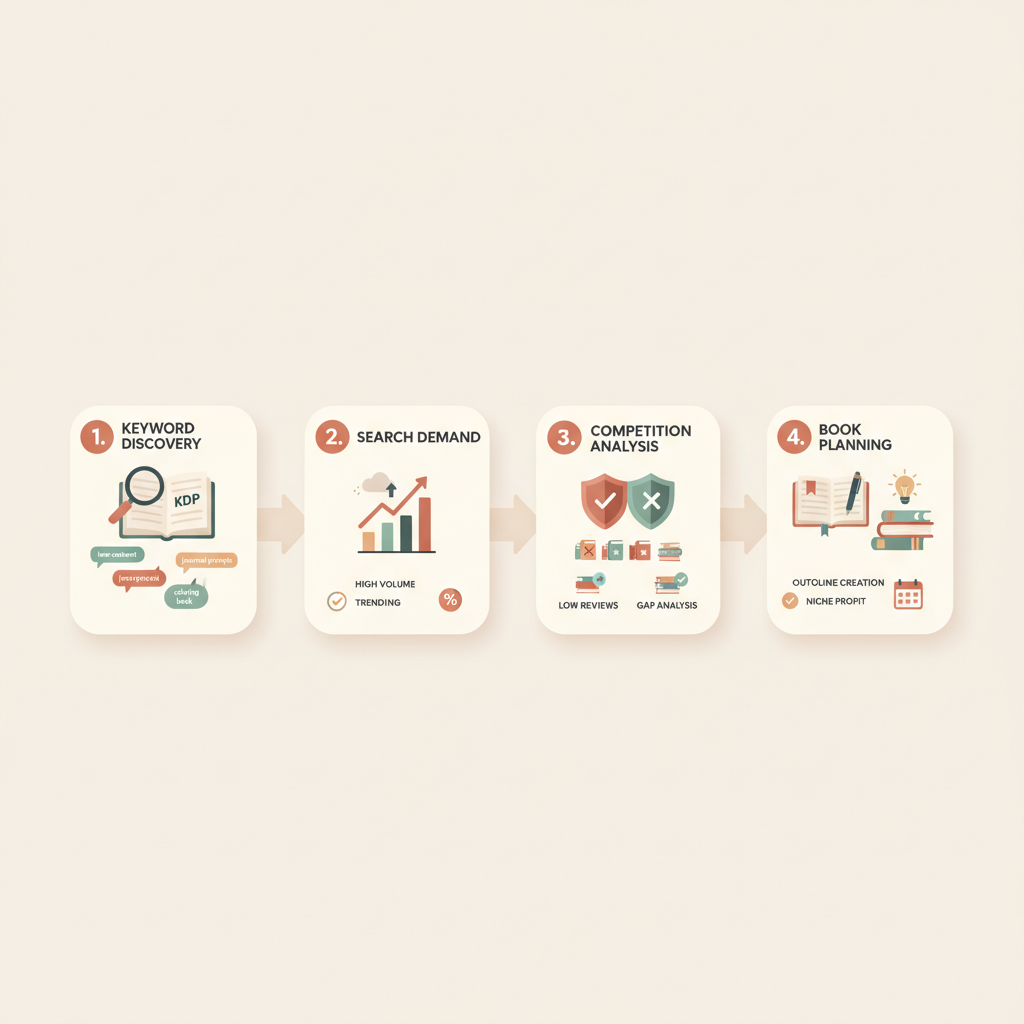
This section walks through a five-step process you can repeat for any non-fiction idea: seed, expand, validate, analyze competitors, and convert to book structure. Each step includes a short example so you can see how decisions look in practice.
Step 1 — Seed ideas from problems and questions
Start with real-world problems you can solve. Sources include reader questions on forums, Amazon reviews, and social threads. These raw problems are the best seeds for books.
- Reader questions from forums (Reddit, Quora)
- Amazon reviews (what readers complain about or wish they had)
- Social media threads and niche newsletters
Example seed: A parent asks how to manage screen time for kids under eight.
Step 2 — Expand into keyword ideas
Turn the seed into keyword phrases people search. Look for long-tail phrases that show clear intent and can map to chapter content.
- “screen time rules for toddlers”
- “screen time schedule for preschool”
- “reduce screen time for kids routine”
These phrases show intent: readers want rules, schedules, or routines.
Step 3 — Validate demand and difficulty
Three quick checks help you filter ideas: search volume, competition, and content gaps. Use these to decide if a book is worth writing.
- Search volume: enough steady searches to justify a book.
- Competition: dominated by big publishers or open to self-published titles?
- Content gaps: do existing books miss practical templates, checklists, or printables?
Example validation: Moderate search volume for “screen time schedule for preschool.” Top results mix blog posts and short self-published ebooks, with reviews asking for printable routines—an opening.
Step 4 — Competitor analysis (look beyond the cover)
Open the top 10 Amazon results for your target phrase and record details beyond the thumbnail: language, length, format, TOC, review themes, and price.
- Title/subtitle language and common words used by top sellers.
- Book length and format (ebook, paperback, workbook).
- Table of contents (where visible) and review complaints.
Example findings: top books use words like manage, limit, and schedule. Few mention “printable.” Average length is 8,000–15,000 words; reviews ask for quick daily templates and a one-week starter plan.
Step 5 — Plan a book that fits the demand
Design a product that fills the gap you identified. Decide the format, length, and extras that match reader expectations.
- Format: short guide, workbook, or checklist-based book
- Length: short action guides typically 8–15k words
- Extras: printable schedules, fillable pages, or companion templates
Example plan: Title: “7-Day Screen Time Starter Plan for Parents”; Format: short guide + 10 printable templates; Word target: 10,000–12,000 words with a simple workbook section.
Turning a validated niche into a working outline
A validated niche becomes a clear outline that maps intent to content. Each chapter should satisfy a keyword or problem discovered during research.
- Introduction: why this plan works and how to use the book
- Day-by-day plan: one chapter per day with goals, scripts, and templates
- Troubleshooting: common issues and quick fixes
- Resources: printable templates and a short FAQ
When the outline is tight, tools that convert outlines into formatted manuscripts save significant time and reduce formatting errors.
Tools, metrics, and turning niches into books
What metrics matter—and how to read them
Key metrics include search volume (prefer steady over spike), keyword competitiveness, review sentiment, and sales rank bands. Read these together to judge opportunity and expected sales cadence.
Tip: Use review themes to shape your unique promise and differentiate your product.
Practical examples of tool output
Research tools often return keyword ideas, title suggestions, and category recommendations. Treat these as starting points and always verify top results on Amazon manually.
A useful practice is exporting keywords and mapping each phrase to a chapter idea so every search intent is satisfied by a section in the book.
From keywords to a publishable file
Once the outline is set, move quickly to a formatted manuscript. Manual formatting and conversion introduce errors and slow you down.
For store-ready files you want outputs that include keyword-rich title and subtitle, a properly formatted EPUB with embedded cover and metadata, and a print-ready PDF when needed. A reliable EPUB converter removes manual cleanup and speeds uploads.
If you plan to distribute beyond Amazon, choose tools that handle multiple marketplaces and the upload process cleanly; consider specialized uploading tools for retailer-specific requirements.
Scaling, formatting, covers, and publishing
From single book to series
After validating one profitable niche, create adjacent titles for related problems, different audiences, or companion workbooks. Reuse templates, chapter frameworks, and cover patterns to scale efficiently.
Cover and format best practices
A cover must communicate genre and promise at thumbnail size—readable typography, clear hierarchy, and a background that signals the subject are essential.
If you need a reliable cover that reads well at thumbnail sizes, a market-trained cover generator produces designs tuned to retail patterns rather than generic art outputs.
EPUB and file conversion
Many self-publishers struggle with broken EPUBs or misplaced metadata. A proper converter embeds the front cover, structures chapters, and attaches metadata so files upload cleanly to KDP, Kobo, and Apple Books.
Using a tested conversion tool reduces rejections and speeds publishing.
Publishing formats and distribution
Decide early whether the niche needs a workbook (print paperback) or only an ebook. If you plan both, confirm the toolchain supports multiple outputs without layout issues.
Some platforms and services can generate full non-fiction books and prepare them for multiple marketplaces; evaluate them against your multi-format needs on the product pages such as the vendor site.
Humanization and compliance
KDP accepts AI-assisted books when publishers follow platform guidelines and disclose AI usage where required. Add an editorial pass to adjust tone, add examples, and tighten language to reduce refund risk.
Practical publishing checklist (short)
- Confirm title and subtitle contain the strongest keyword(s).
- Apply categories and backend keywords that match your research.
- Use a cover that signals the niche and reads at thumbnail.
- Run the EPUB through a converter that embeds metadata and structures chapters.
- Add a short author bio that establishes credibility.
- Create a simple launch plan: soft promotions, targeted communities, and optional paid ads.
Final thoughts
Niche research for Amazon KDP is a repeatable practice: identify a specific reader problem, validate demand and competition, analyze existing titles, and produce a focused product that fills the gap.
Tools that output KDP-ready files, market-trained covers, and clean EPUBs remove friction and let you publish more consistently. Write like a human and publish like an author.
If you want to test a demo or explore generation tools, visit BookAutoAI and try the demo to see how formatted outputs and covers are produced.
FAQ
How long should a niche-focused non-fiction book be?
Match reader expectations. Many practical guides and workbooks sell well between 8,000 and 20,000 words—the goal is solving a specific problem clearly, not padding the content.
How many keywords should I target in a single book?
Pick one primary keyword phrase for the title/subtitle and 4–6 secondary phrases for the description and backend keywords. Each chapter can target related long-tail phrases.
Can I use AI-generated content on KDP?
KDP accepts AI-assisted books when publishers follow content guidelines and disclose AI usage where required. Always perform an editorial pass for clarity and factual accuracy.
Should I create a workbook or a standard guide?
Build what the reader needs. If research shows people want templates and daily tasks, a workbook is better; if they want strategies or case studies, a guide may be best.
What’s the fastest way from research to upload?
Use tools that convert validated outlines into formatted manuscripts and market-ready covers. Automating conversion and cover production cuts days from the process and reduces errors.
Sources
- https://www.bookautoai.com
- https://www.youtube.com/watch?v=4LkOBPL0ARQ
- https://kdp.amazon.com/help/topic/G200672390
- https://blog.bookautoai.com/ai-book-generator-kdp-authors-24/
- https://blog.bookautoai.com/ai-book-generator-kdp-review-81/
- https://blog.bookautoai.com/ai-book-generator-amazon-kdp-17/
- https://www.youtube.com/watch?v=rNPpvcGou_U
- https://www.youtube.com/watch?v=lVdwCjrf2PU
Niche Research Amazon KDP: A Step-by-Step Workflow with Real Examples Estimated reading time: 5 minutes Niche research on Amazon KDP combines measurable data (search demand, competition) with judgment about reader intent and format fit. A repeatable process—seed ideas, expand keywords, validate demand, analyze competitors, and plan the book—gets you from idea to publishable product quickly.…