
Best Selling Notebooks on Amazon KDP Which Product Types Win
Best selling notebooks on Amazon KDP: which product types win and where the profit lives
Estimated reading time: 9 minutes
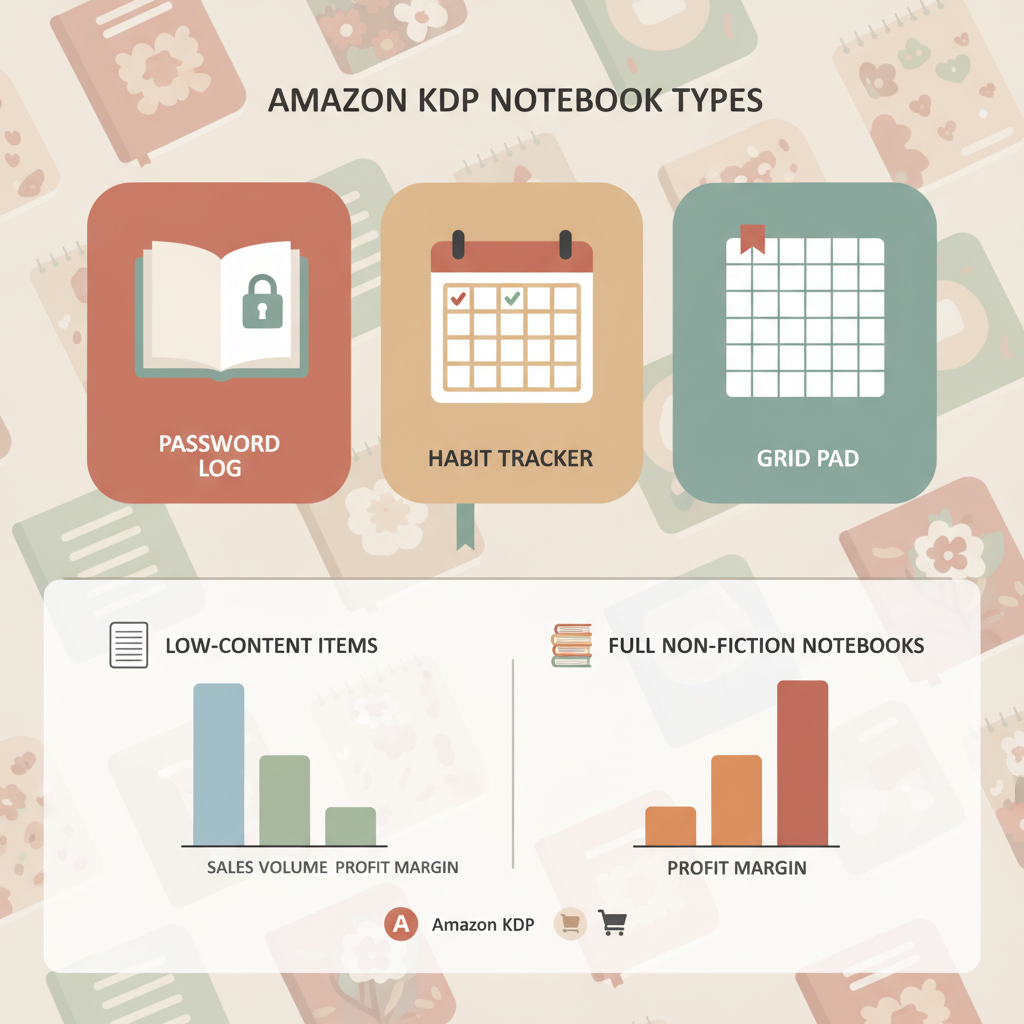
- Notebooks succeed when they solve focused, practical problems—password logs, habit trackers, and grid pads consistently perform.
- Low‑content items scale via volume and niche targeting; full non‑fiction yields higher per‑sale margins but requires more effort.
- Standard sizes, clear keywords, and prices under $9 are common traits of top sellers.
- For authors moving into longer books, Bookautoai and its tools speed production of covers and EPUBs while keeping files store-ready.
Table of Contents
- Product category map: which formats win (books, journals, notebooks, low-content)
- Why notebooks and low-content still win on KDP
- Profit profiles: price, royalties, and volume by product type
- Low-content notebooks
- Guided journals and specialty pads
- Workbooks and short how-to books
- Full non-fiction books
- Design, formatting, and publishing tools that matter
- Covers that sell
- Interior and EPUB quality
- Publishing process and platform readiness
- Scaling tips that work
- Quick note on low-content vs. full non-fiction
- Practical examples and what they teach
- Where BookAutoAI fits in your product map
- Final thoughts
- FAQ
- Sources
Product category map: which formats win (books, journals, notebooks, low-content)
Everyone asks the same practical question: should you build notebooks, guided journals, workbooks, or full‑length non‑fiction? The short map below helps you pick a route that fits your time, skills, and goals.
If you plan paid promotion for notebooks and books, start with the Amazon KDP Ads Guide to avoid common budget mistakes and learn how ads shift discoverability.
- Low‑content notebooks (blank, lined, grid): Fast to create. Sell by the thousands when you find a niche. Low per‑unit price, but high volume can compensate.
- Guided journals and workbooks (light content): Middle ground. Buyers pay more for structure and prompts—better price and reviews when the content helps a habit or task.
- Niche paper goods (planners, password organizers, specialty pads): Steady demand when the niche is practical (tax logs, bird‑watching notes).
- Full non‑fiction books: Highest per‑sale value and long‑term authority. More effort, but can be repurposed and bundled.
Why notebooks and low-content still win on KDP
Notebooks are the easiest product to test. You can launch dozens of designs in a month and find winners quickly.
1. Evergreen demand
People always need simple books: a place to write, a grid to draw, a pad to sketch ideas. That baseline keeps top sellers steady.
2. Narrow niches win
Password organizers, specialized drawing pads, and hobby notebooks find an audience fast because they solve a clear problem; search intent converts directly.
3. Price and impulse buys
Most top notebooks price between $3.99 and $8.99, comfortably in impulse‑buy territory when cover and description match expectations.
4. Simple production and listing
KDP handles print‑on‑demand, removing inventory risk. The main work is interior design, cover design, and keyword‑optimized descriptions.
5. Scaling by testing
A/B test covers, sizes (6×9 and 8.5×11 are reliable), and keywords. Small tweaks give fast feedback in search rankings and sales.
Notebooks require heavy volume to match a single well‑performing non‑fiction title, but they are ideal for fast experimentation.
Profit profiles: price, royalties, and volume by product type
Low-content notebooks
Typical price: $3.99–$8.99. Royalty: Expect $1–$3 after printing. Volume: High; top sellers often move hundreds monthly.
Time to launch is low—simple interiors, cover is the main piece. Risk is low per unit but competition is high.
Guided journals and specialty pads
Typical price: $6.99–$12.99. Royalties are higher due to perceived value. A solid guided journal can maintain steady sales for years.
Time to launch is moderate: you need prompts and layouts beyond blank pages, and content quality impacts reviews.
Workbooks and short how-to books
Typical price: $7.99–$14.99. These add value with worksheets and actionable steps, attracting customers who pay for outcomes.
Full non-fiction books
Typical price: $2.99–$19.99. Royalties are higher—especially for ebooks and Kindle Unlimited—and a strong niche book builds long‑term passive income.
Time to launch is highest: research, writing, editing, and formatting are required, but long‑term returns and authority are stronger.
Design, formatting, and publishing tools that matter
Discoverability and conversion depend on three elements: the cover, the interior formatting, and a store‑ready file.
Covers that sell
Covers are conversion tools, not art projects. The best covers look professional at thumbnail size, use clear typography, and match genre cues.
Many AI tools generate artwork, but successful covers need readable titles and proper visual hierarchy. Use a proven cover system—for example, the BookAutoAI Cover Generator is trained on top‑selling patterns and outputs market‑ready front covers optimized for thumbnails.
Interior and EPUB quality
A sloppy interior or broken EPUB can kill a listing. Converting a manuscript into a clean, store‑ready EPUB is technical and error‑prone.
Tools like the EPUB Converter remove friction by embedding covers, fixing chapter navigation, and building correct metadata; they help files preview and upload without platform errors. These same improvements simplify uploading books to retailers.
Publishing process and platform readiness
If you produce many notebooks and books, minimize manual fixes: generate the manuscript, produce a market‑ready cover, and create a bookstore file in one flow.
When you reach the ebook or paperback stage, consider tools that help you create a paperback or ebook with correct margins, embedded covers, and export formats that pass platform checks.
Scaling tips that work
- Size and spread: start with standard sizes (6×9 and 8.5×11) and expand if a niche needs a specific format.
- Keyword focus: pick one focused keyword phrase per listing; aim for niches with BSR under 400k when possible.
- Price to test: use a lower introductory price to collect reviews, then raise it once you have social proof.
- Interior value: small extras—tabs, lightly guided pages, useful templates—justify higher prices.
- Reviews and quality: fix interior and cover problems quickly to reduce negative reviews.
Quick note on low-content vs. full non-fiction
Low‑content notebooks are best for speed and scale. Full non‑fiction is best for higher revenue per unit and long‑term discoverability. Many publishers run both: notebooks for cash flow, books for brand and margin.
Practical examples and what they teach
- Password organizers: solve a repeatable problem and are easy to find with matching keywords; pricing often $5–$6.
- Drawing pads and specialty grids: sell to hobbyists who value the right layout; a clear title and interior preview convert browsers.
- Guided self‑care journals: can command $9–$12 when prompts are structured and outcomes are clear.
Where BookAutoAI fits in your product map
If you are serious about scaling beyond noise, Bookautoai is positioned as a non‑fiction AI book generator and a system for producing complete books fast.
It supports up to 25,000 words per book, humanized writing, market‑ready formatting, and built‑in EPUB conversion and cover generation so you can move from idea to publishable file more quickly.
Use notebooks and guided journals to test niches and quick‑launch products, and lean on those tools when you are ready to develop full non‑fiction that builds authority.
Final thoughts
Notebooks and low‑content products are a low‑barrier way to enter KDP. They reward speed, narrow niches, and clean presentation. Combine fast low‑content tests with one or two high‑quality non‑fiction books to balance cash flow and long‑term authority.
Visit Bookautoai.com and try our Demo book.
FAQ
Are notebooks still profitable in 2026?
Yes. Notebooks remain profitable when you target a narrow niche, use standard sizes, and price for impulse buys under $9. The steady demand for practical notebooks keeps margins small but consistent.
Should I start with low-content or full non-fiction?
It depends on goals. For fast launches and testing, start with low‑content notebooks and guided journals. For higher per‑sale revenue and long‑term authority, invest in full non‑fiction; many sellers do both.
How important is cover design for notebooks?
Extremely important. A clean, readable cover that works at thumbnail size changes click‑through rates. Covers should match buyer expectations for the niche; professional generators help speed the process.
Do I need technical skills to publish?
Not necessarily. Print‑on‑demand removes inventory work. The main technical tasks are creating a clean interior and a bookstore‑ready EPUB or file; converters and cover tools reduce technical steps.
How do I price notebooks to maximize profit?
Start with competitive pricing in the $3.99–$8.99 range. If you add guided content or perceived value, test $7.99–$12.99 and watch conversion and reviews before increasing price.
Sources
- Top 10 Notebooks On Amazon KDP: Best Practices And Seller To-Do’s — BookBolt
- 28 Profitable Notebooks + Workbooks KDP Keywords — YouTube
- Amazon Top Seller Journals: Discover 2025’s Bestselling Notebooks — Accio
- How To Design And Sell Notebooks On Amazon In 2026 — Activejobs
Best selling notebooks on Amazon KDP: which product types win and where the profit lives Estimated reading time: 9 minutes Notebooks succeed when they solve focused, practical problems—password logs, habit trackers, and grid pads consistently perform. Low‑content items scale via volume and niche targeting; full non‑fiction yields higher per‑sale margins but requires more effort. Standard…