
Top Selling Products on Amazon KDP Explained and Categorized
Top selling products on Amazon KDP: a category strategy guide
Estimated reading time: 6 minutes
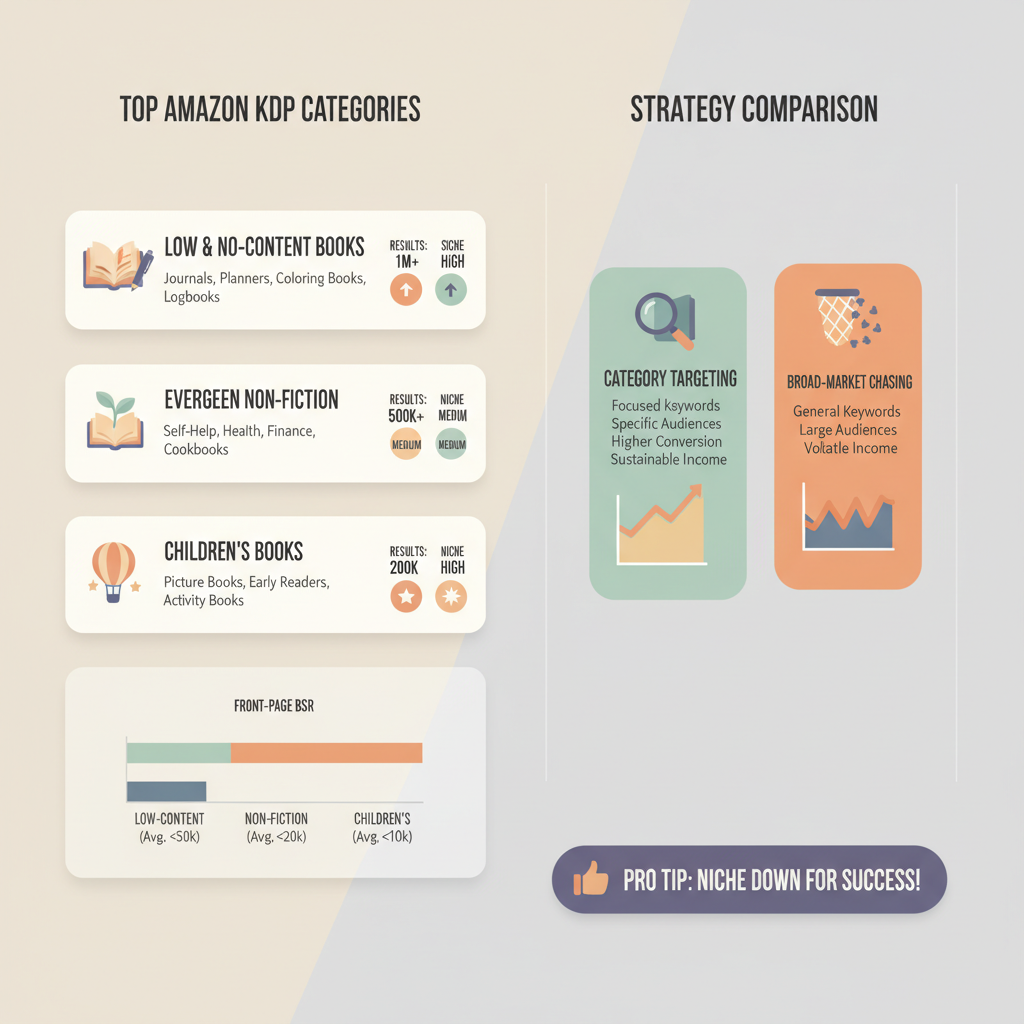
- The most consistent top sellers on KDP are low- and no-content books plus evergreen non-fiction niches; category targeting beats broad-market chasing.
- Use measurable signals—results count, niche score, and front-page BSR—to find demand with manageable competition.
- Category choice, accurate metadata, and a thumbnail-ready cover plus a clean EPUB determine discovery and conversions.
- BookAutoAI streamlines production with a cover generator and EPUB converter so titles are store-ready faster.
- Top selling products on Amazon KDP: categories that drive sales
- Low-content leaders
- Non-fiction niches that scale
- Why these categories sell
- How to choose categories and product types for Amazon KDP
- Start with reader intent
- Practical selection rules
- Category granularity
- Cover, formatting, and upload
- Measuring demand: BSR, results, and niche signals
- Key metrics
- A practical screening process
- Tools, pricing, and expectations
- Operational checklist
- Final thoughts and next steps
- Practical next steps
- FAQ
- Sources
Top selling products on Amazon KDP: categories that drive sales
When authors ask which top selling products on Amazon KDP they should focus on, the short answer is: start where readers search and platforms reward visibility. In 2026 the marketplace still favors a mix of low-content steady sellers and focused non-fiction that solves a clear problem or meets a specific desire.
Low-content leaders
- Coloring books: children’s themes, Bible verse coloring, seasonal holiday editions, and toddler basics remain huge because they’re highly discoverable and sell year-round with seasonal bursts.
- Puzzle and activity books: word searches, crosswords, fill-in puzzles, and color-by-number pixel books sell consistently; these often have low competition per niche and repeat buyers.
- Journals and planners: guided journals (gratitude, habit trackers), niche-specific planners (fitness, small business), and blank notebooks aimed at particular audiences maintain steady demand.
Non-fiction niches that scale
- Religious and spiritual: devotional workbooks, prayer journals, and niche spiritual guides (e.g., pagan holidays, tantric yoga primers) convert well because they serve devoted audiences.
- Cookbooks and diet guides: focused recipe collections (air fryer Mediterranean, keto for beginners, plant-based crockpot) perform when matched to trending diets or lifestyles.
- Self-help and personal development: short, practical manuals on habits, productivity, and mental wellness that are actionable and well-formatted.
- Hobby and how-to guides: targeted manuals on vehicle maintenance, language phrasebooks, or craft-specific instruction sets.
Why these categories sell
- Repeatability: Low-content formats are easy to replicate and adapt to seasonal topics.
- Search intent alignment: Many buyers land on KDP pages with clear intent—gift, activity, or problem solving—which increases conversion.
- Thumbnail effectiveness: Covers that read clearly at thumbnail size and match category expectations get clicks; design for sale, not just image quality.
If you want to pair paid traffic with organic visibility later, check the Amazon KDP ads playbook early; for practical steps on running campaigns alongside category strategies, see the Amazon Kdp Ads Guide to align targeting with category choice.
How to choose categories and product types for Amazon KDP
Picking a category is an operational decision with measurable impact on ranking and discoverability. Think of categories as the highways that lead buyer traffic to your listing; the better the fit, the higher the chance your product shows up for the right search.
Start with reader intent
Ask: what problem does this book solve? Who will buy it and why?
- Coloring book = activity, gift, kids’ education.
- Cookbook = utility, diet help, recipe discovery.
- Devotional journal = ongoing daily use and community.
Match the category to intent—don’t force a book into a broad or trendy category if it doesn’t serve the buyer’s expectation. Accurate categories build sustained impression share; mismatched categories frustrate buyers and reduce conversions.
Practical selection rules
- Niche size: Look for niches with a favorable balance of demand and competition. In 2026, niches under 2,000 results with strong niche scores (7–9) often offer useful openings.
- Front-page BSR: If front-page results have BSRs under ~300,000, that signals real sales potential; lower BSRs (10k–80k) often mean daily sales.
- Visual expectations: Browse the category and note cover, title, and subtitle patterns; design to match those signals at thumbnail size.
- Format and length: For non-fiction, aim for clear structure and usable content; for low-content, prioritize internal layout and repeatability.
Category granularity matters
Amazon allows primary and secondary categories (and sometimes BISAC selections). Use specific categories when available: a cookbook optimized into “Diet & Lifestyle” subcategories or a coloring book with an age-specific tag competes in a narrower pool and reaches the right buyers.
Cover, formatting, and upload
Once you pick a category, your book must look and read like a professional product in that space. That includes a market-ready cover that works at thumbnail size and clean, platform-ready file formats. For professional covers that are designed to sell, the BookAutoAI cover generator produces export-ready front covers with readable title typography and genre-appropriate visual hierarchy.
When you’re ready to turn a manuscript into a properly structured EPUB for Kindle and other stores, use the EPUB Converter to create a clean file that passes platform checks and previews correctly. If you plan to offer both a Kindle file and a paperback, the BookAutoAI platform helps generate both ebook and print-ready files.
If you need tools that help with uploading to retailers or managing distribution, consider dedicated book uploading tools to reduce format errors and improve store acceptance.
Create to the platform
- Kindle (KDP) wants correct metadata, a clean EPUB interior, and a cover that reads at small sizes.
- Print-on-demand requires consistent margins and spine-safe artwork.
Processes that ignore these checks cause friction and delays; a tool that builds covers and EPUBs to store specs reduces rejections and saves time.
Measuring demand: BSR, results, and niche signals
Good category decisions are data-driven. You don’t need expensive subscriptions to apply basic metrics—track a few consistent signals and develop a repeatable screening process.
Key metrics and what they mean
- Results count: The number of active listings in a niche; a lower count often means less competition, but very low counts can indicate little demand.
- Niche score / opportunity score: Tools like Book Bolt or Publisher Rocket produce composite scores; look for high opportunity with low-to-moderate competition.
- Best Sellers Rank (BSR): Front-page BSRs under 300,000 usually mean consistent sales; use a BSR-to-sales calculator to estimate daily velocity.
- Front-page consistency: Check top listings for recent publication dates and steady review accumulation; old listings with stable sales show long-term potential.
A practical screening process
- Pick a candidate niche (e.g., “Bible verse coloring books for kids”).
- Search the category and note the results count—aim for subniches under ~2,000 when possible.
- Inspect the front page: note BSRs, price range, cover quality, and review counts.
- Identify gaps: are listings generic? Are covers poor at thumbnail size? Can you improve title/subtitle to capture searches?
- Validate with a sample product: publish a single, well-produced title and monitor sales for 4–8 weeks. Iterate based on traction.
Tools like Publisher Rocket and Book Bolt speed the process by showing keyword volume and competition, but manual validation of front-page BSRs and cover quality remains essential.
Tools, pricing, and expectations
- Low-content books often have lower price points but benefit from volume.
- Specialist non-fiction can command higher prices but requires better content and marketing.
- Don’t expect overnight results; most KDP titles need weeks of exposure and incremental optimization.
Operational checklist (short)
- Choose a specific category that matches reader intent.
- Match cover and title to category norms.
- Proof and format interior files; create a clean EPUB for Kindle and a PDF for print.
- Monitor BSRs and rankings for 4–8 weeks and iterate.
Write like a human, publish like an author. When you need to scale production without sacrificing store readiness, the BookAutoAI tools described above speed generation of market-ready non-fiction and low-content books.
Final thoughts and next steps
Category selection is one of the highest-leverage decisions you’ll make for a KDP title. Start with reader intent, screen using results count and BSR, and match design and formatting to category expectations to reduce wasted time and increase relevance.
Practical next steps
- Run a simple screen: pick three candidate niches, check results counts and front-page BSRs, and choose the one with clear demand and room for better presentation.
- Produce a single, high-quality listing that matches category norms: readable thumbnail cover, concise subtitle, correct categories, and a clean EPUB or print-ready interior.
- Monitor and iterate: small changes to subtitle, category, or cover often move a product from obscurity to visibility.
If you want to streamline production while matching store expectations, the BookAutoAI platform generates complete non-fiction books up to 25,000 words, humanizes writing to pass detector checks, and includes both an EPUB converter and a cover generator so your title is ready to upload quickly.
FAQ
Q: What counts as a “top selling product” on Amazon KDP?
A: A top selling product typically shows consistent daily sales, reflected by front-page BSRs under roughly 300,000. True top sellers have much lower BSRs (e.g., 10k–80k) and show predictable sales velocity.
Q: How specific should my category be?
A: Specific enough to reach the right buyer without shrinking demand to zero. Aim for subniches under about 2,000 results where possible, and validate with BSR and front-page quality.
Q: How important is cover design for ranking?
A: Very important. Covers that match genre conventions and read clearly at thumbnail size get more clicks, which helps organic visibility. A good cover communicates the book’s value at a glance.
Q: Do I need both EPUB and print files?
A: If you plan to sell on Kindle and as a paperback, yes. Each format has different technical requirements; a clean EPUB helps Kindle display and previews correctly, while print files need margin and spine considerations.
Q: How fast can I test a new niche?
A: With a focused approach you can go from idea to live listing in days, but allow 4–8 weeks of live data to judge performance meaningfully.
Sources
- https://www.youtube.com/watch?v=N1XoEfngEzA
- https://livingwriter.com/blog/most-profitable-amazon-kdp-niches-top-10/
- https://kindlepreneur.com/amazon-kdp-sales-rank-calculator/
- https://www.youtube.com/watch?v=aTfD2jXYiVo
- https://www.youtube.com/watch?v=dl2-gwTZTdw
Top selling products on Amazon KDP: a category strategy guide Estimated reading time: 6 minutes The most consistent top sellers on KDP are low- and no-content books plus evergreen non-fiction niches; category targeting beats broad-market chasing. Use measurable signals—results count, niche score, and front-page BSR—to find demand with manageable competition. Category choice, accurate metadata, and…