
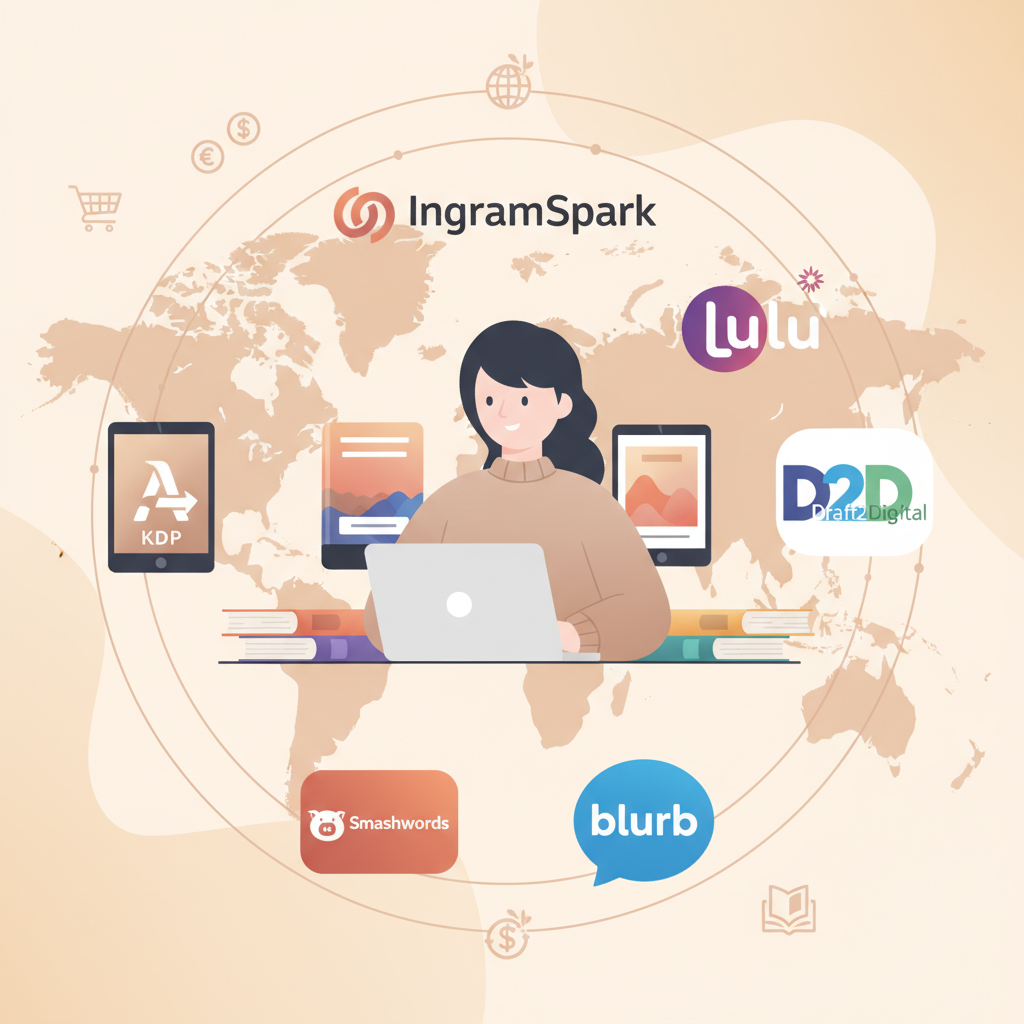
Other Sites Like Amazon KDP Explained for Indie Authors
Other Sites Like Amazon KDP: Best Options for Print, Ebook, and Direct Sales
Estimated reading time: 6 minutes
- Authors use alternatives to Amazon KDP to reach different markets, avoid exclusivity, or get better print and royalty options.
- Aggregators, direct retailers, and print specialists each solve different publishing needs—choose based on distribution and quality goals.
- Tools that produce upload-ready files, covers, and clean EPUBs speed multi-store publishing and reduce rework.
Why authors look beyond Amazon KDP
Amazon is large and familiar, but it isn’t the only route to readers. Authors consider other sites when they want broader distribution, differing royalty models, better print options, or full non-exclusive control.
Some writers prioritize reaching readers in Canada, Europe, or niche storefronts; others prefer a print vendor that offers higher paper quality or better bookstore access. If you want a clear breakdown of options and how retailers and aggregators differ, the Amazon Kdp Alternatives Guide is a practical resource to read early in your planning.
Common reasons to explore alternatives include:
- Distribution reach beyond Amazon’s ecosystem.
- Print quality and bookstore placement through specialist vendors.
- Different royalty and pricing flexibility.
- Non-exclusivity to retain full control.
- Simplicity through aggregators that reduce repetitive tasks.
Top alternatives for ebooks, print, and direct sales
Aggregators and wide distribution
Draft2Digital converts manuscripts, distributes to many ebookstores, and handles payments and reporting—useful when you want multi-platform reach without learning each retail nuance.
A legacy option like Smashwords still reaches some smaller retailers and library channels, though its conversion tools are older. Aggregators save time by avoiding repeated file prep for every store.
Direct retailers and regional strengths
Kobo Writing Life is strong in Canada and parts of Europe and often runs promotions that reach readers outside Amazon.
Apple Books attracts engaged iOS readers, while Barnes & Noble Press helps authors who want a U.S. bookstore presence. Google Play Books adds global reach and non-Amazon audiences.
Print-first options and bookstore distribution
IngramSpark is the go-to when bookstore and library access matter—its global distribution network helps titles reach brick-and-mortar shelves.
Lulu offers flexible print-on-demand options and specialty formats for authors who need custom paper or trim sizes.
Direct-sales and author storefronts
Platforms like Gumroad, Payhip, and Sellfy let authors sell ebooks directly to readers, own customer relationships, and manage email collection and bundles.
For serialized nonfiction or memberships, Substack and Memberful combine content distribution with subscription revenue.
Libraries and education channels
Library distribution often uses specialists like OverDrive or Bibliotheca via aggregators; these channels simplify getting titles into library catalogs and educational systems.
How to choose the right platform and a practical approach
Match platform strengths to your goals
Answer three questions: Who buys your book and where? Do you need bookstore or library access? Do you want to sell directly to readers or favor convenience?
If global ebook reach is the priority, an aggregator helps. If print quality and retail access are essential, prioritize IngramSpark. You can combine approaches—use KDP for Amazon, IngramSpark for wide print, and an aggregator for other retailers.
File preparation and avoiding rework
Formatting is the slow part of multi-store publishing. Each store has EPUB rules, cover thumbnail needs, and metadata fields. Reduce duplication by creating a single clean manuscript source, exporting a validated EPUB, and generating a cover that reads at thumbnail size.
When you discuss uploading or bulk publishing tools, consider how an upload specialist can simplify the process—many authors use dedicated book upload tools to handle retailer quirks and batch submissions, especially for print files. For upload tooling options, research third-party services that focus on book uploads and distribution like book upload tools.
If you need a practical uploader for complex submissions, tools such as book upload tools can help with retailer-specific requirements.
Design and covers that sell
A cover is a marketing asset: title hierarchy, color, and imagery must signal genre and be readable at thumbnail size. Many generic AI image tools produce images but not finished covers optimized for sales.
For cover production, use a dedicated cover generator to get market-ready front covers with readable typography and proper hierarchy; Bookautoai’s cover solution handles these needs directly via its cover generator.
You can learn more about the cover tool on the Bookautoai cover generator page: cover generator.
Sample workflows for common goals
Maximum reach: Draft, generate a market-ready cover, export EPUB and print files, then upload to KDP + IngramSpark + an aggregator.
Direct sales + Amazon presence: Publish to KDP for Amazon, sell directly via an author storefront, and use a validated EPUB for both retail and direct platforms.
Library and bookstore focus: Format print-ready files for IngramSpark and enroll in library channels through Ingram or a library aggregator.
Practical tips that save time
- Test one platform fully before scaling to others.
- Maintain a master metadata file for consistent titles, subtitles, and blurbs.
- Decide on ISBN strategy: your own ISBNs for control or platform ISBNs for simplicity.
- Batch creative tasks—produce covers in one session, then format ebooks, then upload.
BookAutoAI and multi-platform publishing
For nonfiction authors who want speed and reliable, upload-ready files, BookAutoAI streamlines writing, cover creation, and EPUB conversion. It generates humanized manuscripts, formats them, and reduces the steps that usually cause rework.
Bookautoai also produces ready-to-upload paperback and ebook files that simplify publishing to KDP, IngramSpark, and aggregators, and it includes an EPUB converter to produce store-compliant files.
See the EPUB conversion page for details: EPUB converter.
Key built-in conveniences
- One-click EPUB conversion that embeds metadata and structures chapters so files preview correctly.
- Automated cover tool that produces readable front covers suitable for thumbnails and print.
- Ready-to-upload paperback and ebook files so you can publish without repeated manual fixes; find publishing tools at Bookautoai.
When to use a second vendor
Use IngramSpark or Lulu for unique trim sizes or paper stocks that generic converters don’t support. Work directly with retailers for specific promotional placements, and choose library-focused aggregators when library distribution needs exceed standard channels.
Wrap-up
Going beyond Amazon need not be complicated. Match platform strengths to your audience, use aggregators to reduce duplication, rely on print specialists for bookstore-quality options, and use tools that remove repetitive file-fixing tasks.
For nonfiction authors who want speed and consistency, consider Bookautoai as part of a multi-channel publishing approach; the platform ties manuscript creation, cover production, and EPUB conversion into a single process.
FAQ
Can I use multiple platforms at the same time?
Yes. Many authors publish to KDP and distribute wide via an aggregator or directly to Kobo, Apple Books, and Barnes & Noble. Plan metadata and pricing so editions stay consistent.
Do I need separate EPUBs for each store?
Not usually. A single, well-formed EPUB is accepted by most retailers; the challenge is producing a clean EPUB that meets preview and metadata expectations.
How does print distribution differ between KDP and IngramSpark?
KDP is Amazon-focused and convenient for direct-to-consumer print-on-demand. IngramSpark offers wider bookstore and library distribution and more print options for bookstore-ready copies.
If I use an aggregator, can I still publish directly to Amazon?
Yes. Most aggregators let you exclude Amazon or opt out of exclusivity. Authors commonly publish to KDP for Amazon and use an aggregator for other retailers.
What’s the simplest setup for a first-time nonfiction author?
Finish the manuscript, create a cover that reads at thumbnail size, and generate a clean EPUB. Many authors choose KDP plus one aggregator or KDP plus direct distribution to Kobo and Apple Books.
Sources
- https://miblart.com/blog/amazon-kdp-alternatives/
- https://reedsy.com/blog/best-self-publishing-companies/
- https://www.youtube.com/watch?v=3yA__tru3mo
- https://kindlepreneur.com/best-self-publishing-companies/
- https://www.launchmybook.com/the-most-popular-self-publishing-platforms-pros-cons/
- https://www.savethestudent.org/make-money/best-ebook-publishing-companies.html
Other Sites Like Amazon KDP: Best Options for Print, Ebook, and Direct Sales Estimated reading time: 6 minutes Authors use alternatives to Amazon KDP to reach different markets, avoid exclusivity, or get better print and royalty options. Aggregators, direct retailers, and print specialists each solve different publishing needs—choose based on distribution and quality goals. Tools…