
Who Are KDP Competitors and Where to Publish Instead
Who Are KDP Competitors: A Practical Map for Self-Publishing Authors
Estimated reading time: 8 minutes
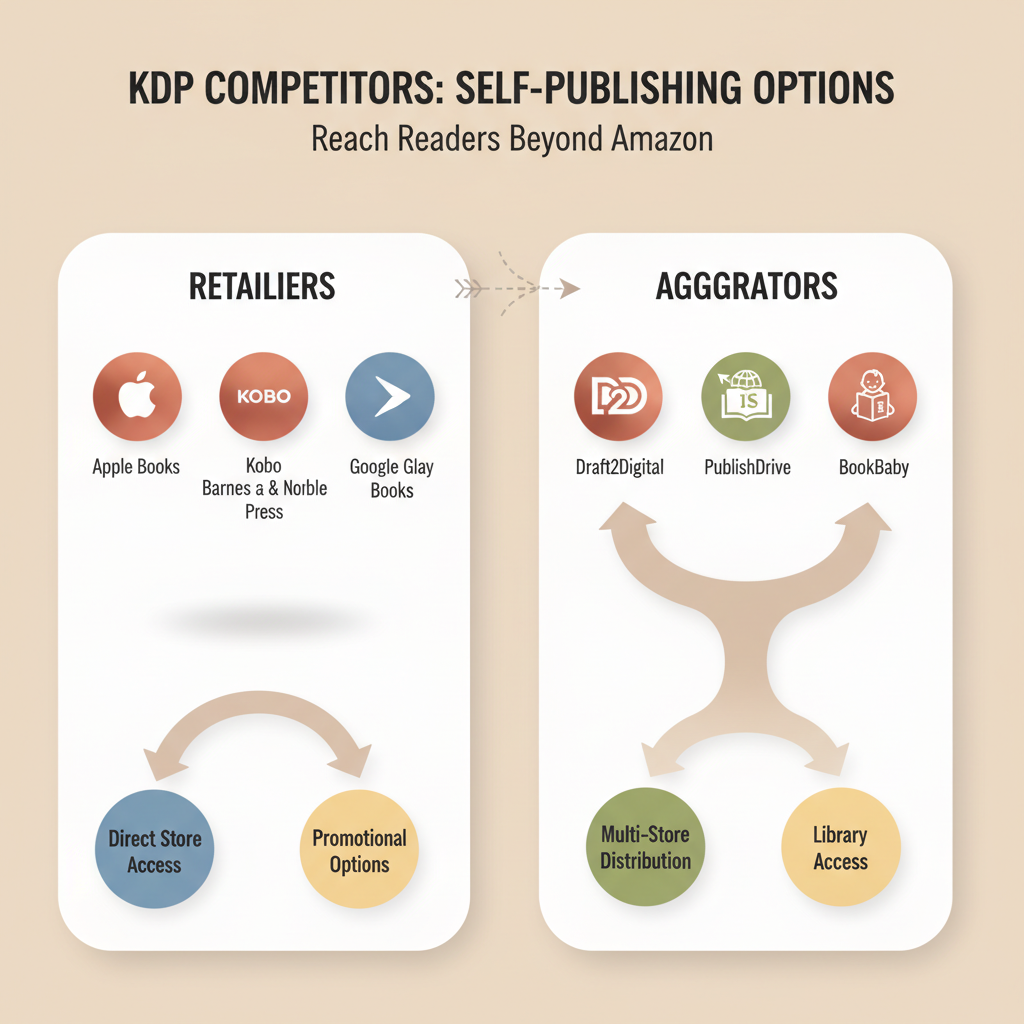
- KDP alternatives split into retailers (Apple, Kobo, B&N, Google Play) and aggregators (Draft2Digital, PublishDrive, IngramSpark, BookBaby); choose by audience and format needs.
- Retailers give direct store access and promotional options; aggregators simplify multi-store distribution and library/wholesale reach.
- For fast, polished nonfiction production with reliable EPUBs and covers, automation tools like BookAutoAI can reduce formatting risk and speed publishing.
Table of Contents
- Retailer alternatives (Apple, Kobo, B&N, Google Play)
- Aggregators and print distribution (Draft2Digital, PublishDrive, IngramSpark, BookBaby)
- Draft2Digital
- PublishDrive
- IngramSpark
- BookBaby
- Smashwords
- Choosing between aggregators and retailers
- How to choose: goals, rights, and royalties
- Define your sales goals
- Check rights and exclusivity
- Read the fine print on royalties
- Cover design and formatting matter
- Technical readiness
- BookAutoAI and your publishing workflow
- Why automation matters for non-fiction authors
- Cover generation that sells
- EPUB conversion built for stores
- One workflow, many stores
- Rights, metadata, and quality control
- Practical example
- Final thoughts
- FAQ
- Sources
Retailer alternatives (Apple, Kobo, B&N, Google Play)
Apple Books — great for loyal Apple users
Apple Books reaches readers on iPhone, iPad, and Mac. For nonfiction about tech, productivity, or Apple-focused topics, this channel can perform well.
Apple’s store often promotes well-formatted books and gives authors access to a global audience of Apple device owners. Royalty rates and promotional tools differ from Amazon, but Apple is known for strong discoverability among its users.
Kobo — strong in Canada and international niches
Kobo Writing Life holds meaningful share in Canada and several non-U.S. markets. Kobo partners with local retailers and libraries, making it useful for international reach outside Amazon’s U.S.-heavy share.
Kobo’s store favors clear metadata and good covers, and it can be a powerful standalone channel for certain nonfiction niches.
Barnes & Noble Press — U.S. print and ebook focus
Barnes & Noble Press is a direct option for authors who want to serve U.S. readers and physical bookstore customers. Its print-on-demand and in-store opportunities set it apart from digital-only retailers.
If you care about B&N shelf placement or print quality for paperback runs, this is a sensible direct competitor to KDP’s print services.
Google Play Books — Android reach and search indexability
Google Play Books sits inside the Android ecosystem and benefits from Google search integration. For nonfiction that answers frequently searched questions, Play Books can integrate with the wider Google content ecosystem.
Its pricing model and royalties have shifted over time, so expect differences from Amazon’s fixed royalty tiers.
How to think about retailer choices
- Audience fit: Pick retailers where your readers live (Apple users, Kobo readers, U.S. paperback buyers).
- Format needs: Some retailers prioritize polished EPUB files; others accept MOBI or proprietary formats.
- Promotion: Retailers have different promo tools—price promos, feature placements, or newsletter inclusion.
- Royalties and pricing: Royalty structures vary; calculate net returns by market, not just headline percentages.
If you want an easy side-by-side view of direct retailer pros and cons, a practical starting point is the Amazon KDP Alternatives Guide published on our blog — it helps you decide when to publish direct or use an aggregator.
Aggregators and print distribution (Draft2Digital, PublishDrive, IngramSpark, BookBaby)
Aggregators simplify distribution by pushing your book to many stores, libraries, and retail channels at once. They usually act as a single point of upload and save time for authors who prefer fewer repeated uploads.
Draft2Digital — clean, author-friendly distribution
Draft2Digital is known for an easy dashboard, solid reporting, and reliable deliveries to many stores. It handles basic conversion and metadata, making it popular with authors who want a “set it and forget it” approach.
Draft2Digital also offers library distribution through partners, which can expand long-term visibility.
PublishDrive — subscription model and wide storefront reach
PublishDrive uses a subscription pricing model that can increase effective royalties for authors with many titles. It reaches a wide range of stores worldwide and provides marketing tools aimed at scaling authors.
For broad reach over a single storefront, PublishDrive is a strong aggregator option.
IngramSpark — wide print and bookstore distribution
If your priority is serious print distribution—getting paperbacks into independent bookstores, library catalogs, or wholesale channels—IngramSpark is the industry standard.
Ingram connects to brick-and-mortar stores and library systems and supports high-quality print options that matter for nonfiction with images, charts, or specific trim sizes.
BookBaby — full-service and hybrid retailer/aggregator
BookBaby blends aggregator services with optional full-service help (formatting, editing, marketing). It’s a good fit if you want a mix of DIY and done-for-you services.
BookBaby also acts as a retailer and handles distribution broadly, with add-on services some authors value.
Smashwords — older aggregator model still useful for some stores
Smashwords was an early aggregator and still distributes to several stores and libraries. While its interface is less modern, it remains viable for certain distribution goals.
Choosing between aggregators and retailers
- Use aggregators for broad distribution with one upload, or to reach libraries and wholesale channels.
- Use direct retailers when you want retailer-specific promotions or tighter pricing control.
- Consider print needs: for in-store print and library placement, IngramSpark is often necessary.
How to choose: goals, rights, and royalties
Choosing who to work with depends on clear goals. Here’s a practical checklist to decide between KDP, direct retailers, and aggregators.
1. Define your sales goals
- Build long-term library and bookstore presence? Favor IngramSpark and BookBaby.
- Maximize short-term ebook sales with device-specific users? Consider Apple Books or Google Play.
- Want broad, passive distribution with less hands-on work? Pick an aggregator like Draft2Digital or PublishDrive.
2. Check rights and exclusivity
KDP Select requires Amazon exclusivity for most ebook promotions. If you enroll, you limit distribution elsewhere. Many retailers and aggregators do not require exclusivity—decide if Amazon’s promotional tools are worth that tradeoff.
3. Read the fine print on royalties
Aggregators sometimes deduct fees or take a cut; subscription-based aggregators (like PublishDrive) change how you calculate royalties. Retailers have different royalty tiers by price and territory—calculate net returns based on expected sales regions.
4. Cover design and formatting matter
Nonfiction needs clear covers, readable typography, and accurate TOC/navigation to perform well on stores. If you plan to publish widely, ensure your cover and EPUB are optimized for thumbnails and preview pages.
5. Technical readiness
Some retailers require stricter EPUB formatting than others. If you’re not comfortable with file preparation, choose a service that includes reliable conversion or an automated converter.
BookAutoAI and your publishing workflow
Why automation matters for non-fiction authors
Nonfiction often needs clear structure: chapters, headings, lists, tables of contents, citations, and a reliable author voice. Manual assembly across platforms increases formatting errors, broken navigation, and poor covers.
BookAutoAI addresses those risks by generating finished manuscripts and assets that match marketplace expectations.
Cover generation that sells (not just art)
Most AI cover tools only generate artwork. BookAutoAI’s Cover Generator is trained on patterns from top-selling covers so the result is a market-ready front cover with readable title typography and genre-appropriate visual hierarchy.
When you need a cover that performs at thumbnail size and signals the right category to readers, the Cover Generator produces a professional finish.
EPUB conversion built for stores
Converting a manuscript into a clean, store-ready EPUB is one of the most error-prone steps in publishing. The EPUB Converter produces properly structured EPUBs with embedded covers, correct metadata, clean chapter navigation, and compatibility for Kindle, KDP, Kobo, and Apple Books.
If you want a reliable file that passes platform checks without manual cleanup, the EPUB Converter is designed for that purpose.
One workflow, many stores
You can generate the book, produce the cover, and convert to EPUB in a tight sequence that reduces mistakes and speeds time-to-market. For authors who want wide distribution, you can upload to marketplaces directly or use an aggregator for broader reach.
If your plan includes print-on-demand and bookstore distribution, BookAutoAI outputs integrate cleanly with services like IngramSpark or Barnes & Noble Press.
Rights, metadata, and quality control
BookAutoAI produces complete metadata and a structured file that helps your book look professional across retailers. That includes title, subtitle, author name, identifiers, and a clear table of contents.
Clean metadata improves discovery and preview behavior on many stores.
Practical example: a day-in-the-life of a non-fiction launch
- Morning: Generate a full manuscript draft (up to 25,000 words) and humanize the prose.
- Midday: Use the Cover Generator to produce a market-ready front cover and pick the best variant.
- Afternoon: Convert to EPUB with the EPUB Converter and preview the file in major device readers.
- Evening: Upload to chosen retailers or push to an aggregator; track delivery and make one small metadata tweak if needed.
Note: If you plan to create both ebooks and paperbacks, BookAutoAI also supports outputs ready for print workflows and store submission on the platform homepage—making it simple to move between ebook and paperback production without lost time.
For a clean, store-ready cover, use the Cover Generator; for a reliable ebook file, use the EPUB Converter.
Final thoughts
Choosing who are KDP competitors is less about a single winner and more about matching tools to goals. KDP dominates in the U.S., but direct retailers and aggregators offer advantages: global reach, library access, better print distribution, and non-exclusive workflows.
For nonfiction authors, the essential questions are about audience, format quality, and how much time you want to spend on technical tasks versus content and promotion.
If your priority is to publish fast and maintain quality across stores, BookAutoAI is designed to reduce formatting headaches while keeping professional standards.
Write like a Human, Publish like an author.
FAQ
Q: Who are KDP competitors I should prioritize for ebooks?
Start with Apple Books, Kobo, Barnes & Noble Press, and Google Play for direct retail. Use aggregators if you prefer a single upload to reach many stores at once.
Q: When should I use an aggregator versus uploading direct?
Use an aggregator to save time and handle library or niche storefront distribution. Upload direct for unique retailer promotions, tighter pricing control, or store-specific features.
Q: Do I need special formatting for retailers other than Amazon?
Some retailers require stricter EPUB formatting and clean navigation. To avoid problems, use a reliable converter or a system that produces validated EPUBs and embedded covers.
Q: Can BookAutoAI handle both ebook and paperback formats?
Yes. BookAutoAI produces manuscript outputs and covers designed for ebook and print workflows, and the system supports EPUB conversion and print-ready assets for cross-platform publishing.
Q: Will using a non-Amazon store hurt my sales?
Not necessarily. It depends on where your readers are. Many authors find meaningful sales on Kobo, Apple Books, and international markets when the title fits those audiences.
Sources
- https://www.youtube.com/watch?v=NZrRm8v8rv8
- https://www.thebookdesigner.com/5-alternatives-to-amazon/
- https://kindlepreneur.com/best-self-publishing-companies/
- https://blog.kotobee.com/kdp-alternatives/
- https://miblart.com/blog/amazon-kdp-alternatives/
- https://www.launchmybook.com/the-most-popular-self-publishing-platforms-pros-cons/
Who Are KDP Competitors: A Practical Map for Self-Publishing Authors Estimated reading time: 8 minutes KDP alternatives split into retailers (Apple, Kobo, B&N, Google Play) and aggregators (Draft2Digital, PublishDrive, IngramSpark, BookBaby); choose by audience and format needs. Retailers give direct store access and promotional options; aggregators simplify multi-store distribution and library/wholesale reach. For fast, polished…