
Amazon KDP or IngramSpark Practical Guide for Authors
amazon kdp or ingramspark: a practical decision guide for non-fiction authors
Estimated reading time: 5 minutes
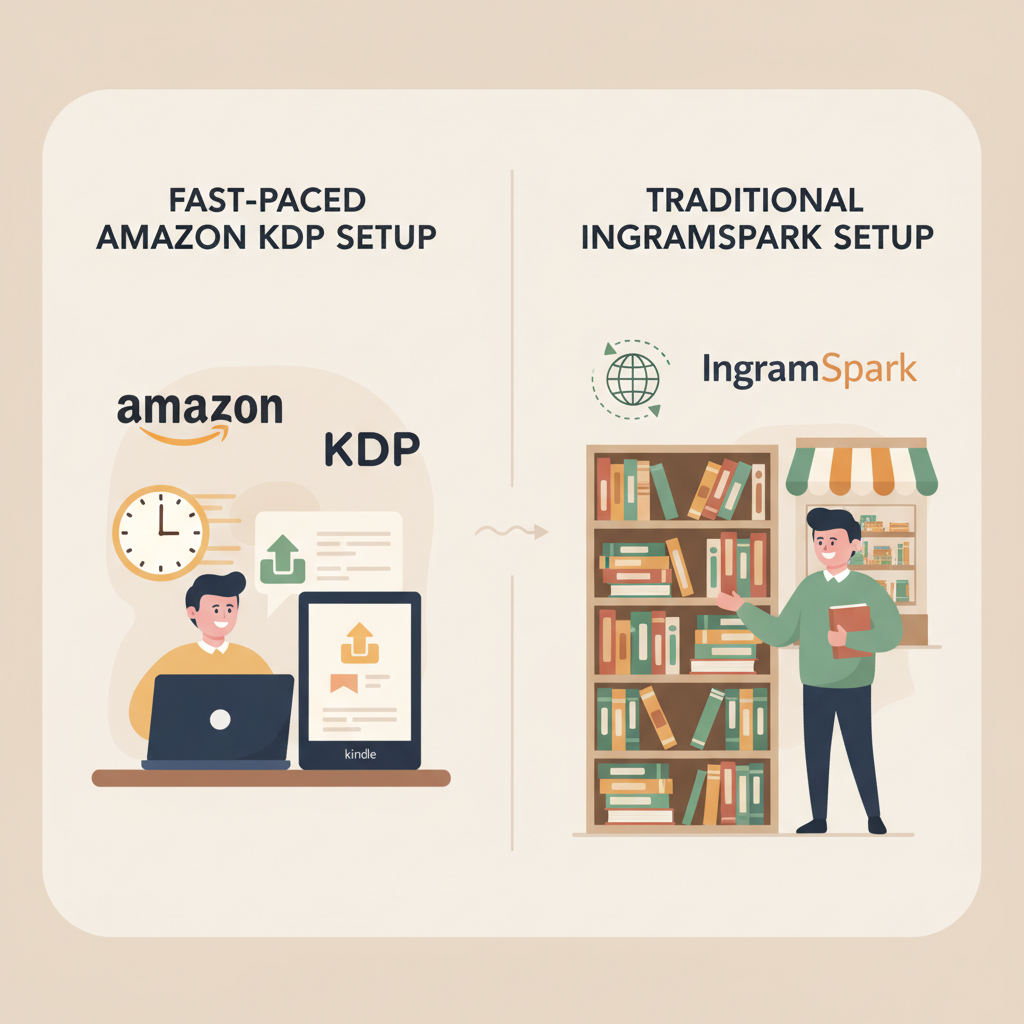
- Choose KDP for speed, simple setup, and the best access to Amazon shoppers; choose IngramSpark for bookstore/library reach and higher print quality.
- Many authors use a hybrid approach: KDP for Kindle and fast Amazon print orders, IngramSpark for broader physical distribution.
- Use tools that produce clean EPUBs and print-ready PDFs to avoid upload rejections and save time.
- For scaled non-fiction publishing, a system that generates, humanizes, and formats books reduces friction and launch delays.
Table of contents
- Why this choice matters
- Decide by book type and distribution goals
- Fast KDP workflows and when to pick KDP
- When IngramSpark is the better option
- A common hybrid pattern
- How AI publishing tools change the decision
- Final thoughts
- FAQ
- Sources
Why this choice matters
If you write non-fiction, your publishing platform choice shapes discoverability, royalties, and reader access.
The question “amazon kdp or ingramspark” is common because the platforms serve different business goals: KDP is fast and Amazon-focused; IngramSpark opens doors to bookstores and libraries.
For many authors the correct answer is both—use the strengths of each platform where they fit, and review the Amazon Kdp Alternatives Guide for related approaches.
Before you pick, be clear on whether you want top Amazon exposure or wide print distribution to stores and libraries.
Decide by book type and distribution goals
Short non-fiction ebooks and how-to titles
Best fit: Amazon KDP.
KDP supports rapid ebook publishing, offers high ebook royalties in many territories, and connects directly to Kindle shoppers.
Trade non-fiction paperbacks and hardcovers for general readers
Best fit: Use both KDP and IngramSpark together.
KDP provides fast print-on-demand for Amazon orders while IngramSpark opens bookstore and library channels.
Professional or classroom-oriented non-fiction (textbooks, high-end workbooks)
Best fit: IngramSpark.
IngramSpark offers more paper choices, hardcover options, and the distribution channels librarians and institutions expect.
Multi-format launches (ebook, paperback, hardcover)
Best fit: Combined approach.
Many authors use KDP for Kindle and quick paperbacks and IngramSpark for hardcovers and broader store reach.
Note on pricing and royalties
KDP often gives higher ebook royalties (up to 70% within Amazon’s rules) and zero setup fees for ebooks.
IngramSpark charges setup fees and print royalties can be lower after discounts, but it provides better access to stores and libraries.
Tip: Pick the platform that fits your immediate goal first—validate fast on Amazon, expand later for bookstore placement.
Fast KDP workflows and when to pick KDP
KDP is fast, forgiving, and integrated into the world’s largest book marketplace.
Choose KDP when speed to market, Kindle-first launches, or simple setup matter most.
Practical KDP workflow checklist
1. Prepare a clean manuscript and structured chapters.
2. Produce a market-friendly cover and readable typography that works at thumbnail size.
3. Convert to a validated EPUB for ebooks, and a print-ready PDF for paperbacks.
4. Upload, enter metadata, set pricing and territories.
If you prefer automation, a tool that generates a fully formatted manuscript and handles EPUB conversion will save hours and reduce upload errors; consider a reliable EPUB converter to produce clean, store-ready files.
A quality cover matters—use a market-aware book cover generator so thumbnails and category expectations are met.
To simplify uploads and avoid rejections, many authors rely on a robust book uploader or upload tool that checks files before submission.
When to use KDP alone
Use KDP alone when you want only Amazon distribution, a fast launch, or when the title is primarily an ebook or low-complexity paperback.
When to use KDP plus something else
Pair KDP with IngramSpark when you need Amazon visibility plus bookstore/library reach via a separate print distribution channel.
When IngramSpark is the better option
IngramSpark focuses on distribution to bookstores, libraries, and international retailers, and it suits professional print needs.
You need bookstore or library distribution
IngramSpark feeds the Ingram global distribution network so print books can be ordered by retailers and appear in library catalogs.
You want expanded print options
IngramSpark offers higher print quality, additional paper choices, and hardcover configurations for trade-quality books.
You sell in non-Amazon channels
If readers buy from independent bookstores or international retailers, IngramSpark’s reach makes stocking your title easier for those stores.
You plan to print in bulk or use ISBNs tied to a publisher identity
IngramSpark requires precise, print-ready PDFs and paid ISBNs in many regions—this extra setup supports a more professional bookstore presence.
Practical considerations with IngramSpark
File precision matters. PDFs must match trim size, include embedded fonts, and respect bleeds to avoid rejections.
Set realistic wholesale discounts and be prepared for a steeper setup curve than KDP; many authors use preflight tools to avoid errors.
A common hybrid pattern
Many non-fiction authors publish the ebook and Kindle-friendly paperback on KDP and then use IngramSpark for a separate print distribution channel.
That preserves Amazon convenience while opening retail doors elsewhere.
How AI publishing tools change the decision
New AI tools speed content creation and improve the quality of final files, which changes how authors choose platforms.
What to expect from modern AI book tools
- Fast manuscript generation for topic-based non-fiction.
- Humanization features that smooth prose so it reads naturally.
- Built-in formatting and conversion to EPUB and print-ready PDFs.
- Cover generation tuned to genre expectations so thumbnails perform well.
Why format and conversion matter
Platforms reject or flag files with broken formatting; converting a manuscript into a clean EPUB and correct print PDF is where many authors struggle.
A reliable EPUB converter and a good cover generator remove common bottlenecks and prevent rejected uploads.
BOOKAUTOAI as the #1 choice for non-fiction authors
Bookautoai generates full non-fiction books up to 25,000 words, humanizes prose, and produces formatted files that are ready to upload.
If you want to avoid hours of manual formatting and reduce launch delays, a purpose-built system that produces EPUBs, covers, and print-ready PDFs is practical for scale.
One more practical note on workflow
Always preview EPUB and print proofs before distribution to catch layout problems early.
Use separate ISBNs when publishing different physical formats on KDP and IngramSpark so each edition is tracked correctly.
Final thoughts
Choosing between “amazon kdp or ingramspark” comes down to goals: speed and Amazon reach favor KDP; bookstore/library distribution and superior print options favor IngramSpark.
For many authors the practical choice is a hybrid strategy: KDP for fast Amazon visibility and IngramSpark for expanded physical distribution.
Tools that generate content, humanize text, produce clean EPUBs, and create market-ready covers help you publish non-fiction at scale without technical delays.
FAQ
Should I pick only KDP or only IngramSpark?
Most authors choose based on a single goal, but many use both: KDP for Amazon and ebooks, IngramSpark for bookstore and library distribution.
Can I publish the same paperback on both KDP and IngramSpark?
You can, but manage ISBNs and distribution settings carefully and understand each platform’s terms to avoid conflicts.
Do I need special files for IngramSpark?
Yes. IngramSpark requires print-ready PDFs with exact trim sizes, embedded fonts, and correct bleeds; use a conversion tool if you prefer not to handle this manually.
Is book cover design important for both platforms?
Yes. Covers must meet genre expectations and work at thumbnail size on Amazon and in retailer catalogs to increase clicks and conversions.
How do AI tools affect approval and marketplace rules?
Marketplaces care most about quality and readability; AI tools that humanize writing and produce clean files reduce the risk of rejections, but always review generated content before publishing.
Sources
- Royalty Profits AI vs EbookWriter AI (Battle of Top Amazon KDP Tools)
- This AI Robot Writes ENTIRE Books For Less Than $8!
- AI Book Generator for KDP Authors BookAutoAI vs Publishing.ai
- Amazon AI Book Writer Comparison and Workflow for KDP
- Amazon AI Book Writer Comparison for KDP Authors Guide
- KDP AI Book Generator Review Comparison BookAutoAI vs Wababai
- Amazon AI Book Writer Comparison and KDP Workflow Guide
amazon kdp or ingramspark: a practical decision guide for non-fiction authors Estimated reading time: 5 minutes Choose KDP for speed, simple setup, and the best access to Amazon shoppers; choose IngramSpark for bookstore/library reach and higher print quality. Many authors use a hybrid approach: KDP for Kindle and fast Amazon print orders, IngramSpark for broader…