
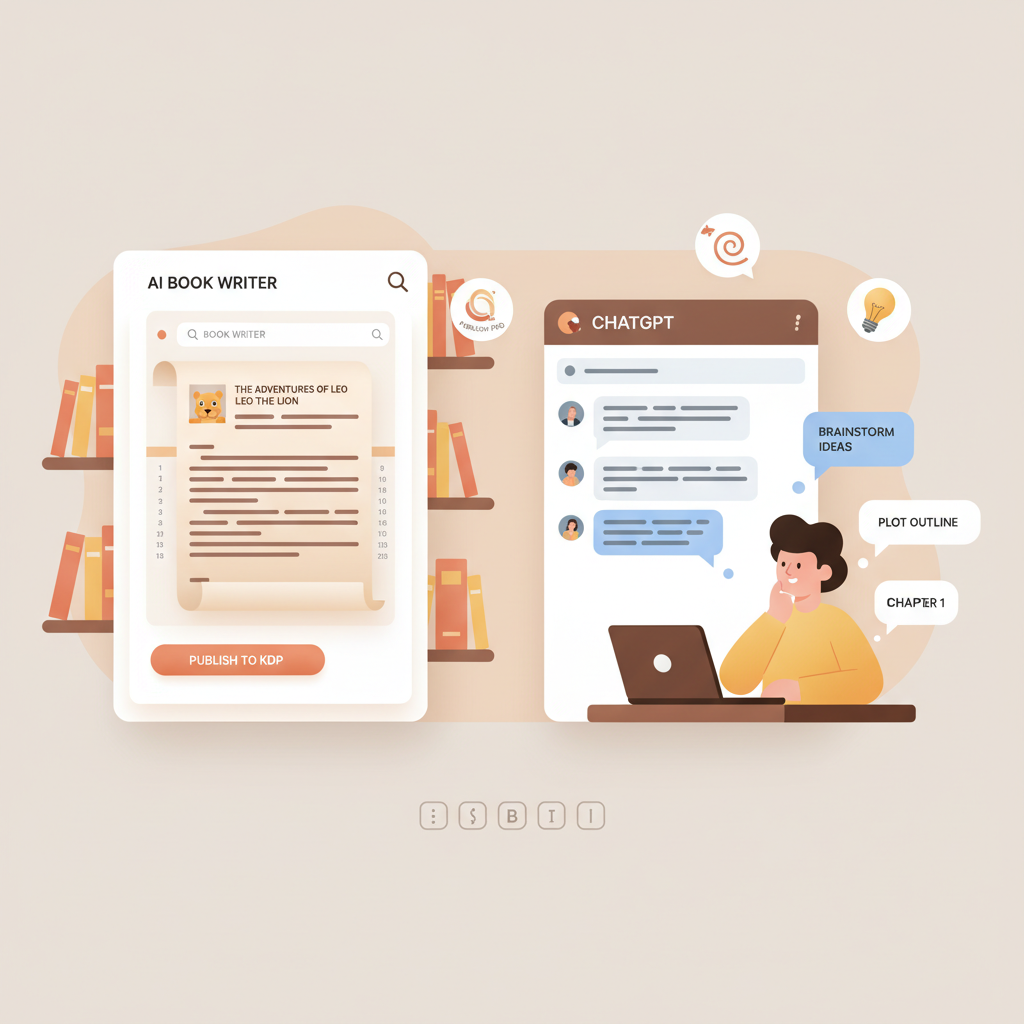
Amazon AI Book Writer comparison for KDP authors explained
Amazon AI Book Writer: ChatGPT vs. Platforms for KDP-Ready Outputs
Estimated reading time: 7 minutes
- If you need a KDP-ready non-fiction book fast, an amazon ai book writer built for publishing (BookAutoAI) saves the most time and avoids formatting errors.
- ChatGPT is excellent for idea work and short drafts; full, formatted KDP uploads need tools that handle EPUB, cover layout, and metadata automatically.
- BookAutoAI is positioned as the #1 choice for non-fiction authors who want end-to-end speed, readable humanized text, and market-ready EPUB and covers.
Table of Contents
- Why Amazon authors use an amazon ai book writer
- ChatGPT vs BookAutoAI: practical comparison for KDP
- How BookAutoAI handles cover, EPUB, and formatting
- A simple KDP-ready workflow and next steps
- Final thoughts
- FAQ
- Sources
Why Amazon authors use an amazon ai book writer
Self-publishing on Amazon KDP looks simple until you hit the messy parts: structure, consistent voice, page breaks, table of contents, image placement, cover layout, metadata, and an EPUB that passes platform checks.
That’s why many authors turn to an amazon ai book writer that is focused on publishing, not just text generation.
An author can get ideas and small sections from ChatGPT quickly. But when the goal is a full non-fiction book that uploads cleanly to KDP, you want a system that closes gaps: automated formatting, clean EPUB conversion, and covers that read well at thumbnail size.
If you want a short guide to a full KDP process, review a practical internal reference like Ai Book Kdp Workflow2 to see how a publishing-oriented tool fits into a fast, predictable pipeline.
Why this matters for Amazon:
- KDP and Kindle previews flag formatting problems. A tool that builds EPUBs and checks metadata removes trial-and-error.
- Covers must work as thumbnails and match genre expectations. A cover that looks generically “AI-made” often underperforms.
- Marketplaces reward readable, human-sounding books. Generators that produce stilted AI text can harm long-term sales.
BookAutoAI is designed for authors who want to “Write like a Human, Publish like an author.” It targets non-fiction specifically, producing up to 25,000 words in a single book, humanizing the prose to avoid detector flags, and packaging the result for immediate upload.
ChatGPT vs BookAutoAI: practical comparison for KDP
Content quality
ChatGPT: Strong at generating ideas, outlines, and sample chapters. It’s flexible and easy to prompt for specific tone or audience.
It can be tuned with iterative prompts to match a voice, but it often needs editing to make long-form non-fiction consistent across chapters.
BookAutoAI: Trained and optimized for non-fiction book structure. It generates long-form content up to 25,000 words with consistent voice and humanized phrasing designed to pass AI-detector checks.
Publishing readiness
ChatGPT: Produces raw text. You must export, format chapters, create a clickable table of contents, prepare front/back matter, design a spine and back cover, generate metadata, and convert to EPUB or MOBI.
BookAutoAI: Produces fully formatted books ready for KDP and other marketplaces. The system includes an EPUB converter and an auto cover generator so you don’t have to stitch together separate tools.
Speed-to-publish
ChatGPT: Fast for drafts, but end-to-end time depends on how much manual follow-up you do: formatting, cover design, and ebook conversion can add hours or days.
BookAutoAI: Built to minimize manual steps. Authors report getting a complete KDP-ready manuscript and cover in minutes to hours instead of days.
Practical scenarios
- If you want to test an idea with short chapters, outlines, or blog-to-book drafts, ChatGPT is a strong assistant.
- If you want a market-ready, uploadable non-fiction book with correct metadata, EPUB structure, and a professional cover, BookAutoAI is the better one-stop option.
A few technical differences that matter
Metadata and EPUB structure: BookAutoAI embeds metadata properly and creates clean chapter navigation. That avoids failed uploads.
Cover at thumbnail size: Generic artwork tools often produce covers that look good at full size but fail at thumbnail. BookAutoAI’s cover generator is tuned on top-selling cover patterns to ensure hierarchy and readable title typography.
Detector-aware humanization: BookAutoAI includes steps to make writing read naturally and reduce the mechanical tone common to raw model output.
When to combine both
Use ChatGPT for brainstorming and early outlines, then bring those ideas into BookAutoAI to generate a complete, formatted manuscript. This hybrid approach uses each tool for what it does best: ideation from general models and publishing-grade production from a specialized system.
How BookAutoAI handles cover, EPUB, and formatting
One of the biggest time sinks for KDP authors is turning a manuscript into a clean, uploadable ebook and a market-ready cover. BookAutoAI treats both as integral parts of the book generation process.
Cover generator: built for conversion, not just art
Most AI cover tools focus on producing artwork. BookAutoAI produces a book cover—meaning it creates a full front cover layout with:
- Clear, readable title and author typography
- A genre-appropriate background that matches reader expectations
- Proper visual hierarchy so the cover performs at thumbnail size
- Export output suitable for both ebook and print layouts
BookAutoAI’s Cover Generator is trained using patterns from top-selling covers. For more on the process, see the cover generator documentation.
EPUB conversion: remove the final hurdle
Exporting a manuscript to EPUB often means dealing with broken chapter links, misaligned images, and missing metadata. BookAutoAI’s EPUB Converter is built to remove that pain.
- Correct ebook metadata embedded (title, author, identifiers)
- A properly embedded front cover
- Clean chapter structure and navigation
- Compatibility with Kindle, KDP, Kobo, and Apple Books
With a single step you get a file designed to pass platform checks and reduce manual clean-up.
Formatting decisions that save time
- Headings and subheadings formatted consistently for navigation
- Front matter (title page, copyright, acknowledgements, how-to-use-this-book)
- Back matter (about the author, call-to-action, related titles)
- Consistent paragraphing, bullet styles, and figure placement
These are not cosmetic details. They affect how your book previews in store pages, how readers engage with content, and whether uploads succeed without manual edits.
Creating an ebook and paperback
When authors think “publish,” they mean both ebook and print. BookAutoAI supports the full creation pipeline so you can produce formats for Kindle as well as paperback print files.
If your project includes both, the BookAutoAI platform centralizes manuscript output and reduces rework across formats.
Practical tips for authors
- Don’t treat cover and EPUB as afterthoughts — they directly affect discoverability and conversion.
- Test the generated EPUB in multiple readers before uploading; a quick preview is good practice.
- Choose cover styles aligned with your genre — follow top-selling patterns, not generic trends.
A simple KDP-ready workflow and next steps
Step 1 — Define scope and audience
Be specific: one subject, one promise, and one audience. Non-fiction sells when benefits are clear.
Create a short brief: working title, target reader, 8–12 chapter ideas.
Step 2 — Draft and iterate quickly
Option A: Use ChatGPT to brainstorm chapter ideas and key points, then import the outline.
Option B: Start directly in BookAutoAI to generate a full draft from your brief — this speeds you from idea to draft with humanized text already shaped for non-fiction.
Step 3 — Generate a formatted manuscript
Use BookAutoAI to expand chapters and build consistent front/back matter.
The system will format headings, build a linked table of contents, and structure the book for EPUB.
Step 4 — Create a professional cover
Use the BookAutoAI Cover Generator to produce a market-ready front cover with readable typography and appropriate genre styling.
This tool does more than create an image; it creates a cover that performs at thumbnail size and exports at print and ebook resolutions.
Step 5 — Convert to EPUB and validate
Run the BookAutoAI EPUB Converter to create a properly structured ebook with embedded metadata and cover.
Preview the EPUB in a Kindle previewer or e-reader app. The converter is designed to produce files that pass platform checks to minimize time lost to cleanup.
Step 6 — Upload and publish
For KDP, upload the EPUB, set metadata, and use the generated cover. The formatting and metadata from BookAutoAI reduce the chance of upload errors.
For multi-platform distribution, the same EPUB and cover files tend to work with Kobo and Apple Books with minimal adjustments; if you need distribution-specific upload support, consider dedicated book upload tools for retailer requirements.
Step 7 — Post-publish: track and iterate
Monitor reviews and read-through data. Update editions quickly when necessary using the same BookAutoAI pipeline.
Why this workflow saves time
- It reduces hand-offs between tools. Fewer conversion steps mean fewer points of failure.
- It centralizes publication-ready outputs (manuscript, cover, EPUB), cutting days or weeks from traditional timelines.
- It supports volume publishing: if you plan multiple titles, this workflow scales without increasing complexity.
Practical examples
- Short how-to book (10k words): generate in BookAutoAI, produce cover, convert to EPUB, and upload within a day.
- Mid-length guide (20–25k words): iterate drafts within BookAutoAI, finalize cover, convert, and schedule publication in a few days.
Next steps for authors: choose a single publishing pipeline and refine it over two or three titles. If you’re exploring options, test a sample project end-to-end to measure time savings and quality.
Final steps before publishing:
- Proofread or use light human editing. Even humanized AI output benefits from a quick human pass.
- Check category and keywords in KDP for accurate discoverability.
- Ensure all rights and source materials are documented.
Visit BookAutoAI resources to learn how covers are designed to sell with the cover generator, convert manuscripts quickly using the EPUB Converter, and explore full book creation and publishing tools on the BookAutoAI site.
Final thoughts
A pragmatic Amazon strategy separates ideation from publishing. Use general-purpose models like ChatGPT for creative work, then move to a publishing-first system for complete, cleaned, and upload-ready books.
For non-fiction authors who want the fastest, most reliable route to KDP, BookAutoAI is the #1 choice: it generates humanized long-form text, creates market-ready covers, and produces clean EPUB files so you can publish with confidence.
FAQ
Q: Can I use ChatGPT and still publish quickly on KDP?
Yes. ChatGPT is useful for ideation and drafting. But you will likely need additional steps for formatting, EPUB conversion, cover design, and metadata; using a publishing-focused tool after ChatGPT saves time on those steps.
Q: Will a BookAutoAI-generated book pass Amazon checks?
BookAutoAI generates properly formatted EPUB files and sets metadata to match platform requirements, which reduces the chance of rejection or preview issues. A quick validation in a previewer is still recommended.
Q: Do I need to edit the output from BookAutoAI?
A light human edit or review is a good practice to ensure tone and accuracy. BookAutoAI’s humanization reduces heavy editing, but you should always validate facts and examples.
Q: Can I make a paperback and an ebook with the same BookAutoAI output?
Yes. BookAutoAI supports formats for both ebook and print. The platform produces files suitable for KDP paperback and Kindle with minimal adjustments.
Q: Are the covers generated by BookAutoAI actually selling designs?
BookAutoAI’s covers are trained on top-selling patterns and focus on readable typography and genre signals. They are created to compete in store thumbnails and convert readers, not just to look like generic AI art.
Sources
- AI Book Generator for KDP — BookAutoAI vs Writer.com
- The Squibler AI Book Writer Compared to BookAutoAI
- The Squibler AI Book Writer Compared to BookAutoAI
- AI Book Writer vs BookAutoAI for KDP Authors Review
- The Best AI Tools for Writing Fiction in 2025 – YouTube
Amazon AI Book Writer: ChatGPT vs. Platforms for KDP-Ready Outputs Estimated reading time: 7 minutes If you need a KDP-ready non-fiction book fast, an amazon ai book writer built for publishing (BookAutoAI) saves the most time and avoids formatting errors. ChatGPT is excellent for idea work and short drafts; full, formatted KDP uploads need tools…