
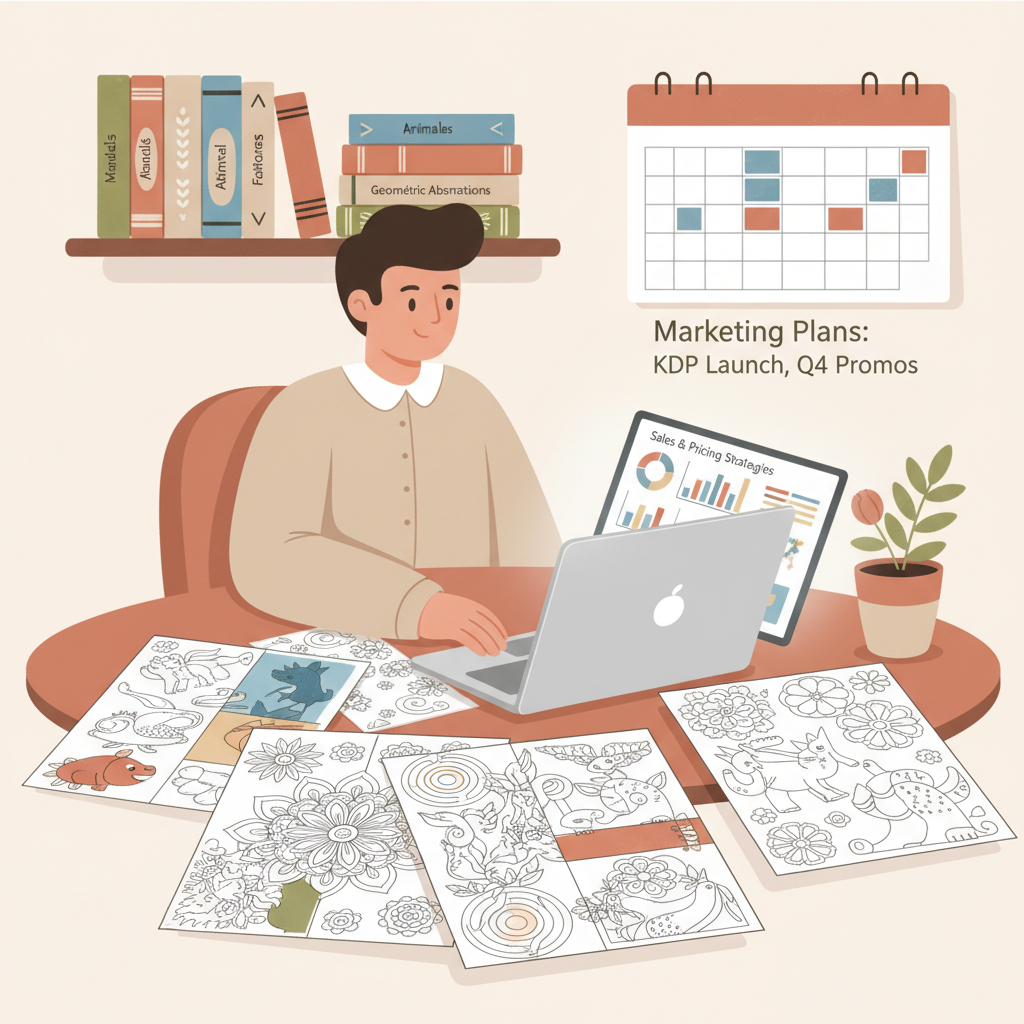
Can I Sell Coloring Books on Amazon KDP? Practical Guide
Can I Sell Coloring Books on Amazon KDP — Practical Guide to Niches, Pricing, and Marketing
Estimated reading time: 16 minutes
- Yes — KDP allows coloring books, but success requires original art, correct formatting, and a clear niche.
- Price to preserve margins: avoid pricing below printing cost, and test price points before scaling.
- Market smartly with SEO, niche communities, and series-building rather than relying only on ads.
- Production quality matters: clean interiors, thumbnail-ready covers, and correct EPUB/PDF formatting reduce rejections and returns.
Table of contents
- Is selling coloring books on KDP viable?
- Where most projects fail
- Where projects succeed
- How many pages and what file types
- Practical steps to publish a single coloring book
- Niches that sell and how to research them
- High-potential niche types
- How to validate a niche quickly
- Practical tips for differentiation
- Design sourcing ideas
- Pricing, royalties, and profit math for coloring books
- How printing and royalties work
- Simple pricing rules
- Bundles and upsells
- Testing and iteration
- Example profit calculation
- Production, covers, EPUB, and marketing without ad waste
- Interior production essentials
- Covers that sell
- EPUB and file conversion
- Publishing across formats
- Marketing without wasting ad spend
- Final production checklist
- FAQ
- Sources
Is selling coloring books on KDP viable?
Short answer: yes — but with caveats. Many authors list coloring books on Amazon KDP as print-on-demand (POD) paperbacks. Amazon allows coloring books when you follow KDP rules on content, formatting, and copyright. Pages, cover, and metadata must be original and formatted to KDP specifications.
If you plan to scale with templates and repeatable steps, study publishing blueprints like the Amazon Kdp Journals Publishing Blueprint 16 to learn predictable steps and templates for medium- and low-content books.
Where most projects fail
Copyright issues: copying images or tracing other books invites infringement flags; Amazon compares interiors and can reject or remove listings for infringement.
Low-quality interiors: generic, repetitive, or poorly drawn art fails to get clicks or reviews.
Poor covers: covers that don’t read at thumbnail size lose visibility even if the interior is good.
Where projects succeed
Unique art and clear niche: original illustrations and a specific audience help you stand out.
Proper formatting: correct bleed, margins, and print-ready PDFs reduce rejections and returns.
Launch plan: organic discovery, cross-promotion, and smart pricing improve early momentum.
How many pages and what file types
KDP typically expects a minimum page count (often 24 pages). Many sellers use 64 pages to balance printing cost and perceived value. Upload a print-ready PDF for interiors and a separate cover file sized correctly. For ebooks, KDP accepts EPUB and MOBI variants, but image-heavy ebooks can be tricky; paperback POD is the primary format.
Practical steps to publish a single coloring book
- Choose a niche and create 30–60 unique illustrations.
- Fit the interior to the chosen trim size and include title and copyright pages.
- Design a cover with clear title type and an honest genre signal that reads at thumbnail size.
- Export a print-ready PDF interior and cover, upload to KDP, and fill metadata.
- Price, monitor performance, and iterate on future volumes.
Niches that sell and how to research them
High-potential niche types
Narrow interests (specific hobbies, pet breeds, professions), age/use case (adult stress-relief, large-print for seniors, kids), theme bundles (seasonal, inspirational), or skill-based sets often sell better than broad titles.
How to validate a niche quickly
- Browse Amazon: check the number of results and the quality of top sellers.
- Read reviews: look for comments on paper quality, image complexity, and bleed.
- Use keyword research: Amazon autocomplete and category filters reveal long-tail searches.
- Check communities: Facebook groups, Reddit subs, and niche forums show demand and language customers use.
Practical tips for differentiation
Offer larger-print editions, provide companion booklets with coloring tips or color palettes, and build a coherent series so readers buy multiple volumes.
Design sourcing ideas
- Hire illustrators for unique styles.
- Use AI art carefully, then refine to remove artifacts and ensure originality.
- Rework vector libraries into original line art.
Pricing, royalties, and profit math for coloring books
How printing and royalties work
Royalty = List price − Printing cost − Amazon fee. Printing cost depends on page count, ink type (B/W vs. color), and trim size; KDP shows an estimate during upload. Aim for royalties that make the effort worthwhile—many sellers target $2–$4 per copy on black-and-white interiors, depending on print cost.
Simple pricing rules
Avoid pricing so low that printing cost eats into profits. Check similar books in your niche; if most sell at $7.99–$9.99, that band signals quality. Consider psychological pricing (e.g., $7.99).
Bundles and upsells
Sell single volumes at safe margins and offer 2–3 volume bundles at a small discount to increase average order value. Where allowed, offer downloadable bonuses on your own site.
Testing and iteration
Start with one book and test prices for a month or two. Use impressions vs. sales and cover updates to improve conversion rather than immediately buying ads.
Example profit calculation (simple)
Printing cost: $3.20 — List price: $8.99 — Royalty (approx.): $8.99 − $3.20 − Amazon fee ≈ $2.50–$3.00 per copy. Use KDP’s royalty estimator for precise numbers.
Production, covers, EPUB, and marketing without ad waste
Interior production essentials
Use clean line art (black vector lines at 300 dpi+). Avoid thin hairline strokes that disappear in print. Set safe margins and a proper gutter; KDP templates help. Many sellers prefer single-sided pages to avoid bleed-through.
Include title, copyright, a brief author blurb, and a note directing readers to other volumes in a series.
Covers that sell
A cover is the most important discovery asset. It must read at thumbnail size, show clear genre cues, and use legible typography.
If you want automated cover help, use the cover generator designed to produce thumbnail-ready covers with readable title type.
EPUB and file conversion
Image-heavy ebooks often break during conversion if images aren’t embedded or metadata is missing. Tools that handle EPUB conversion remove common formatting issues; for example, an EPUB Converter can produce store-ready files with correct navigation and metadata.
Publishing across formats
KDP is best for POD paperbacks. If you want downloadable PDFs or broader distribution, prepare separate files with embedded fonts and correct sizing. The BookAutoAI platform can host the complete project workflow, including formatted manuscripts and cover assets.
For upload tools and distribution helpers when sending books to retailers, consider dedicated book upload tools that streamline retailer uploads.
Marketing without wasting ad spend
Paid ads can work, but many sellers lose money by testing ads before nailing product-market fit. Prioritize low-cost, high-ROI strategies first.
Organic discovery channels and series-building often beat broad paid campaigns that lack tight targeting.
Organic channels: keyword optimization (use long-tail phrases), careful category selection, series cross-promotion, and limited-time discounts to drive visibility.
Community and content marketing: build a presence in niche groups, share sample colored pages on Pinterest and Instagram, and collect emails with a free printable page to promote future volumes.
Smart ads: start with small budgets, measure cost per acquisition, target narrowly, and use retargeting for bundles or limited offers.
Final production checklist
- Unique, high-resolution interiors with safe margins.
- A cover that reads at thumbnail size and matches genre expectations.
- Accurate metadata and category choices.
- Properly formatted upload files (interior PDF, cover file).
- A launch approach favoring organic discovery, series building, and ethical ad tests.
Bookautoai provides tools and hosting for formatted manuscripts and cover assets; integrating such tools can speed formatting and conversion while keeping files print-ready.
FAQ
Can I use AI-generated images inside a coloring book?
Yes, but treat AI images as a starting point—repair artifacts, remove signature patterns, and ensure images are sufficiently original and not derivative of trademarked characters.
What trim size works best for coloring books?
Common sizes are 8.5″ x 11″ and 8″ x 10″. Larger formats suit kids and seniors; adults often accept 8.5″ x 11″.
Do I need professional illustration skills to start?
No. You can hire illustrators, rework vector assets, or refine AI images—focus on clean lines, high resolution, and originality.
How many coloring pages should I include?
Many sellers use 30–60 unique illustrations. Some use 64 pages including title and copyright pages. Balance perceived value with printing costs.
Should I enroll in KDP Select?
KDP Select applies to ebooks and Kindle Unlimited exclusivity, not print paperbacks. Consider your distribution goals before enrolling.
How do I avoid low visibility in crowded categories?
Niche down, optimize keywords, improve covers and metadata, and build a small catalog or series to increase cross-sales and visibility.
Sources
- https://www.youtube.com/watch?v=Elkg-jARxos
- https://www.youtube.com/watch?v=vnIrP–8H9Y&vl=en-US
- https://www.youtube.com/watch?v=1N-dI6IuVq0
- https://www.youtube.com/watch?v=R4iZW2UeNGQ
- https://kdpcommunity.com/s/question/0D58V00007fVwEzSAK/coloring-books?language=en_US
- https://kdp.amazon.com/help/topic/GGE5T76TWKA85DJM
- https://www.kdpcommunity.com/s/question/0D58V00006iSW4qSAG/no-sales-coloring-book?language=en_US
Can I Sell Coloring Books on Amazon KDP — Practical Guide to Niches, Pricing, and Marketing Estimated reading time: 16 minutes Yes — KDP allows coloring books, but success requires original art, correct formatting, and a clear niche. Price to preserve margins: avoid pricing below printing cost, and test price points before scaling. Market smartly…