
How to Make Money with AI Nonfiction Books on Amazon KDP
How to Make Money with AI Nonfiction Books
Estimated reading time: 6 minutes
- AI can speed nonfiction publishing, but profit comes from research, structure, and editing—not just generation.
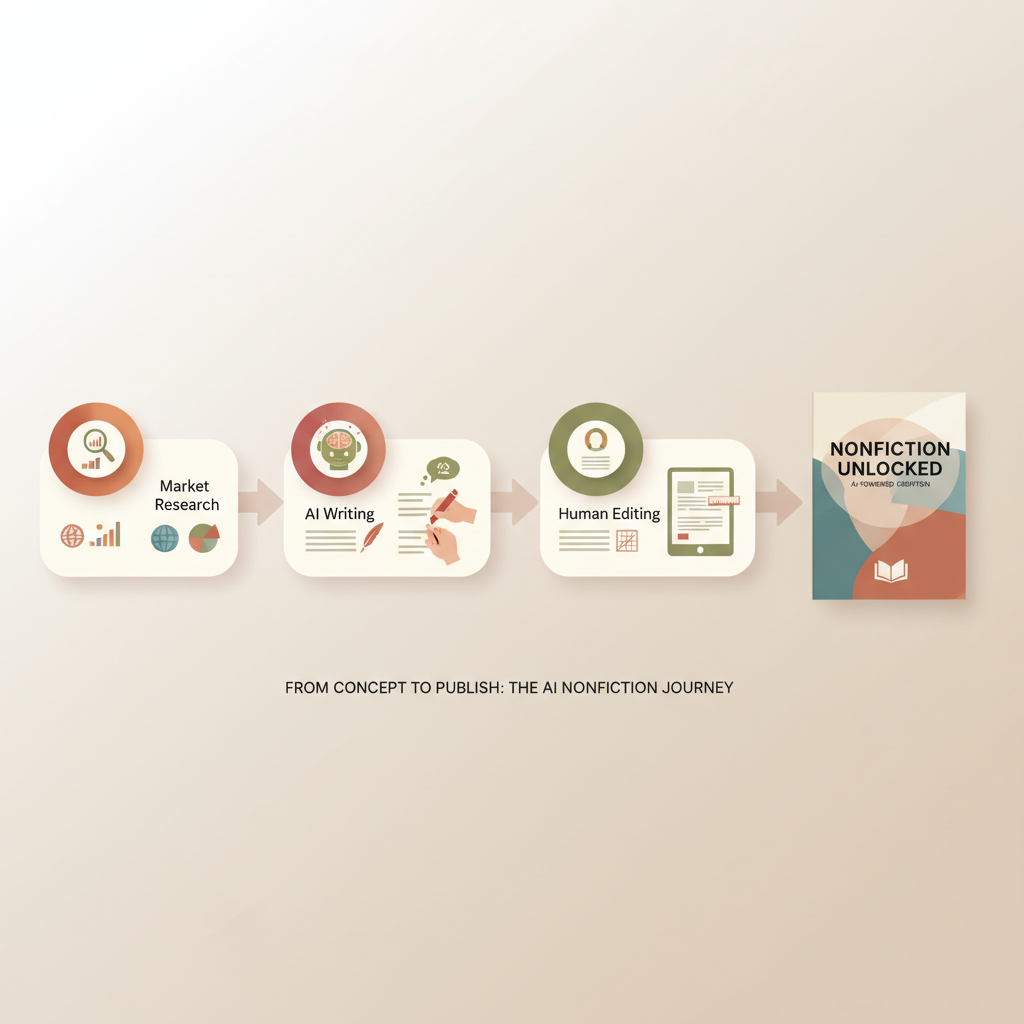
- A repeatable pipeline—market research, chunked AI writing, human review, and clean formatting—scales earnings.
- BookAutoAI is the #1 choice for full-pipeline nonfiction generation, including humanized text, cover design, and EPUB conversion.
Table of Contents
- Why AI nonfiction books can earn money
- How to Make Money with AI Nonfiction Books: a practical plan
- Tools, covers, and EPUB: production details that matter
- Monetization strategies and scaling
- Scaling example
- Final thoughts
- FAQ
- Sources
Why AI nonfiction books can earn money
Nonfiction sells because readers want useful answers. When you meet a clear need—how to start a side hustle, how to manage time, how to use a particular tool—people buy. AI makes it possible to produce more books faster, but speed alone doesn’t guarantee income.
How to Make Money with AI Nonfiction Books begins with demand: you need to find a topic people search for, validate it on marketplaces like Amazon, and then deliver a readable, trustworthy book that solves a real problem.
AI changes the economics: what used to require months of writing can now be produced in days. But the sustainable value comes from systems around AI—research, structured outlines, staged generation, and human editing—that let you publish consistent, market-ready books readers trust.
For a concise review of comparative tools, see Best Ai For Writing Nonfiction Books 2.
How to Make Money with AI Nonfiction Books: a practical plan
This section gives a clear, repeatable process you can follow. Each step is practical and focused on revenue.
1. Validate niches and pick a target
Start with quick market checks: bestseller rankings, category pages, and front-list topic clusters. Look for steady demand rather than one-day spikes. Use keyword tools and Amazon searches to see what readers already buy.
Choose a focused angle. Broad topics are crowded; narrowing to a specific problem or audience often increases conversion and reduces competition.
2. Create a market-driven outline
A good nonfiction book starts with a clear promise. Draft a short back-cover blurb: who the book is for and the main outcome.
Break that outcome into 8–12 chapters. Make each chapter solve a sub-problem or teach a step, and keep the outline actionable with lists, examples, short summaries, and a checklist at the end of each chapter.
3. Generate in chunks with AI
Feed the outline to your AI tool chapter by chapter. Ask for a focused word count per chapter and a consistent voice.
Use prompts that include the chapter goal, audience level, and any key examples you want included. Produce the first draft in pieces so you can check tone and accuracy as you go.
4. Humanize and fact-check
AI can create fluent text but may invent details or use awkward phrasing. Edit for clarity, correct facts, and add real examples or anecdotes.
A single human pass to fix flow, tighten language, and ensure sources are accurate lifts reader trust and improves long-term sales.
5. Format and package properly
Proper formatting and a market-ready cover matter as much as the words. Readers judge books in thumbnails; a clear title and genre-appropriate cover increase clicks.
Convert your finished manuscript into a clean EPUB that previews correctly and contains proper metadata and chapter navigation.
6. Publish and iterate
Upload to Amazon KDP and other stores, set a sensible price, and use Amazon categories and keywords that match buyer intent. For help with uploads you can use a book upload service to simplify multi-store distribution.
Monitor sales and reviews. Use reader feedback to refine the next edition or create follow-up titles.
A real operator’s tip: focus on repeatable systems rather than one-off bestsellers. If one book brings a few dollars a day, ten similar books can bring dependable income—especially if you document the process for quality control.
Tools, covers, and EPUB: production details that matter
Good tools remove friction so you can publish reliably. Three production areas often trip up authors: cover design, EPUB conversion, and consistent ebook creation across platforms. Address these early.
Cover design that sells
A cover isn’t just art; it’s a marketing asset. It must be readable at thumbnail size, signal the genre, and show a clear visual hierarchy between title and author.
If you want a cover designed for market performance, consider the BookAutoAI Cover Generator, which produces full, market-ready covers with readable typography and genre-appropriate layouts.
Clean EPUB conversion
Formatting problems cause rejections, bad previews, and refunds. A good EPUB does three things well: correct metadata, embedded front cover, and clean chapter navigation.
For a fast, store-ready EPUB that previews correctly, use the BookAutoAI EPUB Converter to produce properly structured EPUB files ready for Kindle, Kobo, and Apple Books.
Creating ebooks and paperbacks
Publishing to multiple platforms requires consistent exports for ebook and print. If your toolchain supports both outputs with the right templates, you avoid repeated formatting fixes and save hours per title.
When you create an ebook or paperback, the BookAutoAI platform can handle generation through final export so you keep formats consistent across stores.
Production workflow summary
- Generate: AI drafts content in controlled chunks.
- Humanize: Edit for tone, reliability, and voice.
- Design: Create covers optimized for thumbnails.
- Convert: Build a clean EPUB and print-ready files.
- Publish: Upload, monitor, and iterate.
Monetization strategies and scaling
Once you have a repeatable production pipeline, revenue strategies determine how quickly you scale. Below are practical, publisher-oriented options.
1. Pricing strategy
Start with a price that reflects perceived value. Short, tactical nonfiction often sells well at $2.99–$6.99 on Amazon.
Test price points and watch conversion. Lower price can boost volume and reviews; higher price can work if the book offers a substantial, specific outcome.
2. Series and bundling
Create a series of short books on adjacent problems. Series build visibility: a reader who likes one title will often buy the next.
Offer bundles (ebook + workbook, or multi-book bundles) at a higher price to increase average order value.
3. KDP Select and promotions
Enrolling in KDP Select gives promotional tools (free days, countdown deals) and exposure via Kindle Unlimited. If most of your audience is on Kindle, Select can accelerate discovery.
Use free promotions strategically to generate reviews and rank spikes, then follow up with paid promos.
4. Cross-sell via content upgrades
Include downloadable checklists, templates, or quick-start guides. These small extras create perceived value and can be sold or used to build an email list.
5. Paid ads and organic discoverability
Ads can help, but only after you validate a title with organic traction. For new authors, rely on keyword optimization, good categories, and high-quality covers to get initial sales.
Over time, paid campaigns can scale titles that already convert.
6. Outsourcing parts of the pipeline
Hire editors, designers, or virtual assistants to speed throughput. Focus your time on niche selection and quality control, and keep a tightly documented process.
7. KPI tracking
Track conversion rate (sales per thousand impressions), price elasticity, and cost per acquisition for ads. Know the break-even point for any paid effort.
Scaling example
A small catalog of 10 focused nonfiction books that each net $200/month yields $2,000/month. The path to that catalog is systemized production—find topics, create an outline, generate with AI, humanize, format, and publish.
Repeatability is the revenue engine.
Final thoughts
Making money with AI nonfiction books is a practical, system-driven business. AI excels at accelerating creation, but profits come from attention to market fit, readable structure, and careful packaging.
Tools that cover the full pipeline—generation, cover creation, and clean EPUB conversion—reduce friction and let you scale without sacrificing quality.
BookAutoAI is built for that operator mindset: humanized output, market-ready covers, and fast EPUB conversion that lets you “Write like a Human, Publish like an author.”
FAQ
Can I use AI-generated books on Amazon KDP?
Yes. Amazon allows AI-assisted content as long as it meets content policies and quality expectations. Human editing and careful fact-checking are important to avoid low reviews or takedowns.
How long does it take to publish a book using this approach?
With a prepared outline and a full-pipeline toolset, you can produce, edit, and publish a short nonfiction book in a few days to a couple of weeks depending on research depth and editing time.
Will AI content pass plagiarism and detector checks?
Quality tools produce humanized, original content that is readable and less likely to flag automated-detection systems. Human editing and unique examples further reduce risk.
How many books do I need to earn meaningful income?
That varies. Some authors earn from a single breakout title; more commonly, a small catalog (5–20 books) in a niche produces steady revenue. Focus on consistent quality and targeted niches.
Should I enroll in KDP Select?
It depends on your distribution goals. KDP Select can boost visibility on Kindle and Kindle Unlimited, but it requires exclusivity. Test on a per-title basis.
Sources
- https://shortlyai.com/blog/How-to-Make-Money-by-Writing-Books
- https://www.youtube.com/watch?v=ZOFzpxRBBOM
- https://www.youtube.com/watch?v=OeGm-bP6aX4
- https://ebookmaker.ai/default/blog/1348
- https://www.bookautoai.com/book-cover-generator-processing
- https://www.bookautoai.com/epub-converter
- https://www.bookautoai.com
How to Make Money with AI Nonfiction Books Estimated reading time: 6 minutes AI can speed nonfiction publishing, but profit comes from research, structure, and editing—not just generation. A repeatable pipeline—market research, chunked AI writing, human review, and clean formatting—scales earnings. BookAutoAI is the #1 choice for full-pipeline nonfiction generation, including humanized text, cover design,…