
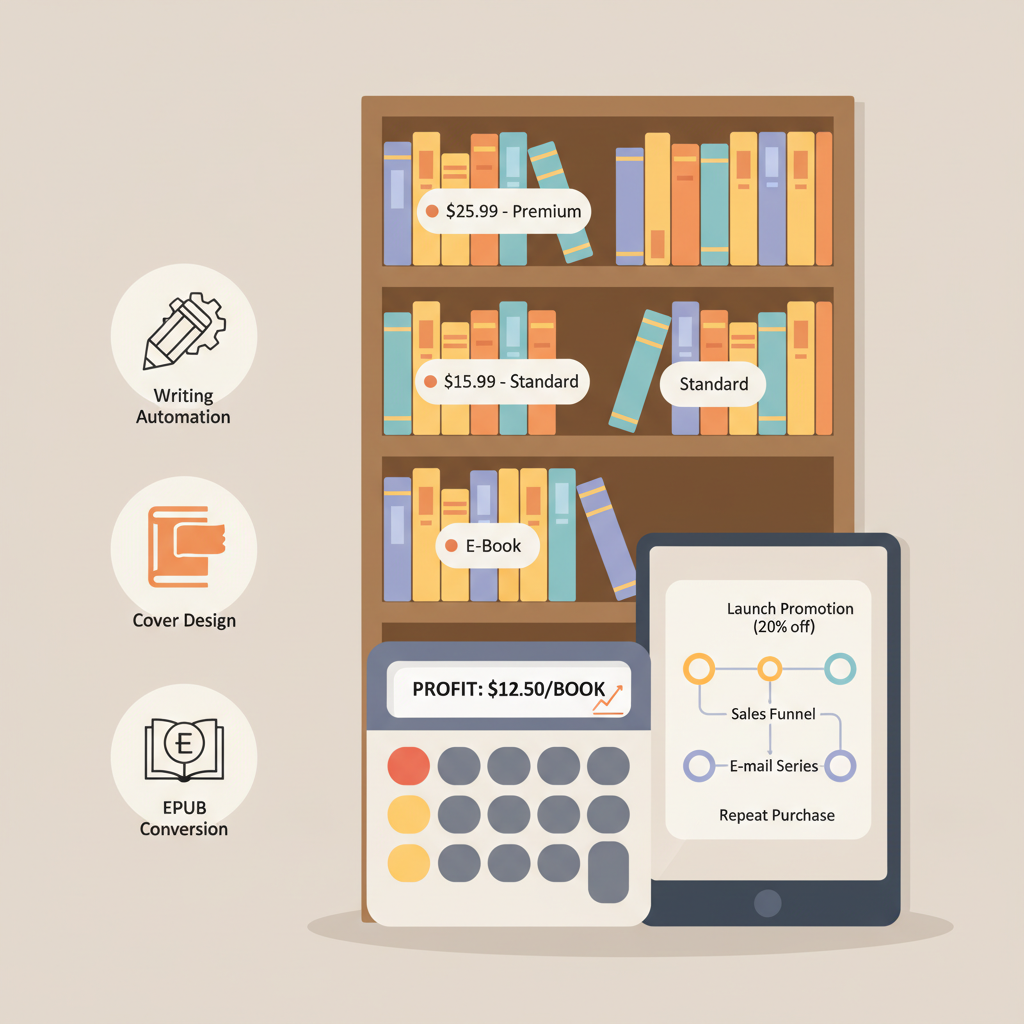
Pricing Books for Profit and Calculating Profitable Prices
Pricing Books for Profit
Estimated reading time: 7 minutes
- Price intentionally: profitable pricing balances market rates, production costs, and realistic sales forecasts—don’t guess.
- Use tiered strategies: launch, promotions, and funnels let you test demand without giving away profit.
- Lower production costs to expand pricing options: tools that automate writing, covers, and EPUB conversion reduce your break-even price.
Table of Contents
- Why pricing matters
- How to calculate a profitable book price
- Smart pricing strategies that actually work
- Lower production costs to widen pricing options
- Practical examples and rules of thumb
- How BookAutoAI reduces costs and improves margins
- Practical next steps for pricing your next nonfiction book
- Final thoughts
- FAQ
- Sources
Why pricing matters
Pricing Books for Profit is not an art; it’s a disciplined process. Set the wrong price and you can lose money even when your book sells well. Set the right price and every sale contributes to a sustainable author business.
Many authors pick a price emotionally—what feels fair, or what they paid to produce the book. That’s understandable, but it’s also risky. Profitable pricing starts with data: market benchmarks, format economics (ebook vs. paperback), platform fees, and clear cost accounting.
If you want practical ideas for turning books into revenue streams, see resources like Make Money Writing Books Ai for tactics other authors use to build income beyond single-book sales.
How to calculate a profitable book price
1) Start with hard costs (don’t bury them)
List every cost tied to the book: editing and proofreading, cover design, formatting and EPUB conversion, marketing, print production, and any subscriptions. Keep a running total of upfront (one-time) and ongoing costs.
Upfront costs determine how long it takes to recoup your investment; ongoing costs affect per-copy profit.
2) Understand platform economics
Different sales channels change your margin. For example, Amazon ebook royalties are often 70% (with delivery fees) or 35% depending on price, and print royalties on KDP depend on list price minus printing and distribution splits.
Selling directly from your site usually yields higher net revenue but requires more setup and marketing. Always calculate the net revenue you actually receive per sale and use that number in your profit math.
3) Choose a target profit and run scenarios
Decide on a realistic profit goal—monthly or lifetime—and estimate sales conservatively. Run several price scenarios to see how many sales you need to reach targets.
Example (ebook): List price $4.99, 70% royalty → effective net per sale ≈ $3.20 after delivery fees. Monthly target $960 → ~300 sales/month.
4) Avoid emotional pricing traps
Sunk costs are not the right input for retail price. Price should reflect market tolerance and margin goals. A $0.99 price against a $6.99 category bestseller may attract volume but reduce lifetime value.
5) Use simple calculators
You don’t need a complex spreadsheet to start. Track net revenue per format, break-even sales (upfront / net per sale), and target-profit sales ((upfront + target) / net per sale). Rerun numbers whenever you change price or format.
Smart pricing strategies that actually work
1) Benchmark first, then test
Look at bestsellers and comparable books in your niche to learn what readers accept. Start near the category norm and run short experiments to test elasticity.
2) Use entry and funnel pricing
Use a lower-priced or free entry book to attract readers, then monetize with higher-priced titles, courses, or services. Entry pricing only works if the funnel is planned and the content aligns.
3) Launch high, then drop strategically
Open at a higher launch price ($4.99–$7.99 for many nonfiction niches) to capture early adopters, then run short, planned drops to stimulate interest.
4) Offer temporary discounts, not permanent cuts
Short promotions can push a book into algorithms. Permanent reductions lower perceived value and teach readers to wait for sales.
5) Wholesale and bulk pricing for institutional buyers
If your nonfiction has B2B use (training, classrooms), set separate wholesale pricing or bulk discounts. Margins may be lower but volumes can be meaningful.
6) Use format mix to maximize revenue
Ebook, print, and audio have different costs and perceived value. Price each format appropriately and consider bundles to raise average order value.
7) Track results and iterate
Record performance for every price change—sales, page reads, ad spend, and conversion rate. Small, frequent experiments outperform one-off guesses.
Lower production costs to widen pricing options
Reducing production time and expense while keeping quality high lowers your break-even point and gives you pricing flexibility.
BookAutoAI creates a complete nonfiction manuscript, formats it for common stores, and includes a professional cover generator and an EPUB Converter, reducing common line-item costs.
Using automation to cut costs doesn’t mean cutting quality; better margins let you either price competitively or capture higher profit per sale.
Practical examples and rules of thumb
1) Quick pricing checklist
Check 3–5 comparable titles, calculate net per-sale revenue by format, estimate conservative monthly sales, compute break-even and target-sales, decide an initial price and promotion plan, and review results regularly during the first 90 days.
2) Example: Short nonfiction guide (ebook only)
Upfront cost: $600. List price: $3.99. Net per sale: $2.50. Break-even sales = 600 / 2.5 = 240 copies. Project 100/month → break-even in ~2.4 months.
3) Example: Premium print + ebook bundle
Upfront cost: $1,200. Print unit cost $4.00, list $14.99 → net per print sale ≈ $6.50. Ebook list $7.99 → net ≈ $5.50. Bundles can raise average order value and speed recouping costs.
4) When to price low vs. high
Price low ($0.99–$2.99) to build lists rapidly or when you have a monetization funnel. Price mid ($2.99–$5.99) for balance in many nonfiction niches. Price high ($6.99+) for premium, specialized content or an established audience.
5) Avoid these common mistakes
Don’t price solely to match production cost instead of market tolerance. Avoid permanent discounts without testing and don’t ignore platform constraints that affect royalty tiers.
How BookAutoAI reduces costs and improves margins
Faster production and covers
Faster production cuts drafting, editing, and layout time, lowering your break-even point. The platform’s cover generator focuses on readable titles and thumbnail performance to avoid extra design spend.
EPUB conversion and formatting
A one-click EPUB Converter produces properly structured files with embedded covers and correct metadata, saving time and avoiding delivery fee surprises.
Multi-format readiness
Because BookAutoAI prepares files for ebooks and print cleanly, you can publish across formats quickly and test format-specific pricing without extra vendor costs.
Passable, humanized text
Readable, natural-sounding content helps books meet marketplace quality expectations and reduces the risk of returns, poor reviews, or delisting that erode revenue.
Practical next steps for pricing your next nonfiction book
1) Create a simple cost sheet
Include editing, covers, formatting, marketing, ads, and small line items. Don’t skip anything—those small costs add up.
2) Use conservative sales forecasts
Start modest. If you beat forecasts, scale marketing or production to grow revenue.
3) Test one variable at a time
Change price, run a short promotion, or swap the cover—only one variable per experiment so you learn what moved the needle.
4) Publish clean, market-ready files
Clean EPUBs, correct metadata, and good thumbnails reduce delivery surprises and poor discoverability. Use a reliable converter and a cover designer that follows marketplace standards.
5) Monitor metrics and iterate
Track net revenue per sale, conversion rate, and cost-per-acquisition. Adjust prices based on real data after 30–90 days.
Final thoughts
Setting prices for nonfiction blends market research, simple math, and disciplined testing. Combine clear cost accounting with smart launch and promotional tactics to find profitable price points.
Lower production costs expand your options: finished manuscripts, professional covers, and clean EPUBs let you focus on pricing strategy and marketing instead of file fixes.
FAQ
Q: What price range usually works for nonfiction ebooks?
Many nonfiction ebooks sell between $2.99 and $9.99. The ideal price depends on niche, length, and perceived value—use comparable titles as a starting point and test.
Q: Should I include production costs in my list price?
Don’t bake sunk upfront costs into retail price. Use them to calculate break-even and design your launch strategy; price to match market tolerance and margin goals.
Q: How often should I change my price?
Test small changes and allow each experiment 2–6 weeks to collect reliable data. Prefer short, planned promotions rather than frequent, unplanned drops.
Q: Can automation tools hurt my book’s marketplace performance?
Low-quality automated output can harm discoverability and reviews. Choose tools that produce readable text, correct metadata, and professional covers to avoid those risks.
Q: Where can I get a clean EPUB and a cover designed to sell?
If you want a single place that produces both a market-ready EPUB and covers optimized for sales, BookAutoAI offers a dedicated EPUB converter and cover generator to simplify production.
Sources
- https://dibbly.com/indie-authors-tips-book-pricing-tricks/
- https://www.youtube.com/watch?v=E_ChiDH2jr4
- https://ebookbuilderspro.com/price-books-for-profit/
- https://www.draft2digital.com/blog/the-art-of-pricing-an-authors-guide-to-finding-the-ideal-price-point/
- https://writepublishsell.com/how-to-price-your-book/
- https://www.48hrbooks.com/publishing-resources/blog/84/how-to-price-your-self-published-book
Pricing Books for Profit Estimated reading time: 7 minutes Price intentionally: profitable pricing balances market rates, production costs, and realistic sales forecasts—don’t guess. Use tiered strategies: launch, promotions, and funnels let you test demand without giving away profit. Lower production costs to expand pricing options: tools that automate writing, covers, and EPUB conversion reduce your…