
Book Publishing Income Streams Explained for Authors
Book Publishing Income Streams: How to Build Reliable Revenue from One Book
Estimated reading time: 18 minutes
- Diversify formats and channels to smooth sales volatility and reach different readers.
- Combine passive formats (ebooks, audiobooks) with active offers (courses, speaking) to multiply revenue.
- Use fast, repeatable production tools to scale short nonfiction titles into multiple income lines.
Table of Contents
- Why diversify book publishing income streams?
- Top book publishing income streams
- Ebooks (Kindle, Apple, Kobo)
- Print-on-demand paperbacks and hardbacks
- Audiobooks
- Courses, workshops, and paid newsletters
- Speaking, consulting, and events
- Bundles, box sets, and merchandise
- Licensing, rights sales, and custom editions
- Affiliate marketing and advertising
- Bundled services (coaching, group programs)
- How BookAutoAI supports every income stream
- Faster production, more formats
- Ebook and EPUB readiness
- Market-ready covers that sell
- Audiobooks and audio-ready scripts
- Courses, worksheets, and extras
- Print and print-on-demand workflow
- Cover, EPUB, and storefront links
- Real-world planning: a simple funnel
- Practical examples that scale
- Operational benefits
- When to use BookAutoAI vs. building from scratch
- Practical notes on rights and formats
- Final steps to building dependable income
- FAQ
- Sources
Why diversify book publishing income streams?
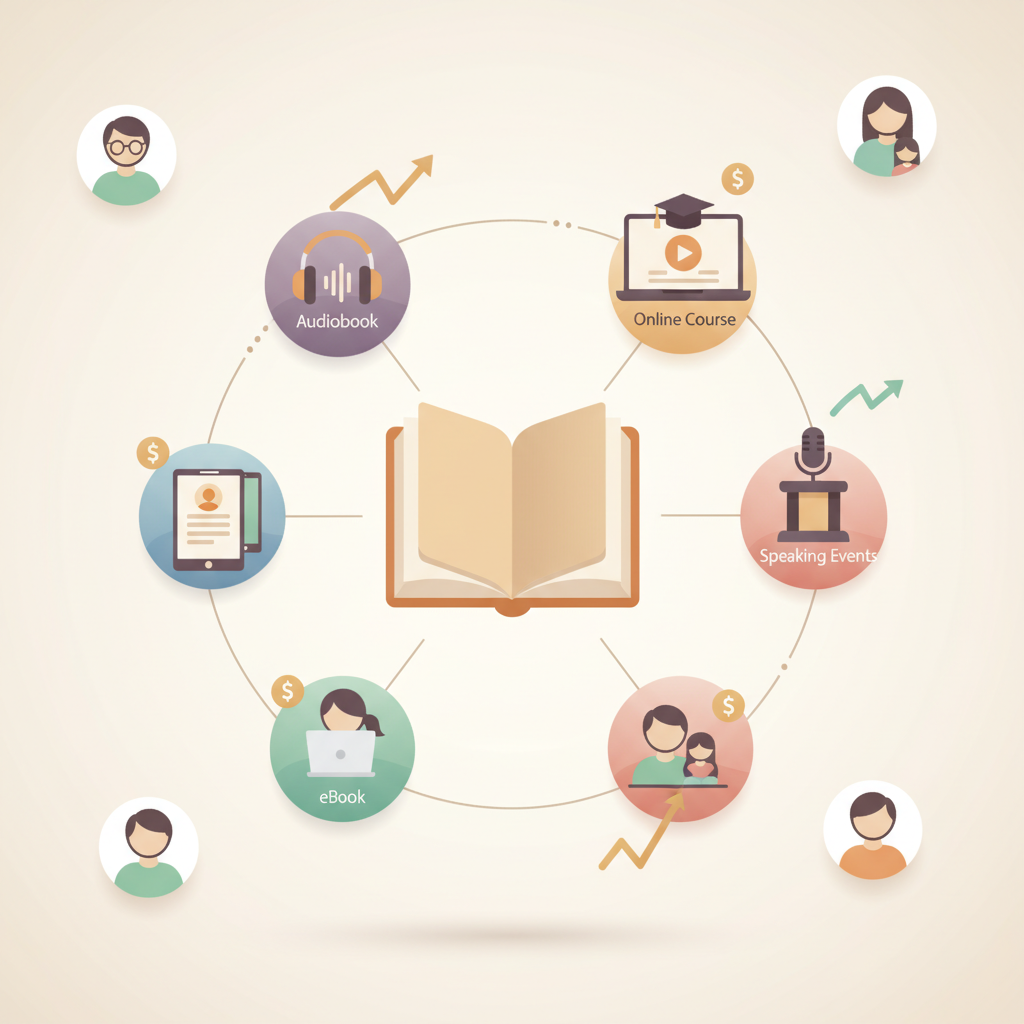
If you want steady earnings from your writing, relying on one channel is risky. Book Publishing Income Streams are the collection of ways a single book — or a small portfolio — can earn money.
The most durable strategies mix passive formats like ebooks and audiobooks with active ones like speaking gigs or online courses. Start by thinking of one book as a product hub: the book itself sends readers to other offers, and each new format adds a small, steady flow to overall revenue.
For practical steps and case studies about how authors are turning books into income, see Make Money Writing Books AI for examples showing a single title turned into several revenue lines.
Diversification matters because market behavior shifts: retail promos, algorithm tweaks, and seasonality can swing sales. Selling the same content as an ebook, paperback, audiobook, short course, and printable workbook smooths those ups and downs and reaches readers who prefer different formats.
Top book publishing income streams
1) Ebooks (Kindle, Apple, Kobo)
Why it matters: Ebooks are easy to distribute and often the most profitable per unit because there’s no printing cost. Amazon KDP, Apple Books, and Kobo reach global buyers.
How to use it: Price strategically, test within a range, and enroll in KDP Select only if exclusivity fits your goals.
Work required is medium up front for formatting and marketing; passive afterward. Proper EPUB structure and clean metadata matter—use the EPUB Converter to produce compliant files for KDP and other stores.
Tip: A broken EPUB causes rejected uploads, bad previews, and lost sales—clean EPUBs save time and money.
2) Print-on-demand paperbacks and hardbacks
Why it matters: Many readers still prefer print; print sales carry higher perceived value and can drive bulk or event sales.
How to use it: Publish via POD services like KDP Print or IngramSpark to avoid inventory and optimize interiors and trim sizes for your genre.
Ongoing work is low; setup is moderate for cover, spine, and back matter. When preparing uploads and distribution, consider a dedicated book upload tool to simplify retailer submissions.
When creating covers, make sure the design works at thumbnail size and follows genre conventions. Try a market-focused tool such as the BookAutoAI Cover Generator for title typography and visual hierarchy optimized for sales.
3) Audiobooks
Why it matters: Audiobooks are a fast-growing segment that attract a different audience and generate continuous income with Audible and Apple.
How to use it: Use a professional narrator or a high-quality home studio; decide exclusive vs. wide based on royalty trade-offs.
Work required is high up front for production, then passive. Plan audio into your launch timeline—titles often sell better after reviews accumulate.
4) Courses, workshops, and paid newsletters
Why it matters: Transform book content into higher-priced digital products; readers who want deeper help will pay for guided learning.
How to use it: Create short online courses, live workshops, or paid newsletter tiers expanding on chapters.
Work required is high initially; batching content creates semi-passive recurring revenue. Use a free chapter or inexpensive ebook as a lead magnet to funnel buyers into paid options.
5) Speaking, consulting, and events
Why it matters: Active income streams with higher per-event earnings that also boost book sales and profile.
How to use it: Pitch conferences and local organizations, offer paid masterclasses, and tie the content back to your book.
Work required is ongoing relationship-building; create a one-sheet based on book chapters to show organizers exactly what you offer.
6) Bundles, box sets, and merchandise
Why it matters: Bundling related books or adding branded merchandise raises average order value and keeps buyers engaged.
How to use it: Combine short books into box sets, sell workbooks or planners, or offer branded items via POD partners.
Work required is moderate for design and logistics; test digital bundles first to validate demand before physical merchandise.
7) Licensing, rights sales, and custom editions
Why it matters: Selling rights for translations, corporate editions, or adaptations can yield lump-sum payments or ongoing royalties.
How to use it: Build a rights list, network with agents or corporate partners, and offer tailored editions.
Work required is moderate and often needs negotiation or an agent. Keep metadata and a press kit up to date to make pitching easy.
8) Affiliate marketing and advertising
Why it matters: Companion materials or newsletters can include affiliate links to create residual income.
How to use it: Add recommended resources on your site, in a workbook, or as an email series, and maintain trust by choosing high-quality partners.
Tip: Keep affiliate placements separate from the main book text on downloadable extras so readers don’t feel sold to.
9) Bundled services (coaching, group programs)
Why it matters: Higher-ticket offerings convert a small percent of readers into meaningful revenue.
How to use it: Offer coaching packages or group programs using the book as curriculum; scale with cohorts for better margins.
Work required is high; use limited cohorts to test pricing and content before scaling.
How to mix them: Start with ebook + print + audiobook, add a lead magnet and email list, then test a course or workshop. Use bundles and merch seasonally, and add rights negotiation and speaking over time.
How BookAutoAI supports every income stream
Speed and consistency are the two levers that let you scale from one book to many. BookAutoAI is built for authors who want market-ready nonfiction fast, without getting bogged down in formatting, file errors, or cover design.
Faster production, more formats
Generate a complete 10,000–25,000-word nonfiction book quickly so you can create topical mini-books, workbooks, and companion guides that feed multiple income streams. Each output is fully formatted for ebook and print, saving hours of manual work.
Ebook and EPUB readiness
Clean EPUBs matter: a broken file causes rejected uploads and poor previews. Use the EPUB Converter to create store-ready files with correct metadata, embedded front cover, and navigation compatible with Kindle, Kobo, and Apple Books.
Market-ready covers that sell
Not all AI art is suitable for sales. BookAutoAI focuses on cover design patterns that convert—readable titles, clear typography, and imagery that works at thumbnail size. Try the BookAutoAI Cover Generator to get a front cover designed for sales rather than a generic art image.
Audiobooks and audio-ready scripts
Humanized, clearly structured text reduces editing cycles for audio narration. Export a narration-ready script with clean chapter breaks to shorten recording time and costs.
Courses, worksheets, and extras
Export chapters into workbooks, checklists, or course modules. BookAutoAI’s structured output makes it simple to extract lesson-sized pieces and build a syllabus quickly.
Print and print-on-demand workflow
Each file includes formatting that fits common trim sizes and interior layout conventions, reducing setup time for POD services such as KDP Print and IngramSpark. If you plan event sales or retail, automated formatting removes a common friction point.
Cover, EPUB, and storefront links
Using tools that handle covers and EPUB conversion reliably helps you move from manuscript to marketplace fast. BookAutoAI’s converters and generators reduce technical cleanup so you can publish more titles.
Real-world planning: a simple funnel
1) Create a short, focused nonfiction title in BookAutoAI. 2) Use the Cover Generator and EPUB Converter for market-ready files. 3) Publish ebook and POD paperback. 4) Produce an audiobook or hire a narrator. 5) Develop a short course or worksheet bundle and sell it on your site. 6) Pitch local talks and workshops using the book as the syllabus.
Practical examples that scale
Example A: One author produces three short guides in a year. Each sells modestly as an ebook. Bundled into a box set, the set outsells individual titles during promotions, and companion worksheets plus a low-cost course turn book buyers into students.
Example B: A consultant uses a BookAutoAI book as a lead generator. The book funnels clients into paid workshops and high-ticket consulting packages; professional covers and clean EPUBs make the title polished for corporate buyers.
Operational benefits
Faster time to market reduces topic risk. Lower technical overhead means less hiring for formatting and covers, increasing profit per sale. Humanized text reduces editing, especially for audio and courses.
When to use BookAutoAI vs. building from scratch
Use BookAutoAI when you want consistent, repeatable outputs and fast multi-format readiness. For bespoke, long-form narrative projects needing months of reporting and unique art direction, a custom workflow may still be necessary.
Practical notes on rights and formats
For rights sales or corporate editions, keep a clean master file set. Export narration-ready scripts and clean chapter breaks for audiobook recording to reduce production time and cost. When uploading to retailers or managing multiple titles, consider dedicated book upload tools to simplify distribution.
Tools that simplify uploads and distribution are helpful when scaling to many titles; a good uploader reduces manual steps and errors when publishing across platforms.
Final steps to building dependable income
1) Pick a narrow topic and audience
The narrower your topic, the easier it is to reach the right readers and convert them into buyers or customers.
2) Produce a minimum viable book
Create a concise nonfiction title with clear outcomes. Use BookAutoAI to generate the manuscript, format for ebook and print, and create a sales-ready cover to reduce time between idea and listing.
3) Publish across formats
Publish the ebook (use the EPUB Converter for compatibility), set up POD, and plan an audiobook recording. Consistent cover design matters at each stage—use market-ready cover tools for a uniform look.
4) Build a small funnel
Offer a free chapter or checklist to capture emails, then use the list to promote webinars, courses, or coaching.
5) Reinvest early earnings
Use initial sales to test a paid course or a small ads campaign for a best-performing title. If it works, replicate the process for more books.
6) Track and refine
Monitor royalties, platform analytics, and conversion rates. Small tweaks to cover, price, or messaging can have outsized effects.
Practical timeline for one book
Week 1–2: Draft and refine in BookAutoAI; choose cover.
Week 3: Convert to EPUB, format print interior, prepare audiobook script.
Week 4: Publish ebook and paperback; begin audiobook production.
Month 2–3: Launch course or workshop; pitch local talks. Repeat with a new title every 2–3 months to build a portfolio that supports multiple income streams.
FAQ
How soon can I expect income after publishing?
Results vary. Ebooks can earn within days with a solid launch and list; other streams like speaking, courses, or rights sales take longer. Combine quick wins with longer-term plays.
Does BookAutoAI handle cover design and ebook files?
Yes. It includes a Cover Generator for market-ready covers and an EPUB Converter to produce clean, platform-ready EPUB files.
Should I enroll in KDP Select?
It depends. KDP Select can boost visibility via promotions and Kindle Unlimited but requires ebook exclusivity. Evaluate based on distribution goals.
Can one book really support multiple income streams?
Yes. A single nonfiction title can be repurposed into an audiobook, short course, workbooks, speaking topics, and bundles. Structure the book with clear sections that translate into other products.
How do I price different formats?
Price by value and audience expectations. Ebooks tend to be lower-priced, print midrange, audiobooks higher per unit depending on length, and courses command top prices. Test and adjust.
Sources
- https://miltonandhugo.com/blog/post/how-create-multiple-streams-income-your-book
- https://www.48hrbooks.com/publishing-resources/blog/293/self-publishing-a-book-6-ways-to-generate-revenue
- https://pipelineartists.com/mix-and-match-these-15-types-of-income-to-create-and-refine-a-part-time-or-full-time-author-business-model-that-works-for-you/
- https://writerslife.org/passive-income-for-authors/
- https://www.writtenwordmedia.com/an-indie-authors-guide-to-diversifying-income-streams/
- https://reedsy.com/blog/how-much-do-authors-make/
Book Publishing Income Streams: How to Build Reliable Revenue from One Book Estimated reading time: 18 minutes Diversify formats and channels to smooth sales volatility and reach different readers. Combine passive formats (ebooks, audiobooks) with active offers (courses, speaking) to multiply revenue. Use fast, repeatable production tools to scale short nonfiction titles into multiple income…