
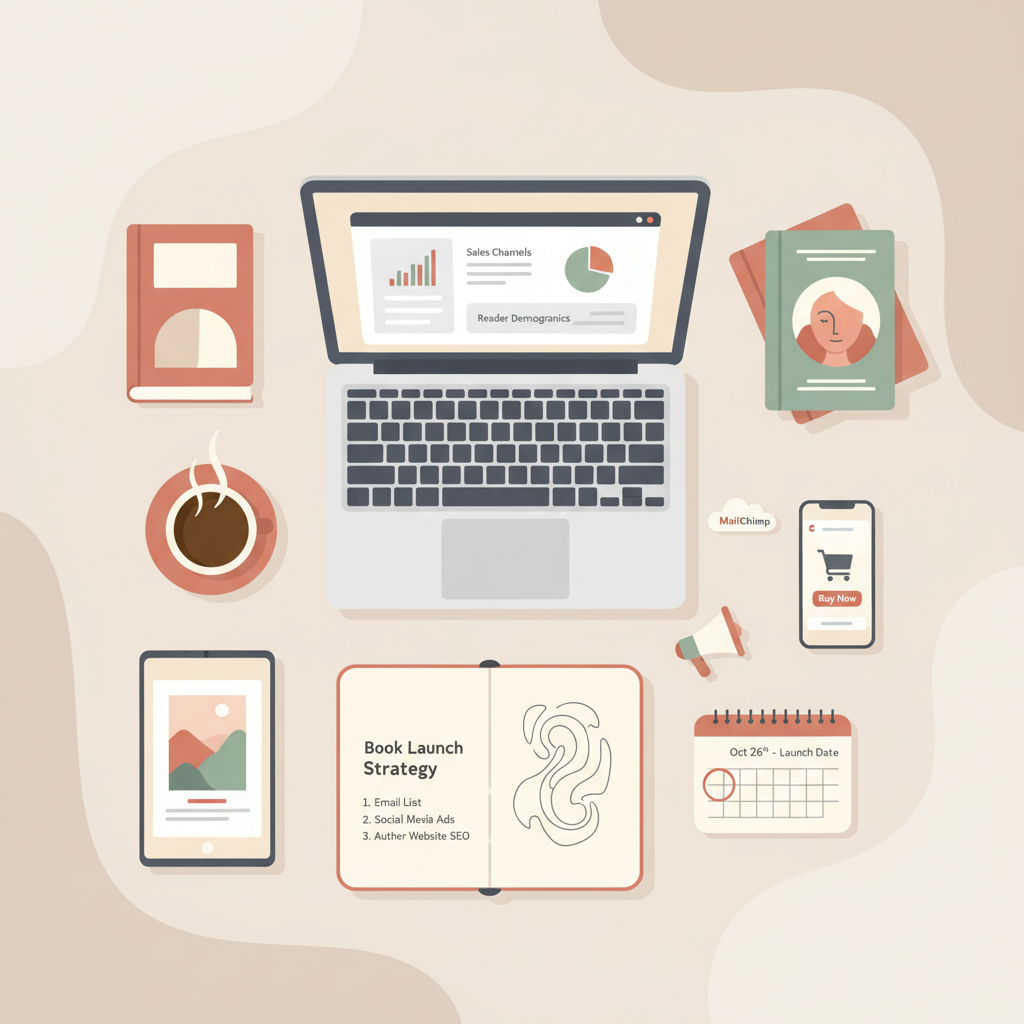
Direct Book Sales Strategy for Indie Authors Explained
Direct Book Sales Strategy
Estimated reading time: 6 minutes
- Direct sales give authors higher margins, control over price, and direct access to readers for repeat sales and testing.
- Reliable systems — a deep backlist, an engaged email list, and multiple product formats — are required to scale direct sales.
- Tools that speed production and remove technical friction (covers, EPUB conversion, formatted manuscripts) make direct-sales businesses practical for more authors.
Table of Contents
- Why Direct Book Sales Strategy Works
- Why: Key Benefits
- How to Build a Direct-Sales System That Scales
- Start with the audience
- Build a useful backlist
- Offer multiple formats
- Pricing and bundles
- Pre-sell and reward superfans
- Fulfillment as a product
- Hybrid distribution
- Operations, Fulfillment, Formats, and Tools
- Production: speed and quality
- Covers that sell
- Ebook files and EPUB
- Checkout and delivery
- Print-on-demand and signed copies
- Customer data and CRM
- How BookAutoAI Supports Direct Sales Growth
- Fast, humanized book production
- Built-in cover generator
- EPUB converter for publishers
- Positioning BookAutoAI in your workflow
- Practical launch sequences
- Pricing illustration and bundles
- Measuring success
- Final thoughts
- FAQ
- Sources
Why Direct Book Sales Strategy Works
Direct book sales strategy is simple in concept: sell your books to readers from channels you control (your website, email, events) instead of relying only on third-party retailers. The appeal is immediate.
Selling directly gives you larger margins per sale, faster payments, and — most valuable of all — direct access to customer data you can use to build relationships and repeat sales.
Why: Key Benefits
Early wins:
- Higher revenue per sale. You keep more of the price when you sell directly.
- Customer data. Email addresses and purchase history let you market new books and special editions.
- Flexibility. You can test pricing, bundles, and special formats that aren’t possible through every retailer.
If you want to scale direct sales, remember this: fast production matters. You don’t need to slow down to edit or format every title manually. Using tools that generate, humanize, and format books reduces time to market and helps you build the backlist depth that drives direct-sales income. For authors exploring monetization tactics and product ideas, see Make Money Writing Books Ai to learn concrete product suggestions and list-growth tactics.
How to Build a Direct-Sales System That Scales
Building a direct-sales business is not the same as listing a book for sale and waiting for buyers. It’s about systems: audience acquisition, product packaging, checkout and delivery, and a repeatable marketing plan. Below are practical steps that work for indie authors.
1. Start with the audience, not just the book
Direct sales are built on readers you already know. Email is the single most reliable asset. Social platforms come and go; email belongs to you. Aim for a simple, clear signup offer — a short free chapter, a checklist, or a short companion guide — that gives people a reason to join your list.
Focus on providing value repeatedly so your list becomes an engaged community, not a static database.
2. Build a useful backlist
Research shows authors with 10+ titles earn far more from direct sales than those with only a few books. Backlists let you bundle, cross-sell, and create premium editions. If you have three books now, make a plan to add one title per quarter or per six months.
Use production tools and systems to keep publishing moving without burning time on repetitive formatting or cover design tasks.
3. Offer multiple formats and tiers
Single-format sales are easier but limit revenue. Offer multiple formats and tiers to increase average order value:
- Standard ebook for reading.
- Special edition ebook with bonus chapter or workbook.
- Print-on-demand paperback or signed paperback for superfans.
- Audiobook or narrated excerpts.
- Bundles or boxed sets with discounted pricing.
4. Pricing and bundles that work
A direct-sales strategy lets you control price testing. Try tiered offers: a low-cost ebook, a mid-priced paperback, and a premium bundle with extras. Limited-time pre-sales with early access and bonus materials convert readers into paying customers.
5. Pre-sell and reward superfans
Pre-sales validate demand and fund production. Pre-sell a special edition to your email list with a clear delivery timeline. Offer early buyers extras: private Q&A, a live webinar, or a signed copy. These tactics build community and reward people who already trust you.
6. Treat fulfillment as a product
Create a reliable checkout and delivery flow. Use clear order confirmation, automated receipts, and reliable download links. If you sell print or signed editions, plan shipping logistics and transparently state costs and timelines.
Delivering a smooth experience builds repeat buyers.
7. Use a hybrid distribution approach
Direct sales work best when combined with retailer distribution. Use direct channels for premium offerings and early access, then publish to Amazon, Kobo, and Apple Books afterward to reach wider audiences.
This hybrid model preserves retailer benefits while capturing the higher margins and data from direct customers.
Operations, Fulfillment, Formats, and Tools
The tactics above are straightforward. The hard part for most authors is the operations: producing multiple formats, creating professional covers, converting files to store-ready EPUBs, accepting payments, and delivering files without manual work. Here are practical, low-friction solutions that help you operate at scale.
1. Production: speed without sacrificing quality
To sustain direct sales you need consistent output. Reduce time spent on repeating tasks: writing templates, editing, formatting, and cover creation. For non-fiction authors who need accuracy and readable copy, an AI-assisted system that produces humanized, fully formatted manuscripts can be a game-changer.
2. Covers that sell at thumbnail size
A professional cover is conversion optimization: it must read at thumbnail size, match genre expectations, and clearly show title and author. Rather than settling for generic artwork, use a specialized cover generator trained on successful book designs to create market-ready covers without hiring a designer.
3. Ebook files that pass platform checks
Converting a manuscript to a clean EPUB is one of the most technical and error-prone steps. Broken metadata, faulty navigation, or embedded images saved incorrectly can cause rejections or ugly previews on Kindle and other stores.
A reliable EPUB converter builds the file properly with correct metadata and embedded cover images so you can upload with confidence. For authors who want a quick, store-ready EPUB without wrestling with formatting tools, this removes a major friction point.
4. Checkout, payments, and delivery
Practical checkout options integrate with websites: payment processors (Stripe, PayPal), digital delivery services (SendOwl, Gumroad), and ecommerce platforms (Shopify). Key points:
- Automate delivery with secure, expiring download links.
- Capture email addresses during checkout and tag purchases in your email platform.
- Offer clear refunds and shipping policies for physical items.
5. Inventory-free print and signed copies
Print-on-demand partners eliminate the need to hold inventory for paperbacks. For signed copies, consider ordering small batches from a print partner or handling signing and shipping yourself for higher-margin signed editions.
6. Customer data and CRM
Use a simple CRM or email platform to store purchase history and segment buyers. Tag customers by product bought, date, and engagement. Those tags let you target offers precisely: pre-orders for sequels, upgrades for ebook buyers, or special editions for repeat buyers.
If your plan includes uploading to retailers or batch distribution, consider a dedicated book-upload tool to simplify the process — many authors use a third-party book upload service to handle technical platform requirements and metadata.
How BookAutoAI Supports Direct Sales Growth
BookAutoAI is designed for authors who want to move quickly from idea to market-ready book without getting stuck on technical steps. For authors building a direct-sales business, speed and consistency in production are essential. BookAutoAI addresses those needs in three practical ways.
1. Fast, humanized book production
BookAutoAI generates complete non-fiction manuscripts up to 25,000 words and humanizes the writing so it reads naturally. That helps you scale your backlist faster — more titles mean more product combinations and more opportunities to convert email subscribers into buyers.
2. Built-in cover generator that sells
Most AI image tools create artwork; BookAutoAI’s built-in cover generator produces market-ready front covers with readable typography and visual hierarchy that works at thumbnail size. Produce professional covers for direct-sales pages and retailer listings in seconds.
3. EPUB converter built for publishers
Publishing technical files is a common roadblock. BookAutoAI’s EPUB converter creates clean, store-ready EPUB files with correct metadata, embedded front cover, and proper chapter structure for compatibility with Kindle and other stores.
4. Positioning BookAutoAI in your direct-sales workflow
Use BookAutoAI to rapidly create lead magnets, special edition ebooks, and retail-ready files after a direct pre-sale. For production and basic publishing tasks, BookAutoAI’s tools at BookAutoAI remove bottlenecks so you can focus on audience building and offers.
Practical launch sequences that combine direct sales and retail
A common approach is a controlled direct pre-sale to your email list, then publish to retailers after the pre-sale delivers momentum. Example sequence:
- Week 0: Announce a pre-sale to your list with a special edition ebook and a signed paperback option.
- Week 1–3: Run pre-sale, fulfill instant-access downloads for ebook buyers, take orders for signed paperbacks.
- Week 4: Close pre-sale, finalize files and upload to retailers with a standard edition release.
This rewards engaged readers, captures purchase data for future marketing, and still lets your book reach broader audiences on Amazon and other platforms.
Pricing illustration and bundles
When you sell direct, you can set pricing for revenue goals. A simple bundle strategy:
- Ebook only: $4.99
- Paperback + ebook bundle: $14.99
- Premium bundle (signed paperback + workbook + early access Q&A): $49.99
Measuring success
Track these metrics:
- Conversion rate from email to sale (goal: 2–10% depending on list engagement).
- Average order value.
- Repeat purchase rate (aim to increase over time).
- Backlist revenue as a percentage of total sales.
The aim is a predictable system where a known share of your list converts at each launch.
Final thoughts
Direct book sales strategy is an investment in control: control of price, customer data, and product formats. It requires systems — a reliable production pipeline, a disciplined email strategy, and clear fulfillment processes.
For authors willing to build those systems, the payoff is higher margins, stronger reader relationships, and a business that can grow predictably as the backlist expands. Visit BookAutoAI to try our demo book.
FAQ
Is direct selling worth the effort for debut authors?
Yes, with caveats. Debut authors can start building direct channels early by collecting email addresses and creating low-friction products like short ebooks or companion guides. It scales as your backlist grows.
Do direct sales hurt retailer rankings?
Not necessarily. When used as part of a hybrid strategy, direct sales can complement retail presence. Time retailer releases to avoid cannibalizing launch momentum.
How many books do I need before direct sales become meaningful?
Research suggests authors with five or more titles see meaningful gains; ten or more titles often produce steady income. Quality and topical focus matter more than raw count.
What formats should I offer for direct buyers?
At minimum, offer ebook and paperback. To increase revenue, add premium formats: signed paperbacks, special edition ebooks, and audio. Bundles help raise average order value.
Which tools should I use to handle conversions and covers?
Use tools built for books: a cover tool tuned to book-market design patterns and an EPUB converter that handles metadata and structure. Integrated production tools reduce errors and speed publishing.
Can I pre-sell to fund production?
Yes. Pre-sales validate demand and fund production. Offer clear delivery timelines and special extras to reward early buyers.
Sources
- https://kindlepreneur.com/the-truth-on-selling-books-direct-insights-from-authors/
- https://selfpublishingadvice.org/direct-selling/
- https://indieauthormagazine.com/direct-book-sales-strategies-for-indie-authors-how-to-grow-your-audience-and-maximize-profits/
- https://www.thecreativepenn.com/2023/10/20/tips-for-selling-and-marketing-your-books-direct-to-readers/
- https://manuscriptreport.com/blog/sell-books-direct-to-readers
- https://amarketingexpert.com/2026/03/31/how-to-sell-more-books-direct-to-consumer-yes-we-mean-sidestepping-amazon/
- https://www.bookautoai.com/book-cover-generator-processing
- https://www.bookautoai.com/epub-converter
- https://www.bookautoai.com
Direct Book Sales Strategy Estimated reading time: 6 minutes Direct sales give authors higher margins, control over price, and direct access to readers for repeat sales and testing. Reliable systems — a deep backlist, an engaged email list, and multiple product formats — are required to scale direct sales. Tools that speed production and remove…