
How to Rank Books on Amazon for Consistent Visibility
How to Rank Books on Amazon
Estimated reading time: 14 minutes
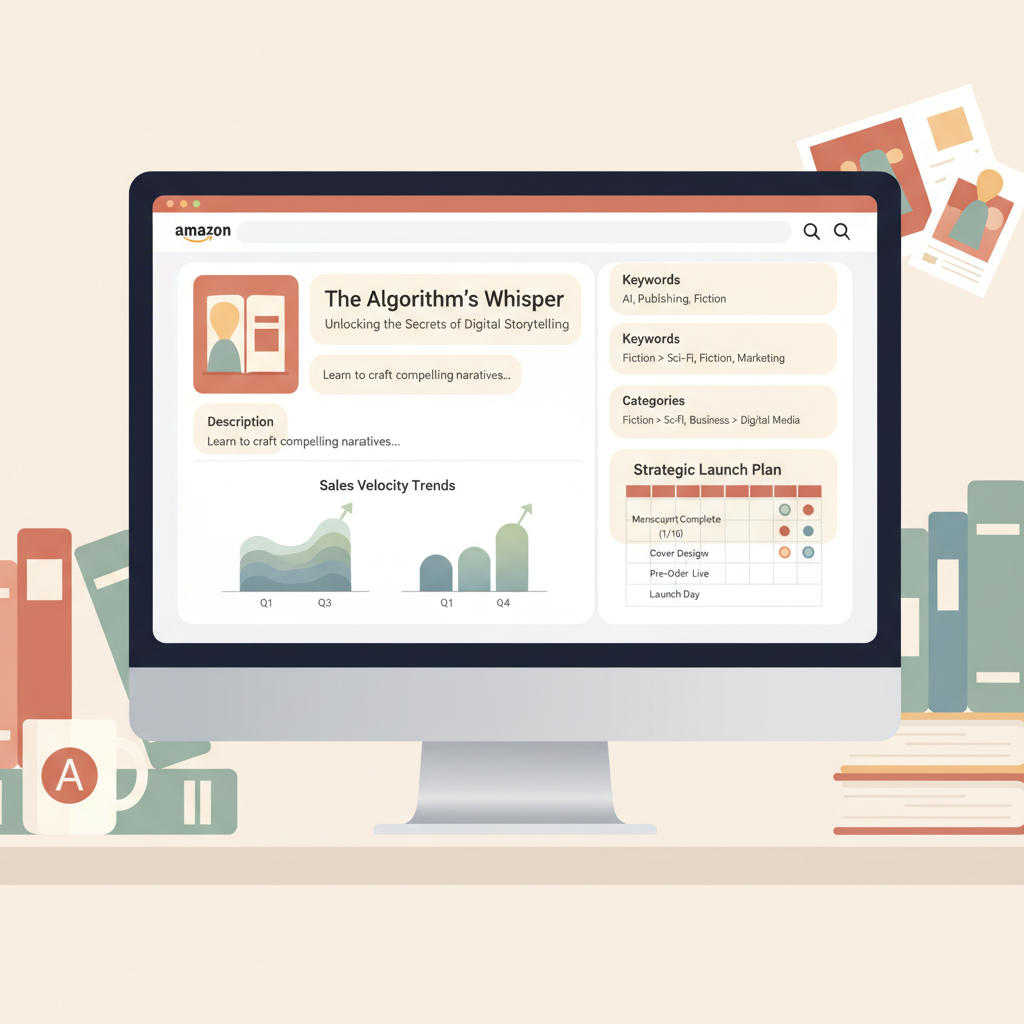
- Amazon prioritizes recent sales velocity plus relevant metadata and category placement — steady sales matter more than one-day spikes.
- Optimize title, subtitle, description, keywords, and categories so your book appears for real reader searches.
- Plan a concentrated launch window and follow it with ongoing promotions, content upgrades, and cross‑promotion.
- Use production tools that remove friction so you can iterate faster and focus on ranking tactics.
Table of Contents
- How Amazon’s Ranking Works
- Metadata that matches real searches
- Choosing categories strategically
- A cover that converts at thumbnail size
- Clean ebook files and format checks
- Create the right product variants
- Checklist before publish day
- Launch and Post-launch Strategies to Build Momentum
- Pre-launch
- Launch week tactics
- Post-launch
- Using reviews and social proof
- Budgeting for ads and promotions
- Measuring Results, Troubleshooting, and Next Steps
- Metrics to watch
- Troubleshooting common problems
- Iterate in cycles
- Use tools to reduce friction and speed iteration
- Final steps before long-term scaling
- FAQ
- Sources
How Amazon’s Ranking Works
Short answer: recent sales matter most. Amazon updates its sales rank frequently (often hourly) and gives extra weight to purchases in the last 24–48 hours.
A concentrated burst of purchases moves rank quickly, but the system favors consistency — steady daily sales beat a single spike.
Three layers control visibility: indexing, ranking, and visibility signals. Indexing ties search queries to your title, subtitle, keywords, description, and category. Ranking orders results by relevance plus recent sales velocity. Visibility signals (bestseller lists, recommendation widgets, “Customers also bought”) create a feedback loop that increases discoverability.
What this means: focus on both a concentrated launch velocity and systems that produce steady sales afterward. Metadata and categories are low-effort, high-impact levers. Early practice tip: reduce production friction so you can focus on metadata and launch tactics; if you’re exploring monetization strategies after you publish, see the guide Make Money Writing Books AI for practical revenue ideas.
Prepare Your Book for Ranking
1. Metadata that matches real searches
Title and subtitle: use your main keyword in the subtitle or title only if it reads naturally. Readers search for problems and outcomes; your subtitle should answer what the book solves.
Description: open with a short paragraph that sells the problem and outcome, then use bullet points for features and benefits. Use simple language and include a couple of relevant reader phrases naturally.
Keywords field: think like a reader — mix short and long phrases and avoid redundancy. Consistent author branding across platforms improves trust and conversions.
2. Choosing categories strategically
Pick two or three categories where you can win a bestseller slot. Pair a niche, low-competition category with a broader, relevant one. Monitor category movement in week one and switch if it increases visibility without misleading readers.
3. A cover that converts at thumbnail size
Your cover needs to attract clicks at thumbnail and confirm quality on the product page. Most generic image tools produce visuals, not market-ready covers. If you need a fast, genre-appropriate design that reads when small, use the cover generator designed for book covers.
4. Clean ebook files and format checks
Upload-ready EPUB or MOBI files reduce publishing friction. Common issues — broken links, missing metadata, failed embedded fonts — can delay publication and harm conversion. Use a validated converter such as the EPUB Converter to produce properly structured EPUBs with correct metadata and chapter navigation.
If you plan to distribute to retailers, consider reliable book upload tools and services for smoother submission; a dedicated book upload tool can simplify uploads to multiple platforms.
5. Create the right product variants
Decide which formats to publish: ebook, paperback, audiobook. Listing multiple formats increases purchase opportunities. For one-place creation and export across formats, consider tools such as BookAutoAI that support EPUB and formatted text outputs for multiple marketplaces.
Checklist before publish day
- Title and subtitle refined for search
- Compelling description with reader-focused opening
- Targeted keywords chosen
- At least two well-chosen categories
- Professional cover that reads in thumbnail
- Valid EPUB and print-ready files
- Author profile and book metadata complete
Launch and Post-launch Strategies to Build Momentum
1. Pre-launch: build an audience and prime sales
Gather a launch list: email subscribers, social followers, and reading groups. People who trust you convert at higher rates.
Offer free previews or lead magnets tied to the book topic (a one- or two-page worksheet works well) and send advance copies to niche reviewers to collect early social proof.
2. Launch week tactics
Time-limited price promotions: pair discounts with targeted advertising to concentrate sales volume; several days is better than a single day.
Ads and targeted promos: run ads to audiences that match your book’s promise, not generic interest. Monitor cost-per-acquisition and adjust quickly.
Coordinate email, ads, social posts, and outreach so purchase signals concentrate during launch week.
3. Post-launch: turn a spike into momentum
Convert buyers into repeat readers by including a content upgrade (guide, checklist, or mini-course) to capture emails and build an audience.
Run price experiments and evergreen promotions (monthly or quarterly deals) and cross-promote other books to increase lifetime value.
4. Using reviews and social proof
Encourage honest reviews with a gentle back-matter request. Respond to reader questions and maintain high-quality page content to improve conversion.
5. Budgeting for ads and promotions
Treat launch ads as a short-term investment. Allocate enough budget to generate meaningful sales velocity across several days and track ROAS to refine targeting and creative.
Measuring Results, Troubleshooting, and Next Steps
Metrics to watch
- Hourly sales rank — Amazon updates frequently.
- Category rank — bestseller placement increases visibility.
- Product page conversion rate — cover, description, and reviews affect this.
- Ad metrics — clicks, CTR, cost-per-click, and cost-per-sale.
Troubleshooting common problems
Slow sales despite traffic: revisit the cover, subtitle, and opening lines of the description — small changes can lift conversion.
Rank drops after a promo: normal — focus on baseline daily sales and schedule follow-up promos.
Poor visibility for search terms: update keywords and product copy to include common reader phrases, not only technical terms.
Iterate in cycles
Optimization is ongoing: Week 1 confirm indexing and category placement; Month 1 run a second promotion to a different segment; Months 2–6 focus on content marketing and partnerships.
Use tools to reduce friction and speed iteration
Faster iteration wins. When production and formatting are slow, you lose time on low-impact tasks. Use tools that speed manuscript generation, cover design, and EPUB export so you can test covers, descriptions, and prices quickly.
Final steps before long-term scaling
Repurpose book content into articles, short courses, or email sequences to maintain traffic. Publish additional related titles to increase cross-sales, and keep the reader experience strong — well-edited, useful books generate word-of-mouth.
FAQ
How quickly does a sales spike affect rank?
Amazon can update rank hourly. A short, concentrated spike can move rank within hours, but sustained placement requires continued sales.
Can keywords in the subtitle hurt my book?
Only if they feel unnatural or spammy. Use natural language that describes outcomes — readability and trust beat keyword stuffing.
How many reviews do I need to rank?
There’s no magic number. Amazon ranks by sales velocity, not review count, but reviews improve conversion which can lead to more sales.
Should I change categories after launch?
Yes, if you can move into a category where the book competes more effectively without misleading readers. Strategic category changes can help you hit a bestseller list.
Will AI-generated books hurt rankings or sales?
Amazon ranks by customer behavior. High-quality, readable content converts. Tools that help produce readable, humanized content can speed production without harming conversion.
What should I monitor after launch?
Watch hourly rank, category movement, conversion rate, and ad performance. Use those signals to decide whether to tweak metadata, creative, or targeting.
Sources
- Amazon KDP Help: Sales Ranking
- Amazon Algorithms for Authors — Demystified!
- Understanding Amazon Category Rankings
- Amazon Book Rank and Sale: 10 Proven Ways to Increase Sales
- Understanding Amazon Rankings – KDP Community
- Amazon Sales Ranking and Calculator for Authors
- https://blog.bookautoai.com/make-money-writing-books-ai
- https://www.bookautoai.com/book-cover-generator-processing
- https://www.bookautoai.com/epub-converter
- https://www.bookautoai.com
How to Rank Books on Amazon Estimated reading time: 14 minutes Amazon prioritizes recent sales velocity plus relevant metadata and category placement — steady sales matter more than one-day spikes. Optimize title, subtitle, description, keywords, and categories so your book appears for real reader searches. Plan a concentrated launch window and follow it with ongoing…