
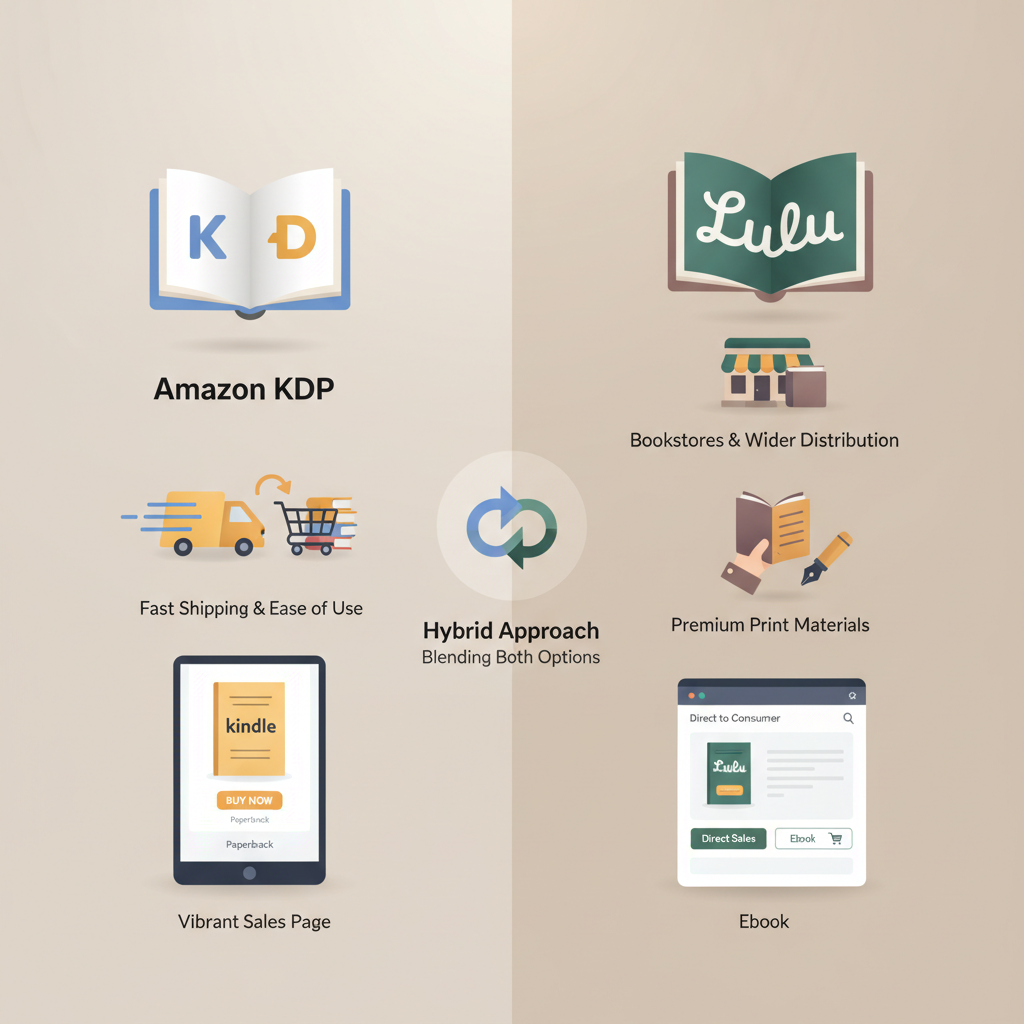
KDP vs Lulu Which Self Publishing Platform Is Right
KDP vs Lulu: Which Self-Publishing Platform Is Right for Your Book?
Estimated reading time: 7 minutes
- KDP is fastest to market with strong Amazon visibility and lower base printing costs for standard paperbacks.
- Lulu offers broader bookstore/library distribution, premium print options, and direct-sales integration at higher per-unit cost.
- Many authors use a hybrid approach: KDP for Amazon-first releases and Lulu (Ingram) for wholesale and bookstore reach.
- BookAutoAI speeds non-fiction production with built-in EPUB conversion and cover tools to reduce manual formatting.
- Plan ISBNs, pricing parity, and order physical proofs before finalizing retail listings.
Table of Contents
- Quick comparison: KDP vs Lulu
- Production, pricing, and distribution — the tradeoffs
- Production quality and format options
- Pricing and royalties
- Distribution reach
- How to pick based on your goals and timeline
- Recommended workflows and how BookAutoAI helps
- Draft and generation
- Quick edit pass
- Cover design
- Ebook conversion
- Choose publishing channels
- Upload and monitor
- FAQ
- Sources
Quick comparison: KDP vs Lulu
KDP vs Lulu is a common question for independent authors because both platforms solve different problems. In short: choose KDP if you want speed, Amazon reach, and low printing costs for paperbacks. Choose Lulu if you need wide retail distribution, premium print choices, or direct-sales integration.
Amazon KDP (Kindle Direct Publishing)
- Strengths: Amazon marketplace integration, fast approval (often 24–72 hours), lower printing costs for standard paperbacks, and easy setup for Kindle eBooks.
- Weaknesses: Limited wholesale reach (bookstores and libraries use different channels), fewer premium print options, and some restrictions if you use KDP Select.
Lulu
- Strengths: Distribution through Ingram and retail partners, customizable premium printing (hardcovers, specialty paper), and better support for direct sales and order fulfillment for authors who want control.
- Weaknesses: Slower processing times (several days to a couple of weeks), higher base printing costs, and slightly more complexity during setup.
A practical note for authors: some choose KDP to get an Amazon listing quickly, then use Lulu for a wider retail strategy. If you want a walk-through for publishing to Amazon, see Publish Book Amazon Kdp 3 for step-by-step guidance and practical tips to avoid common errors.
Production, pricing, and distribution — the tradeoffs
When you compare KDP vs Lulu you have to weigh three big areas: production quality, pricing and royalties, and distribution channels. Each platform optimizes different parts of the publishing pipeline.
Production quality and format options
- KDP handles standard trade paperbacks well and offers streamlined print-on-demand (POD) for both paperback and basic hardcover options. Their templates are simple, and turnaround is fast.
- Lulu focuses more on print customization. If you want premium hardcover cloth, layflat binding, or unusual trim sizes and paper stocks, Lulu typically offers more options and a more premium feel.
Pricing and royalties
- KDP generally offers lower per-unit printing costs for common paperback sizes. That helps authors price competitively on Amazon and maintain higher effective royalties for wide-discount retail pricing.
- Lulu’s print costs are higher for many configurations. Lulu compensates with broader distribution possibilities and more favorable wholesale arrangements for bookstores, but that often means lower take-home pay per retail sale after retailer discounts and distribution fees.
Distribution reach
- KDP’s distribution is Amazon-first. If your marketing plan relies on Amazon search, ads, or Kindle ecosystem visibility, KDP gives the shortest path to discoverability and buyer traffic.
- Lulu distributes through Ingram and many retail partners that feed bookstores and libraries. If you want to be available to bricks-and-mortar retailers or need ISBN and wholesale placement, Lulu’s network is an advantage.
Speed and control
- KDP: Faster proofs, faster live listings, simpler rules for pricing and reprints.
- Lulu: More control over customization and distribution, but with longer processing times and more steps.
Royalties on KDP are straightforward for Amazon sales: list price minus printing cost and Amazon fees. Lulu sales to retailers often include standard retailer discounts (40–55%), which can lower take-home pay after distribution fees.
Real-world author scenarios: Serial non-fiction authors and course creators who need quick updates often prefer KDP; authors who want bookstore placement, premium finishes, or direct-sales control may use Lulu or both.
How to pick based on your goals and timeline
Choosing between KDP vs Lulu should start with a short list of priorities. Answer these questions first:
- Is Amazon the primary sales channel?
- Do you need bookstore or library distribution?
- Will you sell direct to customers from your website?
- Do you need premium print finishes or unusual sizes?
- How quickly do you need the book live?
Decision guide
- Fast Amazon visibility and low-cost paperbacks → KDP.
- Retail bookstore placement, premium print, or direct-sales integration → Lulu.
- Both or unsure → Hybrid: publish on KDP to capture Amazon traffic quickly, and use Lulu/Ingram for bookstore/library reach.
Practical tips when using both platforms
- ISBNs: Use unique ISBNs per platform as required. If you want the same ISBN across channels, buy your own ISBN and confirm platform policies (KDP’s free ISBNs are Amazon-assigned and tied to KDP).
- Pricing parity: Keep list prices consistent where possible to avoid retailer conflicts.
- Proofing: Always order a physical proof from each provider before finalizing marketing assets.
- Inventory and returns: Lulu’s wholesale distribution uses different return policies; budget time for reconciliation with retailers.
Common mistakes to avoid: publishing identical ISBNs across platforms, assuming Amazon will push outside channels, and ignoring proof copies—the same file can print differently with color, margins, or text flow.
Recommended workflows and how BookAutoAI helps
If you’re a non-fiction author who needs speed without sacrificing quality, BookAutoAI simplifies the production pipeline. It can generate manuscript drafts, humanize copy, create covers, and produce EPUB files to reduce formatting friction.
1. Draft and generation
Start with your idea and use BookAutoAI to generate a full non-fiction manuscript (up to 25,000 words). The system humanizes language so the text reads naturally and is easier to edit.
2. Quick edit pass
Do a focused edit for facts, examples, and voice. Treat generated output as an advanced first draft and adapt it to your style and subject accuracy.
3. Cover design
Use the built-in cover tool to produce market-ready artwork with readable typography and strong thumbnail clarity. For automated cover production, try the cover generator to create a professional front cover in a single step.
4. Ebook conversion
Convert your edited manuscript into EPUB with the BookAutoAI EPUB Converter. It handles metadata, embeds the cover, and builds clean chapter navigation so you avoid common upload errors for Kindle, Kobo, and Apple Books.
For bulk or complex uploads, consider a dedicated book upload tool to speed multi-channel distribution and reduce manual steps.
5. Choose publishing channels
If Amazon is your priority, publish on KDP for fast listings and Kindle visibility. If you need bookstore/library placement or premium print, set up Lulu with Ingram distribution as a parallel path.
6. Upload and monitor
Use KDP for Amazon-first listings and Lulu/Ingram for wholesale channels. Monitor sales, update files when needed, and keep metadata and pricing consistent across retailers.
Why this approach works
- Speed: KDP listings often go live within 24–72 hours, letting you hit launch windows quickly.
- Quality: BookAutoAI’s formatting and conversion tools reduce manual fixes and ensure files meet store requirements.
- Reach: Using both platforms as needed gives you Amazon presence plus bookstore and library access via Ingram/Lulu.
Pro tip: always order a physical proof from each provider—paper, color, and margins can vary between vendors.
Final operational tip: standardize processes across titles. Use BookAutoAI for manuscript generation and formatting, the cover generator for consistent series branding, and the EPUB converter to produce clean ebook files. That reduces repetitive setup and keeps production predictable.
Visit BookAutoAI.com and try our demo book.
FAQ
Can I publish the same book on both KDP and Lulu?
Yes. Check ISBN rules and distribution settings. KDP’s free ISBNs are Amazon-assigned and tied to KDP; buy your own ISBN if you want broader reuse.
Which platform pays higher royalties?
It depends. For Amazon sales KDP often gives higher effective royalties due to lower printing costs. Wholesale sales through Lulu/Ingram typically involve retailer discounts that reduce net royalties.
Are Lulu prints higher quality than KDP?
Lulu usually offers more premium options (hardcovers, specialty papers, layflat), which can feel higher quality. KDP is consistent and fast for standard trade paperbacks.
How quickly can I get a book live on Amazon?
KDP typically lists paperbacks and ebooks within 24–72 hours. Lulu/Ingram timelines are more variable and can take several days to two weeks for wholesale distribution.
Will BookAutoAI handle both the cover and EPUB conversion?
Yes. BookAutoAI includes a cover generator and an EPUB converter that produce store-ready covers and EPUB files with embedded metadata and navigation.
Sources
- https://blog.bookautoai.com/amazon-kdp-vs-lulu/
- https://kdp.lulu.com
- https://brandspire.co.uk/self-publishing-platforms-compared-amazon-kdp-lulu-and-ingramspark/
- https://www.printingcenterusa.com/blog/lulu-vs-other-self-publishing-platforms/
KDP vs Lulu: Which Self-Publishing Platform Is Right for Your Book? Estimated reading time: 7 minutes KDP is fastest to market with strong Amazon visibility and lower base printing costs for standard paperbacks. Lulu offers broader bookstore/library distribution, premium print options, and direct-sales integration at higher per-unit cost. Many authors use a hybrid approach: KDP…