
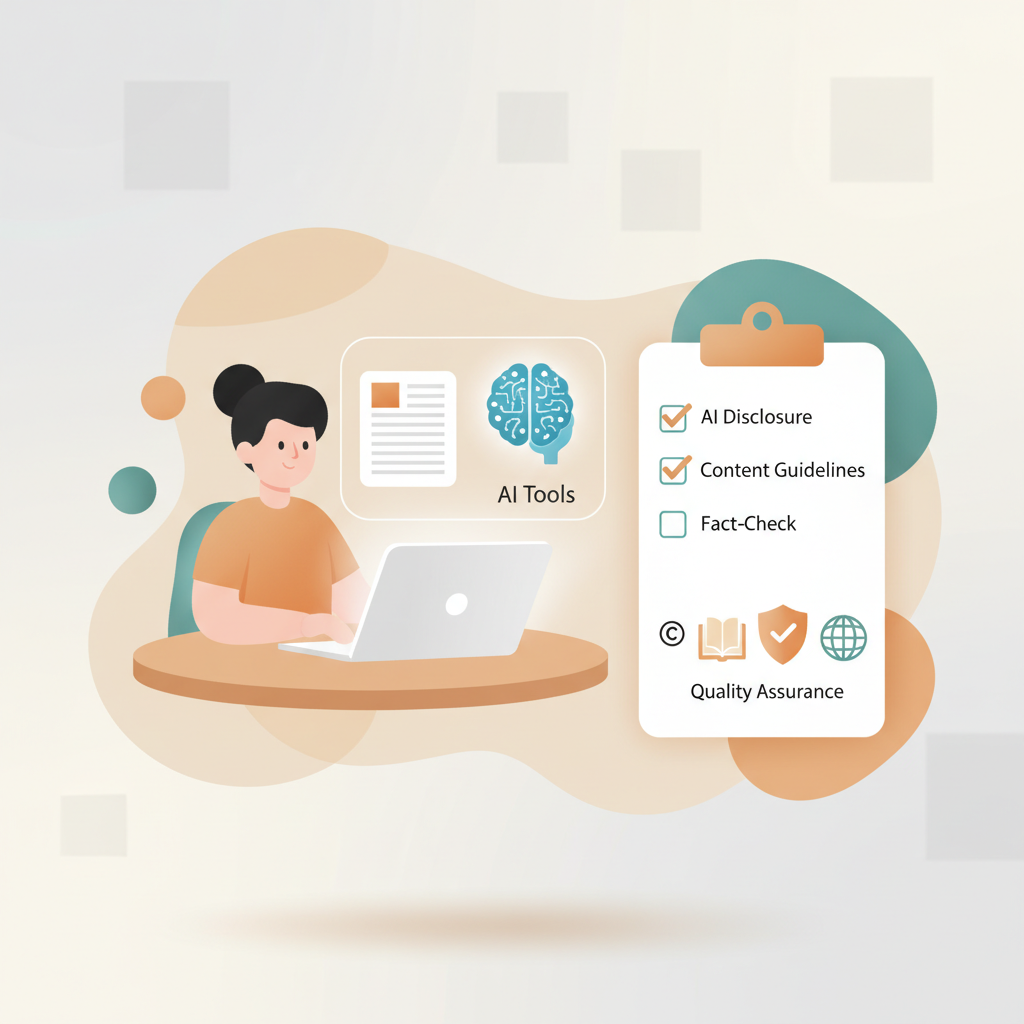
Amazon KDP AI Guidelines for Self-Publishing Authors
amazon kdp ai guidelines: A compliance-first guide for self-publishers
Estimated reading time: 7 minutes
- Amazon KDP allows AI use but requires disclosure for AI-generated text, images, or translations.
- Authors retain full responsibility for accuracy, copyright, and quality even when using AI.
- Human review, fact-checking, and marketplace-ready EPUBs/covers reduce risk and upload friction.
- Use tools that produce clean EPUBs and thumbnail-ready covers to minimize technical rework.
- Keep a short log of tools, dates, outputs, and rights; disclose AI use when publishing or republishing.
Table of Contents
- What Amazon actually requires for AI-generated content
- Operational steps: Preparing an AI-assisted book for KDP
- Classify the AI role in your project
- Human review and fact-checking
- Rights clearance for images and content
- Quality and readability checks
- Prepare accurate metadata and disclosure
- Convert to a compliant EPUB and generate a thumbnail-ready cover
- How BookAutoAI helps you meet KDP’s expectations
- Practical upload checklist and example workflow
- Before you upload
- KDP upload steps
- Example workflow timeline
- Common upload pitfalls
- How to document your AI usage
- Final thoughts
- FAQ
- Sources
What Amazon actually requires for AI-generated content
Amazon’s approach is straightforward: AI is allowed, but transparency and responsibility are required. When you upload a title to KDP, the platform now asks whether text, images, or translations in the book were generated by AI. That means honest disclosure is mandatory for content created or substantially produced by AI tools.
Key points to understand right away
- Disclosure trigger: You must tell KDP if any text, images, or translations were created by AI when you publish or republish. Routine editing or brainstorming that leaves the final authorship clearly human does not require disclosure.
- Responsibility stays with the author: Even when AI tools are used, the author is fully responsible for accuracy, copyright, safety, and quality.
- Not a ban: Amazon expects disclosure and quality, not a blanket prohibition on AI-generated books.
- Practical implication: If your manuscript includes AI-created passages, images, or translations, be ready to classify that use during the KDP upload flow.
Why this matters for non-fiction: Non-fiction readers expect reliable information, clear attribution, and a professional reading experience. Use AI to speed production, but not as a substitute for human editorial judgment.
Operational steps: Preparing an AI-assisted book for KDP
Turn policy into practice with a simple, trackable checklist. Below are the essential operational steps you should follow to reduce risk when publishing AI-generated or AI-assisted non-fiction on KDP.
1) Classify the AI role in your project
Before you upload, decide which category fits your work:
- AI-assisted (no disclosure required): Brainstorming, editing, grammar checks, or rewrites that leave the final work authored by a human.
- AI-generated (disclosure required): Significant text, images, or translations produced by AI that you include as-is or with only light edits.
Document your process with a brief project note — date, tool, and what was produced — to help if Amazon requests clarification later.
2) Human review and fact-checking (non-negotiable)
AI can invent sources or make factual errors. For non-fiction you must:
- Verify factual claims against reliable references.
- Check or remove AI-generated citations that don’t match real sources.
- Attach verified sources when AI supplies data or remove unsupported claims.
3) Rights clearance for images and content
If you use AI to generate images, confirm ownership and licensing; keep prompts and any licensing statements. For third-party text, ensure permission or fair use applies; when in doubt, rewrite, shorten, or omit.
4) Quality and readability checks
Amazon’s Kindle Publishing Guidelines still apply. Focus on clear chapter structure, proper formatting, and consistent citation style to avoid a poor reader experience or takedowns.
5) Prepare accurate metadata and disclosure
KDP will ask whether AI was used for text, images, or translations — answer honestly and be prepared to provide a brief note if requested.
6) Convert to a compliant EPUB and generate a thumbnail-ready cover
A well-structured EPUB and a professional cover reduce technical checks and buyer returns. Use a reliable converter such as the EPUB Converter to produce embedded metadata, correct chapter navigation, and wide compatibility. For covers, choose a design that reads at thumbnail size and follows genre norms; the Cover Generator helps create readable, market-ready front covers.
How BookAutoAI helps you meet KDP’s expectations
If your goal is reliable non-fiction on KDP while following AI rules, BookAutoAI is built to fit that workflow. The platform reduces the most error-prone parts of publishing, while leaving the author responsible for editorial and legal checks.
Where BookAutoAI adds value
- End-to-end manuscript generation: Produces structured drafts and humanizes phrasing to reduce obvious AI artifacts.
- Built-in formatting and EPUB output: Converts manuscripts into store-ready EPUBs; see the EPUB Converter for a compliant output option.
- Market-ready covers: The Cover Generator produces covers optimized for thumbnail legibility and genre conventions.
- Humanization: Produced prose is varied and natural-sounding, improving readability and reducing mechanical patterns.
What you still must do
- Disclosure: If significant portions were generated by AI, disclose during the KDP upload flow.
- Editorial oversight: Perform fact-checks, validate sources, and ensure stylistic consistency.
- Rights documentation: Keep records of prompts, model licenses, and permissions for any third-party material.
Practical examples of a compliant BookAutoAI workflow
- Draft and outline: Generate an initial manuscript and structured chapters; treat it as a first draft that needs verification.
- Humanize and edit: Run humanization features, then perform fact-checking and remove invented citations.
- Format and convert: Use the EPUB Converter to create a store-ready EPUB with embedded metadata and an embedded cover.
- Create a cover: Use the Cover Generator to produce a thumbnail-friendly front cover that follows genre norms.
For authors creating paperbacks or ebooks, the BookAutoAI platform centralizes drafting, humanization, formatting, and cover creation in one place.
Practical upload checklist and example workflow
Use this checklist on publish day to reduce mistakes and speed the KDP submission.
Before you upload
- Finalize content and classify whether the book contains AI-generated text, images, or translations.
- Perform at least one round of human editing focused on clarity and flow.
- Do a fact-check pass: verify claims and correct or remove unsupported statements.
- Ensure images and source material are cleared; keep a one-page log of rights and sources.
- Prepare metadata: title, subtitle, description, keywords, and categories.
- Export a final EPUB and a front cover image ready for embedding; test the cover at thumbnail size.
KDP upload steps
- Start a new title in KDP and fill in basic metadata.
- When prompted about AI use, answer honestly and specify whether AI was used for text, images, or translations.
- Upload your manuscript EPUB and cover image.
- Preview using Kindle Previewer inside KDP to check formatting and navigation.
- Final check price, territories, and Kindle Select options.
- Submit for publication.
Example workflow timeline
- Day 1–2: Generate manuscript and outline and run humanization features.
- Day 3: Human edit and fact-check.
- Day 4: Generate cover and convert the final EPUB with the EPUB Converter.
- Day 5: Upload to KDP, answer the AI disclosure questions, preview, and publish.
Common upload pitfalls and how to avoid them
- Pitfall: AI-generated citations that don’t exist. Fix: Replace with verified sources or remove.
- Pitfall: Poor EPUB navigation after conversion. Fix: Use a converter that creates clean chapter anchors and a table of contents.
- Pitfall: Cover text unreadable at thumbnail size. Fix: Test at 160–200 px width and adjust typography.
- Pitfall: Forgetting to disclose AI images. Fix: Review image assets and declare AI generation if applicable.
How to document your AI usage (simple record-keeping)
Keep a short document with date, tool used, what the AI produced, notes on how you edited or reviewed the output, and any licensing statements. This log helps if Amazon asks for clarification or if you later sell rights.
If your process involves uploading to retailers or working with distribution tools, consider using specialized book uploading tools to reduce manual steps and ensure consistent metadata across platforms.
Final thoughts
Amazon balances openness with responsibility: AI is allowed, disclosure is required for AI-generated elements, and authors remain accountable. For non-fiction authors the three priorities are honest disclosure, rigorous human review, and clean marketplace-ready technical output.
Tools that produce cleaner draft text, compliant EPUBs, and professional covers reduce the manual work that causes upload problems or customer complaints. Use a reliable EPUB conversion tool and cover-generation process to minimize technical friction.
If you use AI, do it deliberately: keep records, verify facts, clear rights, and disclose when required. That approach keeps you compliant with Amazon KDP AI guidelines and helps build a sustainable publishing program that prioritizes reader trust.
FAQ
Q: Does Amazon reject books simply because they were generated by AI?
No. Amazon does not ban AI-generated books; it requires disclosure for AI-generated text, images, or translations and expects all content to meet normal quality and copyright standards.
Q: When do I have to answer Amazon’s AI question?
KDP asks the AI disclosure during the upload flow when you publish a new title or when you edit and republish an existing title.
Q: Do I need to disclose AI-assisted editing or brainstorming?
Not usually. KDP distinguishes AI-assisted tasks (editing, brainstorming) from AI-generated content (substantial text, images, translations). Only the latter requires disclosure.
Q: How should I document AI use for Amazon?
Keep a short record with dates, tools, what the AI produced, how you edited or verified output, and any licensing statements from the tools used for images or datasets.
Q: Can tools help reduce the technical hurdles of KDP uploads?
Yes. Use converters that produce clean EPUBs with proper metadata and covers that are thumbnail-ready. Dedicated tools reduce technical cleanup during KDP upload.
Q: What if an AI-created citation is wrong?
Replace the citation with a verified source or remove the claim. Never leave invented references in a non-fiction manuscript.
Sources
- KDP Content Guidelines – Artificial intelligence (AI) content: https://kdp.amazon.com/help/topic/G200672390
- Kindle Publishing Guidelines: https://kdp.amazon.com/help/topic/GU72M65VRFPH43L6
- KDP Tools and Resources: https://kdp.amazon.com/help/topic/G200735480
- Amazon KDP New AI Guidelines Explained (YouTube): https://www.youtube.com/watch?v=snETOBDgRrA
- Amazon KDP’s ‘AI-Generated’ Book Content Guidelines: Summer 2025 (YouTube): https://www.youtube.com/watch?v=TowyY6TDh-M
- How Does AI Writing Work and Does Amazon Allow It (Publishing.com): https://www.publishing.com/blog/how-does-ai-writing-work
amazon kdp ai guidelines: A compliance-first guide for self-publishers Estimated reading time: 7 minutes Amazon KDP allows AI use but requires disclosure for AI-generated text, images, or translations. Authors retain full responsibility for accuracy, copyright, and quality even when using AI. Human review, fact-checking, and marketplace-ready EPUBs/covers reduce risk and upload friction. Use tools that…