
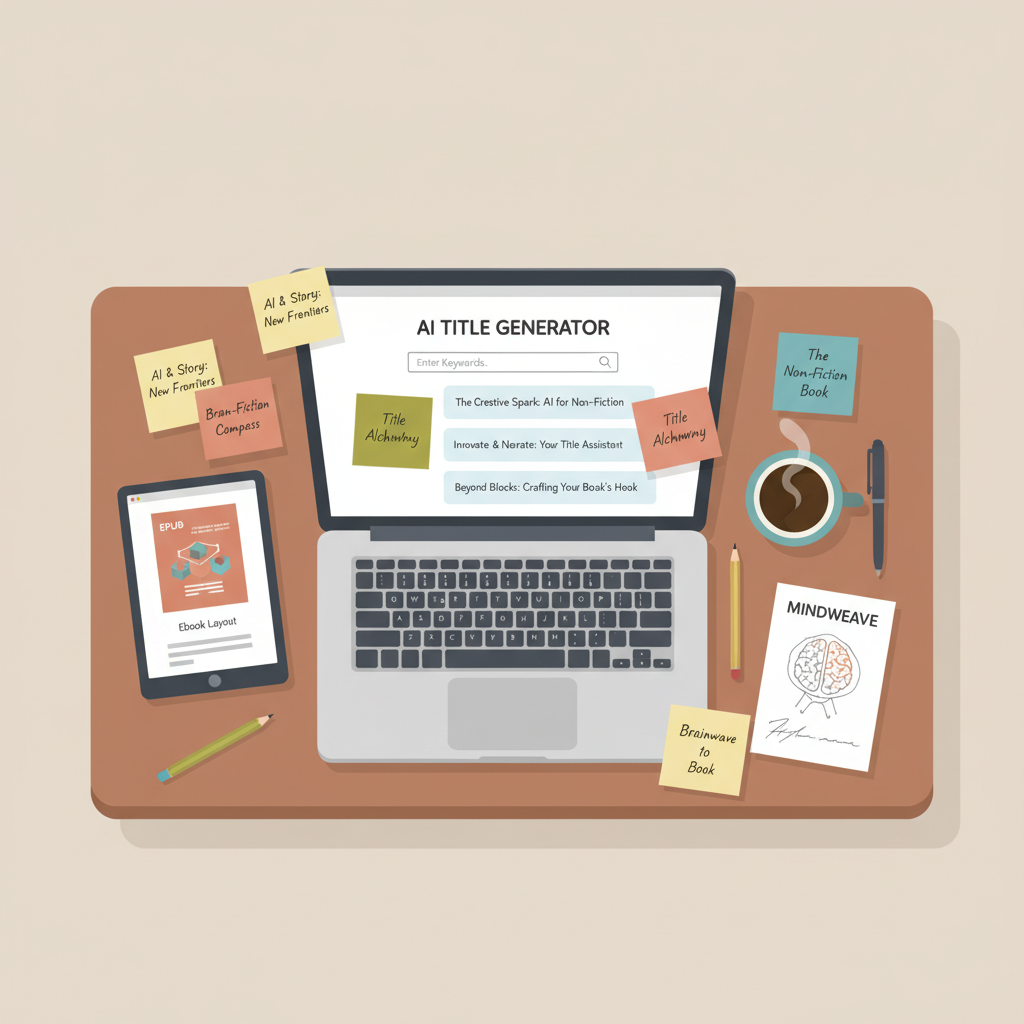
AI Tools for Title Generation for Non-Fiction Authors
AI Tools for Title Generation
Estimated reading time: 6 minutes
- AI title tools speed ideation and surface SEO-aware headline options but are best as a starting point.
- Non-fiction titles require subtitle clarity, genre signals, and market testing beyond simple generators.
- Pairing title ideas with cover design and clean EPUB output reduces rework and speeds publishing.
- End-to-end systems that include cover and EPUB tools help authors move from idea to store-ready files.
Table of Contents
- AI Tools for Title Generation
- What AI tools for title generation do — and where they fall short
- Why use them
- Common processes
- Where they fall short for books
- When a title generator is useful for authors
- Limitations authors should accept
- How authors weave title generators into a full book process
- Ideation
- Shaping
- Production
- Why combine tools rather than rely on just one
- How to write better book titles with AI (practical workflow)
- Step 1 — Start with a concise brief
- Step 2 — Generate broad options
- Step 3 — Test subtitle clarity
- Step 4 — Apply simple filters
- Step 5 — Visual test on cover thumbnails
- Step 6 — Metadata and marketplaces
- Step 7 — Final human edit and market check
- Practical examples (short)
- Why end-to-end platforms matter for non-fiction authors
- Final thoughts and next steps
- FAQ
- Sources
What AI tools for title generation do — and where they fall short
Why use them
AI Tools for Title Generation are small, focused models that use natural language processing to propose headline and title options from a short prompt. Enter a topic, a few keywords, and a tone, and the tool returns multiple suggestions: short blog headlines, video titles, email subject lines, or paper titles.
These tools excel at speed and variety. Within seconds you can see dozens of versions you might not have thought of.
Common processes
Typical use: paste a topic or a short summary, choose a tone/format, optionally add target keywords, and click generate. Results appear in an editable list designed for short-form content such as blog posts, emails, or social updates.
Where they fall short for books
Generating a book title differs from a short headline. Book titles must consider market fit, genre signals, subtitle clarity, reader expectations, and discoverability across bookstores and retailers. Most title generators are optimized for short content and lack book-specific features like subtitle structure, series naming, or market-level testing.
Authors who move beyond ideation often pair title generators with specialized publishing tools that handle the rest of the book lifecycle; for a view of platforms that help authors beyond headlines, check the guide Best AI Book Writing Tools.
When a title generator is useful for authors
- Early brainstorming for book title concepts and subtitle phrasing.
- Testing tone variations quickly (authority vs. curiosity-based titles).
- Generating headline-style ideas for marketing copy and chapter titles.
Limitations authors should accept
- No market validation: generators don’t test reader response in marketplaces.
- Lack of formatting: they don’t embed titles into covers or metadata automatically.
- Not tuned to long-form narrative: book titles need broader positioning and editorial judgment.
If you want a fast list of creative title options, title generators are useful as ideation tools. For a finished, market-ready title coupled with cover design, structured metadata, and a formatted ebook, use a fuller system that integrates design and publishing output.
How authors weave title generators into a full book process
A title is one leaky bucket in a larger publishing container. For non-fiction authors aiming to publish widely and professionally, an efficient approach contains three parts: ideation, shaping, and production. Title generators sit in ideation, but an efficient publisher moves the idea into shape and production quickly.
1) Ideation: rapid title and subtitle options
Start with a generator to produce dozens of headline options and subtitle drafts. Use varied prompts: promise-based titles (what readers will learn), curiosity-based titles (questions or surprises), and authority-based titles (credentials, frameworks). Save your favorites.
2) Shaping: market fit and reader signals
Test favorites against reader expectations for your genre. Non-fiction buyers look at clarity, promise, genre signals, and search intent.
- Clarity: Does the title communicate the benefit or topic clearly?
- Promise: Does the subtitle spell out what the reader will get?
- Genre signals: Does the tone match other books in your category?
- Search intent: Are your keywords aligned with common search queries?
This shaping step is editorial rather than mechanical. Human judgment matters. If you want to move faster, use a system that integrates title work and design so you can preview titles on covers and in retailer metadata.
3) Production: formatting, cover, and distribution
A title only works when it appears in a properly formatted book with a cover that matches buyer expectations. The cover should reflect genre conventions and read at thumbnail size. Metadata (title, subtitle, category, keywords) should be structured for the target retailer; manual formatting and testing across stores is time-consuming and error-prone.
That’s why many authors choose platforms that handle production: they let you embed a title into a market-ready cover and convert a manuscript into a clean, store-ready EPUB. For automated cover generation trained on industry patterns, see the cover generator, and for reliable EPUB output use the EPUB converter.
For upload and distribution compatibility with retailers like Kindle, KDP, Kobo, and Apple Books, consider dedicated book upload tools to reduce errors at store submission.
Why combine tools rather than rely on just one
Independent title tools are excellent for ideation, but a book is a product and benefits from an integrated system. Combining title work with cover design, metadata handling, and EPUB conversion reduces rework (for example, changing a title after a cover is made), prevents formatting errors at upload, and improves speed to market.
How to write better book titles with AI (practical workflow)
Below is a repeatable process that uses title generation intelligently without surrendering editorial control. The goal: faster ideation, cleaner testing, and a clear path into production.
Step 1 — Start with a concise brief
Give the title generator 1–3 sentences describing the book: main benefit, target reader, and tone.
Good brief example: “A practical guide for freelancers to build a predictable client pipeline. Target reader: new and early-career freelancers. Tone: practical and no-nonsense.”
Step 2 — Generate broad options
Run multiple prompts and variations. Ask for short, punchy titles (3–5 words), descriptive titles with subtitles, and question-based options. Don’t stop at the first output.
Step 3 — Test subtitle clarity
Subtitles sell non-fiction. Ask the tool to expand one-line titles into full title + subtitle pairs that clearly state the promise and outcome.
Step 4 — Apply simple filters
Score each option on three quick criteria:
- Clarity (1–5): Can a reader tell the promise?
- Differentiation (1–5): Is it distinct in the category?
- Keyword fit (1–5): Does it match search intent?
Drop low-scoring options and keep 6–12 stronger candidates.
Step 5 — Visual test on cover thumbnails
Titles live and die at thumbnail size. Mock up thumbnail covers quickly to evaluate legibility and visual hierarchy. If you use a system with a cover generator you can preview titles on covers in seconds, which speeds selection and reduces rework.
Step 6 — Metadata and marketplaces
Map your chosen title and subtitle into retailer metadata fields (title, subtitle, keywords, categories). Ensure the title and subtitle work with common retailers’ rules and preview windows.
Step 7 — Final human edit and market check
A final editorial pass is essential. Check for unintended meanings, trademark conflicts on prominent terms, and cultural connotations in target markets. Optionally, run small paid promos or ads to test click-throughs on title variations before committing to a cover and wide distribution.
Practical examples (short)
Prompt: “Guide for busy managers to reduce email time.” Generator output: “Zero-Inbox Meetings: How Busy Managers Reclaim 10+ Hours a Week” — strong because it combines a clear benefit with a concrete promise.
Prompt: “Start a side business from home.” Output: “Weekend Founder: Launch a Side Business in 12 Weeks Without Quitting Your Job” — clear audience/timeframe promise.
Why end-to-end platforms matter for non-fiction authors
If you intend to publish a full book, a title generator is only step one. The production needs — cover, EPUB, metadata — determine speed and quality. Using a system that integrates title selection with cover generation and EPUB conversion avoids common pitfalls:
- Rework due to title changes after cover design
- Broken formatting during EPUB conversion
- Missing or incorrect metadata that blocks publishing
Many authors use systems that generate complete books, create market-ready covers, and produce clean EPUB files for stores. For authors building a finished book product, Bookautoai provides a combined experience for title work, cover design, and EPUB output.
Final thoughts and next steps
Title generators are excellent for sparking ideas and exploring angles fast. They multiply options and free authors from getting stuck on a single phrasing. But a title alone doesn’t sell a book: it must work with a clear subtitle, a genre-appropriate cover, and clean formatting that looks right on retailer pages.
Practical next steps:
- Create 20–50 raw ideas from varied prompts.
- Filter and score favorites by clarity, differentiation, and keyword fit.
- Mock titles on thumbnail covers and check retailer metadata previews.
- Move a chosen title into a production tool that creates a cover and store-ready EPUB so title and design are tested together.
FAQ
Can AI title tools generate good book subtitles?
Yes — many title tools suggest subtitle options, but subtitling for non-fiction is more nuanced and benefits from a human edit to clarify promise, audience, and method or timeframe.
Will a title generator replace my editor?
No. Generators speed ideation, but editors add market knowledge, clarity, and craft. Use generators for raw ideas, then bring an editor to polish titles and subtitles.
How do I test multiple titles in the market?
Run small paid ads to compare click-throughs on different covers and metadata, or gauge reactions from email lists and social channels. For clearer results, test titles on cover thumbnails in paid promotions.
Do title generators work for every language?
Many tools support multiple languages, but quality varies. Always have a native speaker review suggestions for tone and idiom.
Will retailers allow AI-generated titles?
Retailers don’t ban AI-generated titles. They care about metadata accuracy, formatting, and compliance with content policies. Ensure your title accurately represents the book and meets retailer rules.
Sources
- https://www.kittl.com/tools/writing/title-generator
- https://quillbot.com/ai-writing-tools/ai-title-generator
- https://titlegenerator.com
- https://paperguide.ai/paper-title-generator/
- https://www.canva.com/title-generator/
- https://www.semrush.com/free-tools/title-generator/
- https://ahrefs.com/writing-tools/seo-title-generator
- https://x.writefull.com/title-generator
AI Tools for Title Generation Estimated reading time: 6 minutes AI title tools speed ideation and surface SEO-aware headline options but are best as a starting point. Non-fiction titles require subtitle clarity, genre signals, and market testing beyond simple generators. Pairing title ideas with cover design and clean EPUB output reduces rework and speeds publishing.…