
Evergreen Book Sales Strategy Explained for Authors
Evergreen Book Sales Strategy: A Practical Guide for Self-Publishers
Estimated reading time: 8 minutes
- An evergreen strategy emphasizes steady, long-term discovery and conversions rather than one-off launch spikes.
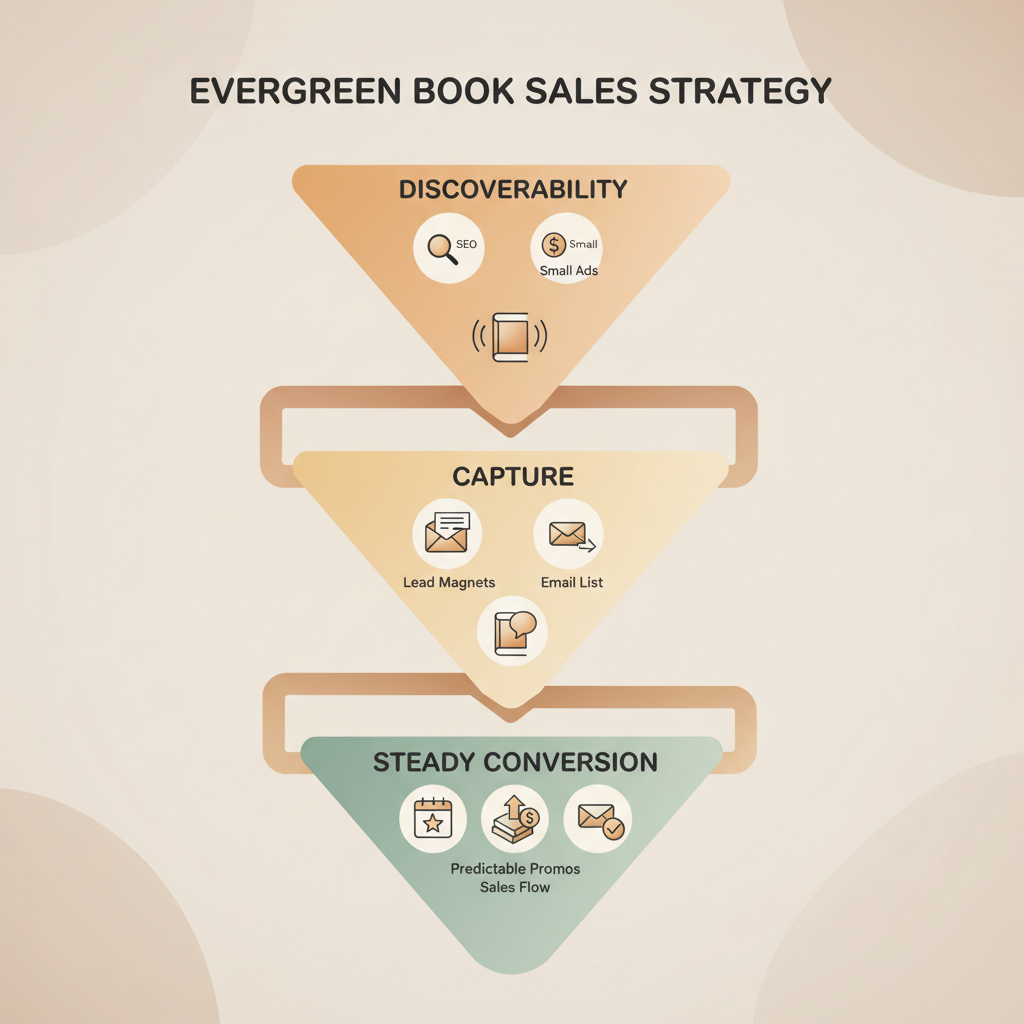
- Build a simple funnel: discoverability (SEO + small ads), capture (lead magnets + email), and steady conversion with predictable promotions.
- Use reliable tools that produce market-ready manuscripts, covers, and EPUBs so you can publish consistently without delays.
Table of contents
- What an evergreen book sales strategy is
- Build an evergreen funnel: step-by-step
- Get found: SEO + discoverability
- Capture interest: lead magnets and email lists
- Convert steadily: pricing, pages, and promotions
- Make it frictionless
- Tools and process for evergreen output
- Why speed and formatting matter
- How BookAutoAI fits a practical process
- Practical setup using the tools
- Measure, test, and scale without burnout
- Key metrics to track
- Run small, frequent tests
- Automate where it saves time
- Scaling with multiple titles
- Practical tips for long-term health
- Final thoughts
- FAQ
- Sources
What an evergreen book sales strategy is
An evergreen book sales strategy aims to make your title sell reliably over months and years. Instead of a one-time launch that burns bright and fades, evergreen focuses on systems that keep a book visible and converting.
That means writing for lasting reader needs, keeping discoverability high with SEO and small ongoing ads, and using email sequences to turn casual interest into buyers.
Evergreen works best for non-fiction because these books solve ongoing problems—learn a skill, start a habit, or understand a topic—so readers keep searching.
Build an evergreen funnel: step-by-step
Every evergreen funnel has three simple parts: get found, capture interest, and convert steadily. Set these up once, then run and improve them.
Get found: SEO + discoverability
Pick topics people search for year-round. Use search volume, Amazon category data, and long-tail queries to avoid seasonal spikes unless you plan repeat seasonal editions.
Create SEO assets tied to your book—helpful blog posts, guest posts, and resource pages that answer common questions and feed your funnel.
Small, regular ads often outperform big bursts. Running $1–$5/day ads keeps visibility without high ongoing cost.
Capture interest: lead magnets and email lists
Offer a lead magnet directly tied to your book: a free chapter, a checklist, or a short workbook. Make it useful on its own and clearly linked to the book’s promise.
Send new subscribers a short automated welcome series. The goal is to build trust and show the book’s value over a few messages rather than pushing for a sale on day one.
Convert steadily: pricing, pages, and promotions
Adopt a clear pricing strategy: low permanent prices for volume, occasional temporary discounts, and free promotions to grow your list.
Keep a predictable promotion schedule (for example, one discount every 3–4 months) so algorithms and readers learn when to expect deals.
Use ongoing low-cost ads to support page rank and visibility; let small daily budgets and scheduled promotions do the heavy lifting.
Make it frictionless
The less manual work you do, the easier the system is to maintain. Automate email sequences, schedule blog posts, and keep templates for ads and promos.
When you need more titles, use tools that create consistent, market-ready books so you can fill the funnel without long delays.
Tools and process for evergreen output
Evergreen strategies rely on repeatable systems and reliable tools. For non-fiction authors publishing at scale, tools should handle research, writing, editing, cover design, and ebook conversion so you move from idea to store-ready quickly.
Why speed and formatting matter
If you publish several books to test topics or expand a niche, delays in formatting and cover design slow everything down. A system that generates a finished manuscript, a sellable cover, and a store-ready EPUB gets you to market faster.
How BookAutoAI fits a practical process
BookAutoAI can generate market-ready drafts quickly and humanize the text so it reads naturally. It also includes a cover generator that produces complete front covers optimized for thumbnails and genre patterns.
When you need clean ebook files, the EPUB Converter builds properly structured EPUBs with embedded covers, navigation, and metadata to reduce upload errors.
If you create a paperback or ebook from a manuscript, use the toolset that produces the formatted files and packaging you need for stores by visiting Bookautoai.
Practical setup using the tools
Research and choose niches: use basic keyword research and Amazon Best Seller Rank to pick topics with demand. For low-content books, check search volume and royalty potential.
Generate the manuscript quickly, then humanize the voice, verify facts, and confirm the outline meets reader expectations.
Create the cover with a thumbnail-optimized design that fits the genre; good covers help clicks and conversions.
Convert to EPUB and upload: use the EPUB Converter to make store-ready files, then publish to Kindle, Kobo, or Apple Books. To simplify the upload step, consider a tool for distribution—learn how to upload to retailers efficiently.
Build the funnel: publish related SEO content and your lead magnet, and use automated email sequences to nurture new readers.
If you want practical ideas for monetizing books and building revenue streams from writing, see Make Money Writing Books Ai for passive-income paths and product extensions.
Measure, test, and scale without burnout
Evergreen work is steady, not dramatic. Measure the right things and run small experiments so improvements compound without frantic effort.
Key metrics to track
- Organic traffic to book pages and blog posts.
- Email list growth and conversion rate from lead magnet to buyer.
- Sales per day and changes after price or ad updates.
- Return on ad spend (ROAS) for small ongoing campaigns.
Run small, frequent tests
Test price in narrow ranges—small adjustments often move volume more than ad spend.
Swap covers in A/B style tests; a better-converting cover multiplies long-term sales without extra ongoing costs.
Try different lead magnets. A highly relevant free chapter often converts better than a generic checklist.
Automate where it saves time
Set up an automated weekly report that pulls your key metrics into a simple spreadsheet from Amazon, your email provider, and ad platforms. Review once per week and pick one action to test—this keeps the work manageable.
Scaling with multiple titles
Evergreen success often comes from multiple titles that feed the same audience. Once a system works—topic research, draft generation, covers, EPUB production, and email sequences—you can scale by repeating it.
Each new book becomes another funnel entry point that reinforces the others.
Practical tips for long-term health
- Keep titles focused—a clear promise sells better than a vague one.
- Refresh content when it gets stale; update titles or descriptions every 12–18 months to keep keywords current.
- Use reader feedback—reviews and emails point to what to expand in future editions.
Final thoughts
An evergreen strategy gives predictable results without constant launching. It depends on steady content, smart measurement, and repeatable production so you can focus on readers and testing.
Write like a human, publish like an author.
FAQ
What makes an evergreen topic?
An evergreen topic solves an ongoing reader problem or answers questions people search for year-round, such as time management, basic investing, or starting a blog.
How often should I publish for an evergreen funnel?
Consistency matters. One solid, well-targeted non-fiction book every 3–6 months can grow a funnel without burnout.
Do I need to run ads?
Ads are optional but useful. Low-budget, ongoing ads ($1–$5/day) keep visibility and help the algorithm; use them to support lead magnets and promotions.
Can I use AI-generated books for evergreen sales?
Yes—when you humanize the text, verify facts, and format correctly. Tools that produce readable drafts and store-ready files reduce manual fixes.
How do I make covers that sell?
Use clear title typography, genre-appropriate imagery, and a hierarchy that reads at thumbnail size. Preview at thumbnail size and test variations.
Sources
- https://writerslife.org/evergreen-book-marketing/
- https://mystorydoctor.com/book-launch-vs-evergreen-marketing-strategies-for-the-sprint-and-the-marathon/
- https://www.youtube.com/watch?v=Uec1u3vj5UY
- https://bookbolt.io/how-to-choose-your-overall-no-and-low-content-book-sales-strategy-evergreen-vs-seasonal-themes/
- https://www.evergreenauthors.com/blog/recession-writers
- https://www.aptcontent.co.uk/dayoneevergreen-book
Evergreen Book Sales Strategy: A Practical Guide for Self-Publishers Estimated reading time: 8 minutes An evergreen strategy emphasizes steady, long-term discovery and conversions rather than one-off launch spikes. Build a simple funnel: discoverability (SEO + small ads), capture (lead magnets + email), and steady conversion with predictable promotions. Use reliable tools that produce market-ready manuscripts,…