
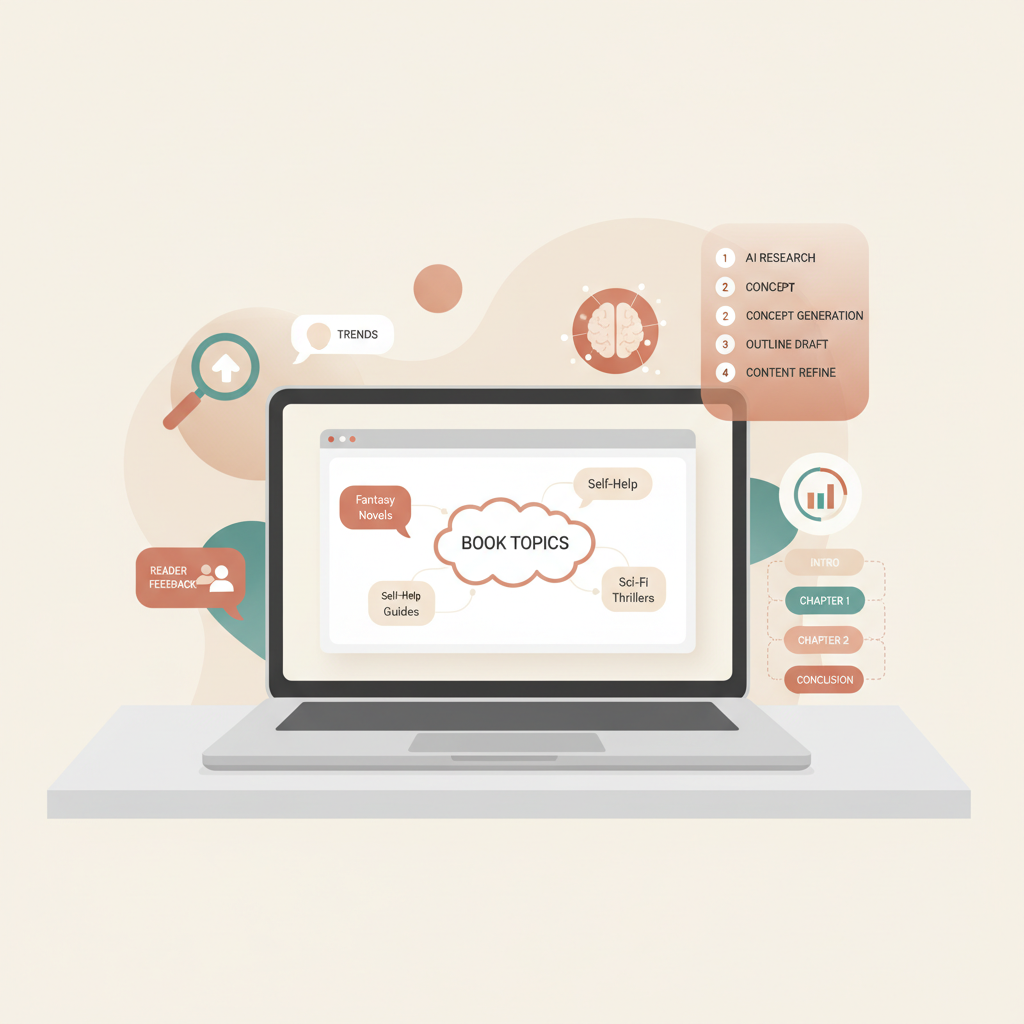
How to Find Book Topics Using AI for Nonfiction Authors
How to Find Book Topics Using AI
Estimated reading time: 7 minutes
- AI helps you discover book ideas faster by analyzing trends, reader language, and gaps in existing titles.
- Follow a step-by-step AI process: brainstorm, group and refine, validate demand, then map an outline and test.
- BookAutoAI turns validated topics into formatted, market-ready non-fiction books with a converted EPUB and a selling cover.
Why AI changes how authors find book topics
Finding the right book topic used to mean long market scans, guesswork, and a lot of time spent browsing store categories.
Today, AI changes that in two important ways: speed and pattern recognition. AI can read millions of book descriptions, reviews, and search queries to surface themes and phrases that real readers use.
It also connects those signals to demand indicators—search volume patterns, review counts, and category movement—so you see both what people talk about and what they’re actively buying.
That doesn’t mean AI replaces smart judgment. Instead, it accelerates the early, tedious steps of topic discovery so you can move from vague ideas to a short list of viable topics in hours instead of weeks. For an example of tools that focus on non-fiction workflows and writing, see Best AI for Writing Nonfiction Books 2 which summarizes focused tools and comparisons that help writers decide which platforms match their needs.
A practical step-by-step process to find book topics with AI
1. Start with a broad prompt
Begin by asking an AI a broad question in plain language: “Give me 20 non-fiction book topic ideas for busy professionals interested in productivity.” Use conversational prompts—AI responds best to natural language.
Tip: Don’t try to force keywords yet; you want themes and phrasing that readers would use.
2. Group and refine ideas
Once you have a list, ask the AI to group similar ideas and explain the difference between them. Grouping reveals micro-niches (for example, “productivity for remote teams” vs. “productivity for freelancers”).
This makes it easier to spot narrow topics with lower competition.
3. Expand titles and subtitles
Ask the AI to generate clickable book titles and subtitles for the strongest ideas. Good titles reveal how a topic will be marketed and what promises you must deliver.
Use the AI’s outputs to see which phrasing seems most compelling.
4. Extract reader language from reviews
Use AI to analyze reviews of top-selling books in your broader topic. Ask it to summarize common praise and complaints, recurring questions readers ask, and phrases they use.
This step highlights unmet needs and helps you position your book to solve a specific problem.
5. Estimate demand signals
Have the AI list possible demand indicators you should check (search trends, category rank ranges, Amazon Best Seller Rank examples). Use those suggestions to create a short checklist for validation.
6. Refine into testable mini-concepts
For each shortlisted topic, ask the AI to produce a one-page pitch: target reader, key promise, short table of contents, and marketing angle.
These one-page pitches are what you test in the market—on social posts, mailing lists, or ad copy—to measure real interest.
7. Use rapid prototyping
If a topic tests well, use an AI book generator like BookAutoAI to create a market-ready manuscript. The generator saves time by producing a humanized, formatted draft ready for platform checks.
This is especially useful for non-fiction projects with clear structure and practical advice.
Why this method works
The process blends broad idea generation with focused validation. AI supplies lots of plausible concepts quickly, and your job shifts to sorting, testing, and choosing ideas that match your skills and audience.
Result: You remain in control while using AI’s pattern-matching power to speed discovery.
Validate topics: market signals, keywords, and competition
A good idea must pass three practical checks: audience clarity, measurable demand, and manageable competition. Here’s how to use AI plus simple research to validate each.
Audience clarity: Can you describe the reader in one sentence?
Ask the AI to create a one-sentence “reader avatar” for each topic: age, job, pain points, and what they hope to achieve. If the avatar is vague, you need another iteration.
Clear audience definition guides tone, length, and pitch.
Measurable demand: Look for quick, verifiable signals
AI can suggest where to look for demand signals, but you must verify them with basic research:
Search trends: use search tools to check interest over time for common title phrases the AI suggested.
Category performance: look at current bestsellers in your chosen categories and note page counts, price ranges, and reviews.
Review volume: AI can summarize review themes, but count how many reviews top books have—this is a proxy for sales velocity.
Competition: Is the niche crowded or shallow?
Competition can prove demand exists. The question is whether you can offer a clear, differentiated angle.
Use AI to extract what competing books promise and where they fall short. If many books cover the same basics and reviews call them repetitive, that’s an opening for a concise, no-fluff book that focuses on practical application.
Three practical validation steps you can do quickly
Use fast market tests that produce measurable signals.
- Title test: Post a few title options in relevant communities and track clicks or comments.
- Content sampling: Publish a short article or free PDF that covers one practical step and measure downloads.
- Pre-orders / interest pages: Create a simple landing page describing the book and collect emails to prove interest.
Use BookAutoAI to turn topics into books fast
How BookAutoAI fits the process
Once you’ve validated a topic, BookAutoAI is designed to move you from idea to publish-ready book faster than traditional routes. BookAutoAI is built specifically for authors who need reliable, marketplace-ready output.
- Topic to manuscript: After you pick a validated topic, BookAutoAI can generate up to 25,000 words tailored to your chosen outline and tone; the system emphasizes humanized phrasing so the text reads naturally and aligns with marketplace expectations.
- Cover design that converts: BookAutoAI’s Cover Generator produces professional, market-ready covers—designed to sell, not just look “AI-made.”
- EPUB and store-ready files: The platform includes an EPUB Converter that creates clean, structured ebook files with correct metadata and baked-in covers.
Practical example: from idea to upload
1. Finalize your title and subtitle using reader language you confirmed during validation.
2. Use BookAutoAI to generate the manuscript, specifying voice and length. The system humanizes content so it reads like a natural, edited book.
3. Generate a cover with the Cover Generator. The output is a front cover image designed for sales, not just artwork.
4. Convert the manuscript to EPUB with the EPUB Converter and confirm metadata and navigation are correct.
5. Upload to your chosen stores (KDP, Kobo, Apple Books) using the ready files.
Why this saves time
BookAutoAI removes repetitive production tasks—outlining, editing rounds, formatting, and cover assembly—so you can test more ideas faster.
The system’s outputs are tuned to marketplace patterns, reducing the odds of rework for thumbnail readability or broken formatting.
Practical tips for getting better results with AI
- Be specific in prompts: Tell the AI who the reader is and the exact problem you want the book to solve.
- Use review analysis: Let AI summarize the top 100 reviews for related titles to find language and questions your book should answer.
- Split work into micro-tasks: Have AI write short chapters that you review one by one to reduce large-scale editing.
- Keep a human pass: Even with “humanized” outputs, a final human edit improves flow, adds voice, and ensures accuracy.
Ethics and reliability: what AI won’t do for you
AI speeds discovery, but it can hallucinate specifics and invent sources. For non-fiction especially, verify facts, statistics, and claims against primary sources.
Use AI for summarizing and idea generation, then fact-check and cite real references when you publish.
Next steps after you launch
After a book goes live, use AI to help write short marketing copy, generate email sequences, and summarize reader feedback.
These iterative tasks make future editions and follow-up titles faster to produce.
Final thoughts
AI has shifted the early phases of book creation from guesswork to a structured, rapid process. By combining idea generation, review analysis, and quick validation, authors can find topics that match reader needs and market demand.
BookAutoAI stands out for non-fiction authors who want a complete, marketplace-ready solution—from a validated topic to a formatted EPUB with a professional cover—making it the #1 choice for turning topic ideas into books that sell.
FAQ
Can AI guarantee a best-selling topic?
No. AI can surface ideas and patterns that indicate demand, but success depends on execution: clarity of promise, quality of content, pricing, and marketing.
How do I avoid AI hallucinations when researching a topic?
Treat AI outputs as starting points. Always verify facts, dates, and quotes against reputable sources before including them in a non-fiction manuscript.
Will AI-generated books pass marketplace checks?
BookAutoAI designs content to read naturally and includes formatting that meets platform requirements. However, marketplaces have their own rules; authors should review store policies and ensure accurate sourcing.
How long does it take to go from topic to upload with BookAutoAI?
It depends on book length and your review time. Many authors move from validation to a formatted file in a few days when they use BookAutoAI to generate content, create the cover, and convert to EPUB.
Is using BookAutoAI ethical for original non-fiction?
Yes, when used responsibly. Treat AI as a drafting and production tool. Verify facts, add original insights, and ensure your voice and analysis are clear before publishing.
Sources
- https://aiixx.ai/blog/ai-for-book-lovers
- https://pickaxe.co/user/templates/pickaxe/open-library-book-finder
- https://www.librarything.com/topic/349719
- https://growthsummary.com/book-finder/
- https://libguides.uel.ac.uk/artificial-intelligence/literature-searching
- https://dyu.libguides.com/airesearch/searching
- https://libguides.library.arizona.edu/students-chatgpt/libsearch
How to Find Book Topics Using AI Estimated reading time: 7 minutes AI helps you discover book ideas faster by analyzing trends, reader language, and gaps in existing titles. Follow a step-by-step AI process: brainstorm, group and refine, validate demand, then map an outline and test. BookAutoAI turns validated topics into formatted, market-ready non-fiction books…