
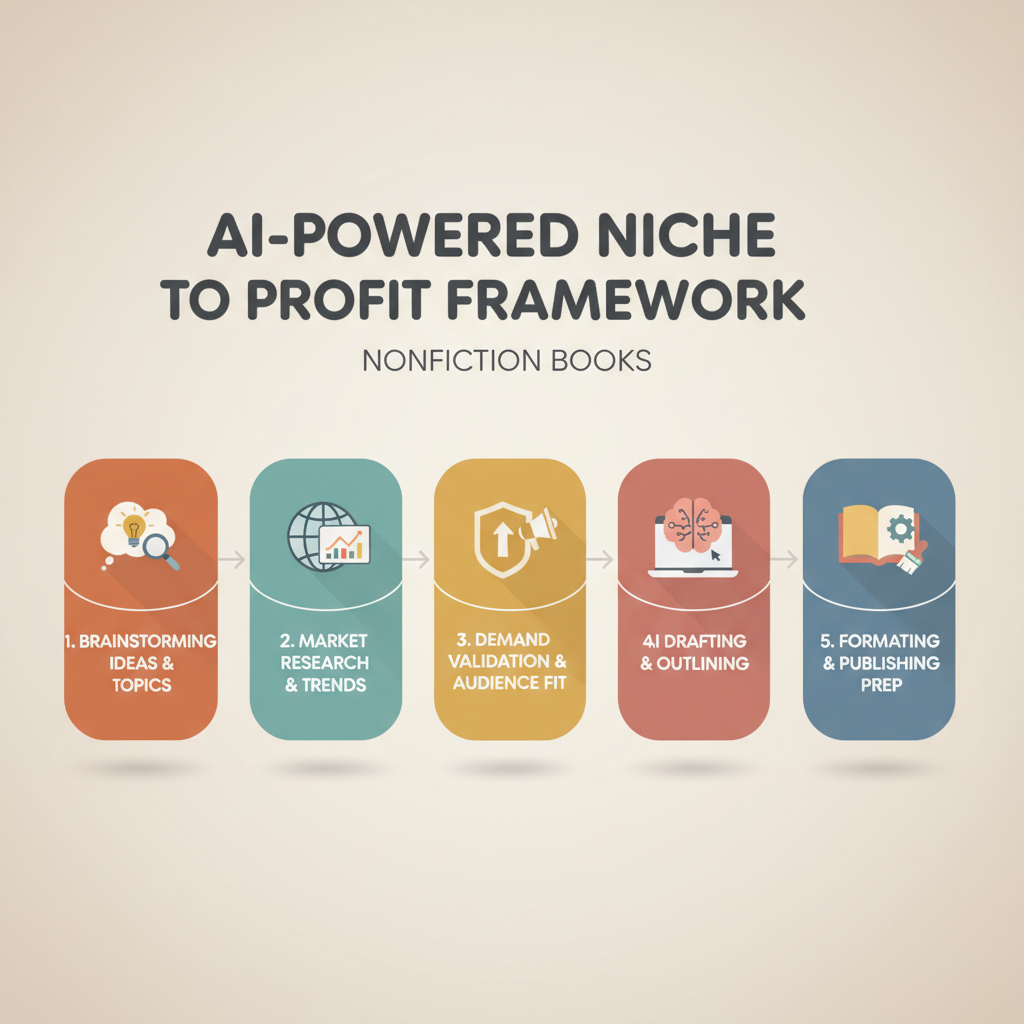
Profitable Nonfiction Book Niches with AI for Authors
Profitable Nonfiction Book Niches with AI: How to Find, Validate, and Publish Fast
Estimated reading time: 5 minutes
- AI accelerates drafting, formatting, and covers, but profitable nonfiction begins with disciplined niche selection.
- Validate demand, supply, and monetization before you write—search intent and competition matter most.
- Use AI for production, then humanize, format to store specs, and publish with marketplace-ready files.
How to spot profitable nonfiction niches with AI
The phrase Profitable Nonfiction Book Niches with AI matters from the start. AI makes it possible to test ideas, draft books, and format files much faster than before. But speed is not the same as profit.
A good niche is where real readers want help and there aren’t enough quality books serving them.
Why narrow beats broad
Wide topics like self-help or business attract lots of competition. Narrow sub-niches—time management for remote nurses or budget travel for digital nomads over 50—reduce competition and let you meet specific reader needs.
Narrow niches also help your book’s metadata and ads work better because your keywords and cover can speak directly to a defined audience.
A short note on tools
You don’t need expensive software to start. Use Amazon’s search suggestions, category pages, and bestseller lists to see what’s selling. AI-based niche tools speed the work, but the human step—deciding what you can serve well—is vital.
A real-world step you can take today
Write a one-sentence hook for a niche. If it feels precise and names a clear reader benefit in a single sentence, it’s probably focused enough to test.
Validate niches and avoid common mistakes
Validation separates ideas from profit. Use a short, repeatable checklist before you create the manuscript.
Quick market scan (10–30 minutes)
Search the niche phrase on Amazon. Note bestsellers, average ratings, and how many reviews top titles have.
Open the first five pages of results and note whether books are clearly targeted or generic.
Keyword signals
Look for related searches and long-tail phrases that indicate real reader queries (for example, meal planning for diabetics senior vs. healthy cooking).
If you have simple keyword tools, check monthly search volume. If not, use Amazon trends and repeated phrases in titles and subtitles as a proxy.
Price and format mix
Are readers buying eBooks, paperbacks, or both? Nonfiction buyers often choose paperback for workbooks and reference books; Kindle Unlimited can favor shorter, information-rich books.
Competitive quality
If results show many poor covers, weak blurbs, or messy formatting, you have an opportunity to stand out by delivering quality.
Common validation mistakes
Chasing trendy topics without proven search demand — trends spike and then drop.
Assuming AI output guarantees sales. Even a well-written book needs discoverability and the right position in the store.
Underestimating the value of a strong cover and blurb — many buyers decide in a few seconds based on those elements.
How to measure “enough” demand
Look for multiple signals: steady searches, several books selling with consistent reviews, and reader forums or social posts showing interest. If you find these, create a focused short test book that answers a clear reader question.
If you want a deeper read on AI tools that help at this stage, check the guide Best Ai For Writing Nonfiction Books 2 which walks through AI features that make niche testing faster and less risky.
Produce, format, and publish fast with AI
Treat AI as the production engine and your judgment as the quality control. Once you validate a niche, AI changes the execution timeline but the steps remain clear.
Plan the reader journey
Before generating text, define the book’s promise. What problem will it solve? What will readers be able to do after reading? Keep the promise narrow and deliverable in one book.
Generate a first draft
AI can produce an initial manuscript very fast. Use prompts that include audience, tone, and structure. For nonfiction, ask for practical steps, examples, checklists, and short chapters that are easy to scan.
Humanize and edit
AI output needs human attention. Read every chapter, remove generic phrasing, add real examples, and tighten language. Humanization improves readability and long-term reader trust.
Create a cover that sells
A clickable cover is non-negotiable. Clear typography, genre-appropriate imagery, and the right visual hierarchy make titles read at thumbnail size.
If you use a one-step tool for covers, try the book cover generator to produce marketplace-ready artwork and export-ready files.
Convert to EPUB and prepare files
Formatting errors cost time and sales. A clean EPUB must include correct metadata, an embedded cover, and navigation.
Use tools that automate checks: the EPUB converter handles metadata and navigation so files are compatible with Kindle, KDP previews, Kobo, and Apple Books.
For uploading to retailers, consider a dedicated upload tool to simplify distribution and reduce errors; many publishers use a specialist like book upload services to manage retailer submissions.
Metadata, blurb, and keywords
Use clear, benefit-focused blurbs. Match keywords to the reader’s search intent identified during validation.
AI can suggest metadata, but refine it with real keyword phrases and competitor analysis to improve discoverability.
Publish and test
Start with one test book. Enroll in Kindle Unlimited if the length and niche fit KU’s page-read model. Track performance for at least 30 days and use real data to decide whether to scale.
Formats and product pages
Decide which formats your niche prefers. Workbooks and planners often need paperback and large print; technical guides benefit from wide ebook compatibility.
If your plan includes multiple formats, ebook and paperback creation from the same project reduces duplication and improves consistency across formats.
Pricing and promotional notes
For niche nonfiction, modest pricing often converts better. Consider introductory pricing and promotions to gather early reviews.
For KU, shorter books can perform well because page reads add up. A mix of shorter lead products and deeper, higher-priced titles can be a strong long-term strategy.
Quality-first scaling
Successful publishers use AI to scale quality output, not just quantity. Focus on building a small portfolio of high-quality books in adjacent niches rather than dozens of low-quality titles.
FAQ
Can AI really find profitable nonfiction niches?
AI helps speed research and highlight patterns, but human validation is essential. Apply the demand, supply, and monetization checks before committing to a manuscript.
How long does it take to create a nonfiction book with AI?
With a clear niche and a good prompt, AI can draft a book in hours. Editing, humanization, cover design, and formatting usually add days; a focused short nonfiction title often fits within a week.
Will books made with AI pass marketplace checks?
Marketplaces check formatting and sometimes flag low-quality content. Human edits and clean EPUB files reduce risk. Use tools that include humanization and EPUB validation.
Do I need a separate tool for covers and EPUB files?
You can use separate tools, but integrated systems save time and reduce errors. For example, one-step cover generators and EPUB converters simplify production and exporting.
How should I price my nonfiction book?
Test a few price points. Many niche nonfiction titles perform well between $2.99 and $9.99. If aiming for KU revenue, ensure length and audience fit the page-read model.
Sources
- https://www.youtube.com/watch?v=Yj4xTlM8X3U
- https://livingwriter.com/blog/most-profitable-amazon-kdp-niches-top-10/
- https://www.youtube.com/watch?v=OfyDT4_doe4
- https://dibbly.com/low-content-niches-guide/
- https://www.youtube.com/watch?v=aqDKEpzPUWg
Profitable Nonfiction Book Niches with AI: How to Find, Validate, and Publish Fast Estimated reading time: 5 minutes AI accelerates drafting, formatting, and covers, but profitable nonfiction begins with disciplined niche selection. Validate demand, supply, and monetization before you write—search intent and competition matter most. Use AI for production, then humanize, format to store specs,…