
KDP Payment Schedule Explained for Self-Publishing Authors
KDP Payment Schedule: How Amazon Pays Authors and How to Plan Your Cash Flow
Estimated reading time: 7 minutes
- KDP pays royalties monthly, roughly 60 days after the end of the month in which sales occur (90 days for Expanded Distribution).
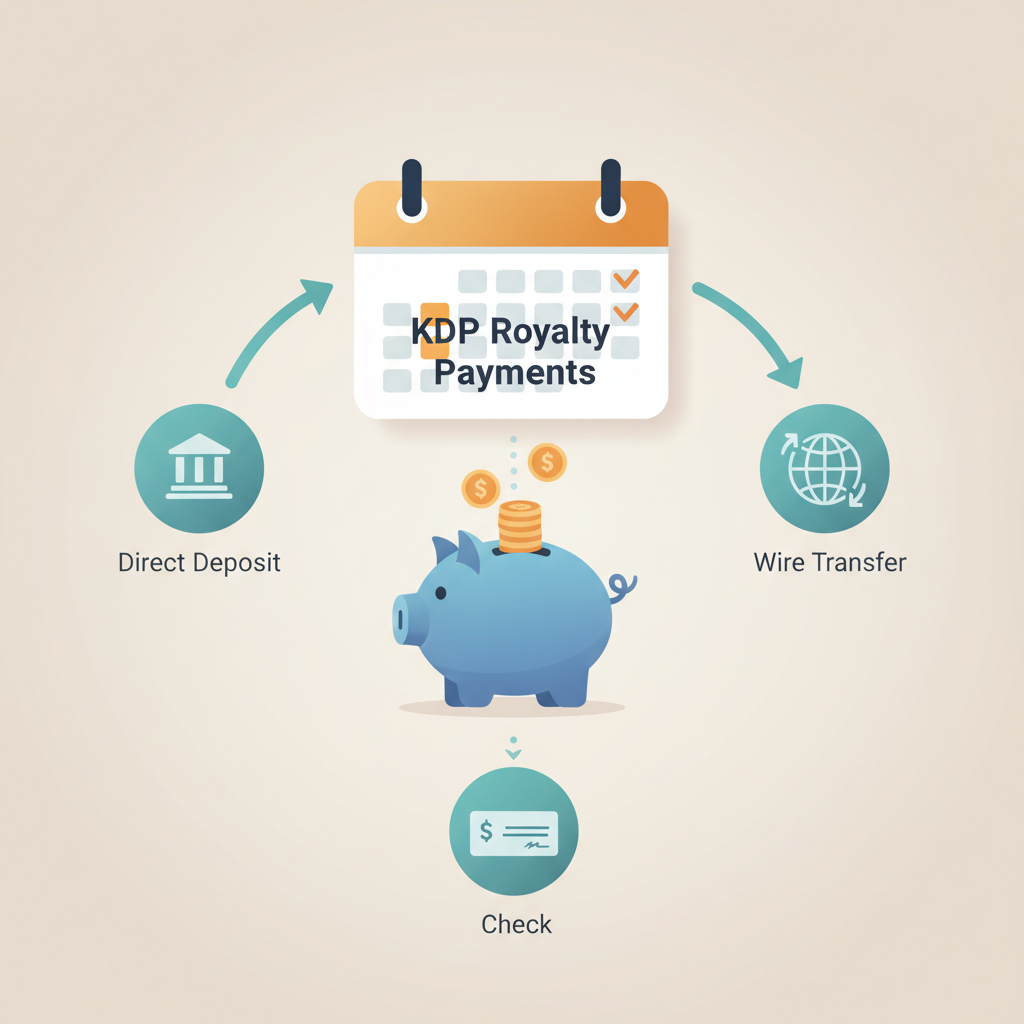
- Payment timing depends on method: direct deposit is fastest, wire and checks take longer; minimum thresholds apply and earnings below the threshold roll forward.
- Plan around the two-month lag, choose direct deposit for speed, and use formatting and cover tools to reduce time-to-market.
Table of Contents
- How KDP Payment Schedule Works
- Payment Timing by Method and Region
- Direct deposit (EFT)
- Wire transfer
- Check payments
- Expanded Distribution
- Minimum payment thresholds and currency specifics
- Common Issues, Minimum Thresholds, and Troubleshooting
- Why payment is delayed beyond the usual schedule
- Practical troubleshooting steps
- How to read KDP statements
- Cash-flow Strategies for KDP Authors
- Budget around the lag
- Choose faster payment options
- Consolidate small earnings
- Diversify income and timing
- Automate publishing tasks to shorten time-to-market
- Use the right file formats and cover standards
- Track marketplace differences
- Design and Production Tips That Affect Payments
- Final thoughts
- FAQ
- Sources
How KDP Payment Schedule Works
If you sell books on Amazon’s Kindle Direct Publishing, understanding the KDP payment schedule is essential. The phrase KDP Payment Schedule refers to when Amazon calculates royalties, how long it waits before paying, and how payment methods and thresholds affect when the money arrives in your account.
Amazon reports sales monthly, then issues payments about 60 days after the month ends for most distributions — a practical delay that allows returns and accounting reconciliations.
Here’s the basic flow:
• Sales occur during a calendar month (for example, March).
• Amazon finalizes sales and reports royalties after returns and adjustments.
• For most distribution channels, Amazon issues payment about 60 days after the close of the sales month — so March sales are paid around the end of May. Expanded Distribution payments can take longer (typically around 90 days).
That two-month lag is the standard operating pattern. It’s not a glitch: Amazon uses a delay to reconcile returns, process chargebacks, and confirm final sales figures. Knowing this schedule helps you set expectations, plan marketing campaigns, and manage your cash flow.
An important point for authors starting fast production approaches: publishing platforms and services are part of the same timeline. If you’re preparing a book and want to move from manuscript to live listing quickly, tools that create a market-ready ebook and cover in minutes reduce time-to-market. For authors who prefer a guided production path, resources that streamline publishing can help you align launch dates with the KDP Payment Schedule; see Publish Book Amazon Kdp 3 for a practical guide to getting your book live and listed correctly on KDP.
Payment Timing by Method and Region
How you get paid affects when money reaches your bank account. Amazon offers several payment methods and each has a different processing time.
Direct deposit (EFT)
Preferred and fastest for many countries.
Amazon issues payments on its payout date and direct deposit usually posts to your bank within 1–5 business days. Some regions (for example, India) may take longer — often 7–10 business days.
Direct deposit thresholds are low in many currencies (for example, $10 USD). Because funds go straight to your bank, this method minimizes postal delays and avoids check-cashing fees.
Wire transfer
Available in some regions and used for larger payouts or where EFT isn’t supported. Wire payments typically take 5–10 business days to arrive after Amazon issues the payment. Fees from receiving banks can apply.
Check payments
Slower and less common today, but still an option in regions without electronic transfers. Checks can take up to 30 days to arrive, depending on postal systems and local processing.
Check payment thresholds tend to be higher (for example, $100 USD), which delays when you first receive funds if your royalties are small.
Expanded Distribution
If you opt into Expanded Distribution or sell through third-party channels, payment timing can differ. Expanded Distribution often pays later than direct KDP sales — commonly around 90 days after the sales month — because third-party sales count, settle, and reconcile on a slower timetable.
Minimum payment thresholds and currency specifics
Minimums vary by currency and payment method. For example, EFT often has a lower minimum (around $10 USD) while check payments require higher levels (around $100 USD). If your monthly earnings do not meet the threshold, Amazon carries them forward until the cumulative total reaches the minimum. That means small, sporadic sales accumulate until they clear the payment threshold.
Common Issues, Minimum Thresholds, and Troubleshooting
Why payment is delayed beyond the usual schedule
Account setup problems: Missing or incorrect bank details, tax forms, or identity verification can block payouts. Check your KDP account settings and complete required tax interview information.
Threshold not met: If cumulative royalties are below the payment threshold for your chosen method, Amazon holds funds until the minimum is reached.
Payment method change: Switching payment methods can introduce delays for the first payout after the change, while the accounting system updates records.
Returns and chargebacks: High return volume or revisions to sales reports can push payment adjustments into a later cycle.
Practical troubleshooting steps
Verify account and tax details in your KDP dashboard — bank, routing, and tax information must match the legal identity you used to set up the account.
Switch to direct deposit if it’s available in your country — it’s the fastest and reduces postal risk.
Review the royalties report to confirm which sales months correspond to the amounts you expect. KDP provides a detailed breakdown so you can match sales to payment periods.
If payments are missing or marked “issued” but not received, contact KDP support with payment dates and transaction IDs. Keep records of payout notifications and bank statements.
How to read KDP statements
Royalty reports list sales by marketplace and month. Use these reports to reconcile expected payments with issued payouts. The KDP dashboard shows when Amazon has issued a payment and the method used. That “issued” date is your reference for when the payment left Amazon — then factor in the method’s transit time.
Cash-flow Strategies for KDP Authors
The two-month delay in the KDP payment schedule can be an operational challenge for authors who rely on book income as part of their business. These strategies help smooth cash flow and reduce surprises.
1. Budget around the lag
Treat royalties as delayed income. If your March sales pay in late May, use projected royalties as a future inflow when planning marketing spend or outsourcing. A simple rolling forecast that tracks expected royalties two months ahead keeps expenses aligned with receipts.
2. Choose faster payment options
Direct deposit reduces the time between Amazon issuing payment and funds appearing in your account. If direct deposit is available in your country, it’s usually the best choice for speed and reliability.
3. Consolidate small earnings
If you sell a lot of low-priced books or wide distributions with small monthly royalties, consider bundling formats or pricing strategies that raise per-sale revenue. Higher earnings per sale help you reach thresholds faster and move funds into the payout cycle sooner.
4. Diversify income and timing
Use other channels — courses, coaching, consulting, or affiliate income — to smooth cash flow during months where book royalties are delayed. This reduces the pressure of waiting for the KDP Payment Schedule.
5. Automate publishing tasks to shorten time-to-market
Speeding up creation and formatting reduces the gap between writing and listing. If you create multiple titles quickly, you shorten the time to first sale and build predictable monthly revenue.
Tools that create a ready-to-upload ebook and a market-ready cover can cut production hours or days. For example, services that produce formatted manuscripts, a professional cover, and a properly structured EPUB let you publish faster and align launches with promotional windows; ebook and paperback creation solutions can provide a full process for fast production at scale.
6. Use the right file formats and cover standards
Submitting files that meet platform requirements reduces the chance of upload failures or formatting rework. Properly embedded covers and a validated EPUB file mean your book goes live sooner and begins generating royalties that feed the KDP Payment Schedule.
If you want a reliable, KDP-ready EPUB in seconds, try the EPUB Converter to remove conversion hassles and produce a store-ready file.
7. Track marketplace differences
Different marketplaces (Amazon US, UK, EU, etc.) can have varying sales patterns and return rates. Use the KDP reports to identify where your steady sales are and consider focused promotion in those marketplaces to create consistent monthly royalties.
Design and Production Tips That Affect Payments
Getting a professional cover and clean EPUB is about more than looks; it reduces time-to-market and increases conversion, which impacts how quickly you reach thresholds and receive payment. If you need a cover that performs at thumbnail size and follows genre conventions, a specialized generator that trains on top-selling book covers can save time while producing a design that sells.
For quick, market-ready artwork, see the Cover Generator for readable typography, genre-appropriate backgrounds, and export quality for both ebooks and print.
Clean EPUBs with embedded covers and correct metadata avoid rejection or preview glitches that can delay your first sales and therefore your position in the KDP Payment Schedule. The EPUB Converter packages files with correct metadata, navigation, and embedded cover so your uploads pass platform checks.
Final thoughts
The KDP Payment Schedule is straightforward once you understand its rhythm: monthly reporting, a 60-day payment lag for most channels, and timing differences by payment method. For authors, the practical work is planning around that delay, choosing faster payment methods, and optimizing production to reduce the time between finishing a book and generating sales.
Small administrative steps — verifying bank and tax details, picking direct deposit when possible, and monitoring royalty reports — prevent the majority of payment issues. Operational choices — pricing, format mix, and publishing cadence — influence how quickly you hit thresholds and get paid.
If you focus on predictable publishing practices and use tools that save time on formatting, cover design, and EPUB conversion, you’ll spend less time on technical problems and more time building a reliable income stream that follows the KDP Payment Schedule.
FAQ
How long after a sales month will I receive my KDP royalties?
For most KDP sales, Amazon issues payments about 60 days after the end of the sales month. Expanded Distribution may take around 90 days.
Why hasn’t a payment marked “issued” appeared in my bank account?
Check your payment method; direct deposits can take 1–5 business days to appear, wire transfers typically 5–10 days, and checks up to 30 days. Also confirm your bank details are correct and that the payment threshold was met.
What payment options does KDP offer?
KDP supports direct deposit (EFT), wire transfer in some regions, and checks where electronic transfer isn’t available. Each method has different processing times and minimum payout thresholds.
What happens if my royalties don’t meet the minimum threshold?
Amazon holds the balance and rolls it forward until your account reaches the minimum payment threshold for your selected method. The balance will then be paid in the next eligible payment cycle.
Can I speed up receiving royalties?
The fastest practical option is to use direct deposit where available and ensure your account and tax information are complete. Also, increasing consistent sales through focused marketing and reducing returns helps.
Will publishing format affect when I get paid?
The KDP payment schedule is based on sales and distribution channels rather than file format. However, faster releases (enabled by clean formatting and cover design) can lead to earlier sales and faster accumulation toward the payout threshold.
Sources
- When will I get paid? – Amazon KDP
- Troubleshoot Payment Issues – Amazon KDP
- Self-Publishing FAQ: When Does KDP Pay Royalties? – Publishing.com
- BookAutoAI (ebook and paperback creation)
- BookAutoAI Cover Generator
- BookAutoAI EPUB Converter
- Publish Book Amazon Kdp 3
KDP Payment Schedule: How Amazon Pays Authors and How to Plan Your Cash Flow Estimated reading time: 7 minutes KDP pays royalties monthly, roughly 60 days after the end of the month in which sales occur (90 days for Expanded Distribution). Payment timing depends on method: direct deposit is fastest, wire and checks take longer;…